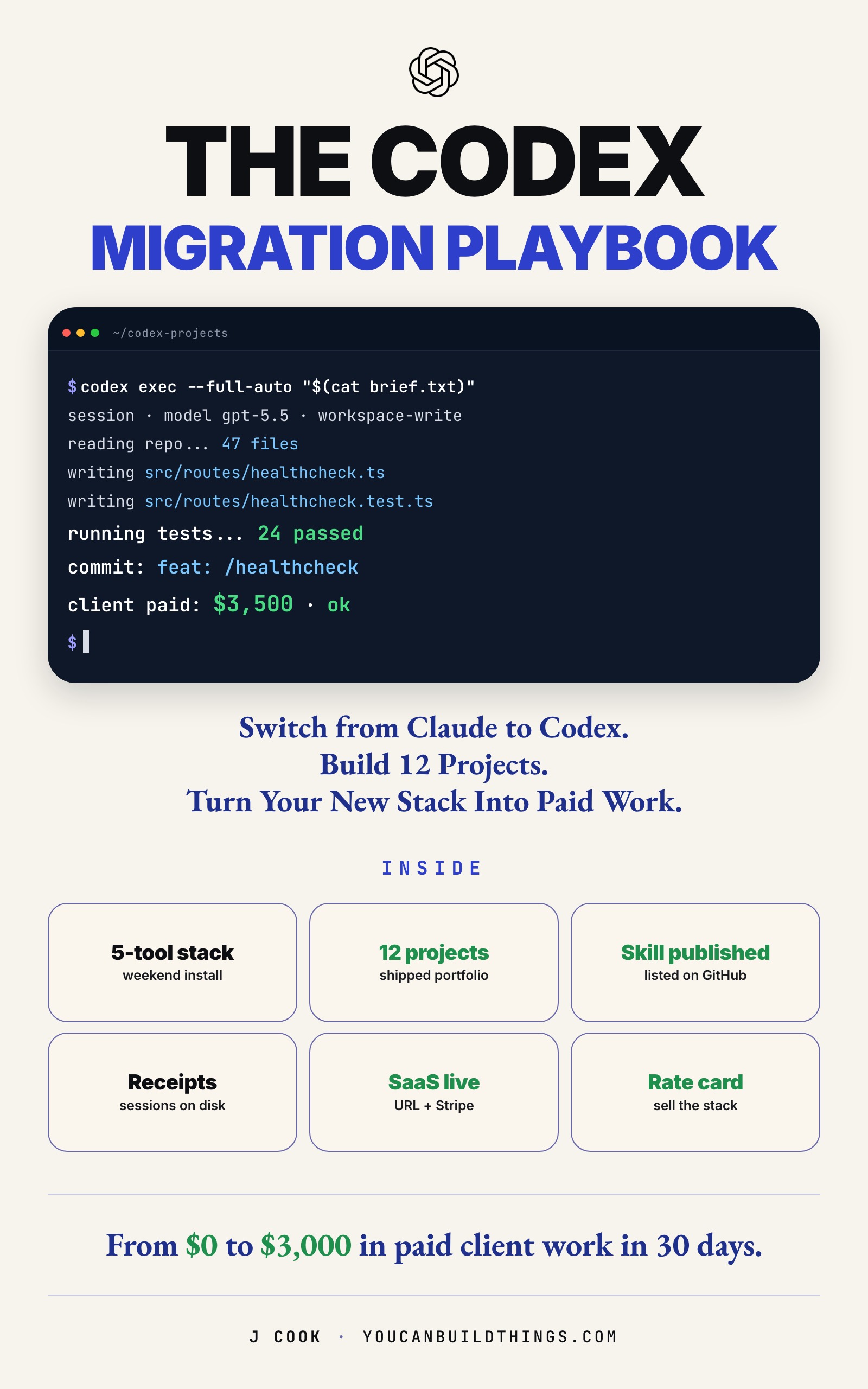
The Codex Migration Playbook
Switch from Claude to Codex. Build 12 Projects. Turn Your New Stack Into Paid Work.
You opened Claude Code this morning and felt it: the tool that used to feel like magic now feels crowded, expensive, and unpredictable. This is the 30-day Codex migration sprint. Day 1: 5-tool stack installed and a real session log on disk. Day 7: deployable SaaS at a live URL with a Stripe test charge. Day 14: a weekly quota tracker that keeps your workflow productive. Day 21: a published Codex Skill. Day 30: twelve shipped projects, a rate card, and a credibility kit you can use to start paid client conversations. Switch the stack. Build the projects. Turn the migration into paid work.
Most AI coding books stop at prompts, CLI setup, and generic productivity advice. This one is built around shipped artifacts: parsers, dashboards, Skills, routing layers, SaaS projects, recovery playbooks, and portfolio pieces that prove you can use Codex in the real world. The goal is not to “learn Codex.” The goal is to migrate with receipts: twelve real projects, a published Skill, a deployed app, a rate card, and the offer you use to start paid client conversations.
What You'll Build
Why r/codex is leaving the $100 Claude plan and what the receipts actually show.
The mental model shift: from chatbot to background agent that finishes tasks while you sleep.
Six prompts, $15.41. The token math behind Codex Plus, Pro, and the $200 plan, plus a parser that turns your session logs into a dollar ledger.
Install commands, real package names, working configs: the stack the 773-upvote thread promised.
Deployable SaaS at a live URL with a Stripe test charge by hour four.
Which model for which task and how reasoning-effort routing cuts weekly burn 30-50%.
Three permission profiles, three parallel sessions, five tickets closed in one sleep cycle.
Artifacts, gpt-image-2, Computer Use, multi-terminal, SSH into devboxes. Codex as the everything-app.
When the $200 plan beats API and how to stay productive at 80% of weekly cap with a quota tracker.
Publish a Codex Skill, land a consulting gig, win a hackathon: the four monetization paths with a rate card.
OpenAI advertised 400K. Codex Desktop reports 258K. Compaction breaks before 220K. A recovery playbook for the bugs you'll hit.
A multi-provider routing layer (Codex, Claude, OpenCode, Gemini, OpenClaw, local Qwen) that survives the next pricing shock.
Free Articles from this Book
GPT-5.5 vs GPT-5.4 in OpenAI Codex: A Per-Task Picker
GPT-5.5 vs GPT-5.4 in OpenAI Codex. A per-task config.toml that routes 8 task classes to the cheapest model that delivers, with dollar costs and 3.5x savings.
from: The Codex Migration Playbook
The OpenAI Codex 1M Context Window: 1M Is Really 258K
OpenAI Codex 1M context window. Layered: 1M API, 400K advertised, 258,400 reported, ~220K compaction breaks. The real ceiling and the issues that prove it.
from: The Codex Migration Playbook
Build an OpenAI Codex Cost Tracker in 60 Lines
An OpenAI Codex cost tracker that parses ~/.codex/sessions/ JSONL and turns every session into a per-task dollar ledger. 60 lines of Python on your machine.
from: The Codex Migration Playbook
The 5-Tool OpenAI Codex Stack: 773-Upvote Post Answered
The OpenAI Codex stack the 773-upvote r/codex post promised. 5 tools to install, 2 to cut, exact install commands, and the package-name gotchas devs hit.
from: The Codex Migration Playbook
Survive OpenAI Codex's Weekly Limit (the graphify Lever)
OpenAI Codex weekly limit fix. graphify cuts the same prompt from 18 reads/74K tokens/$0.45 to 4 reads/22K/$0.14. Same output. The actual lever, measured.
from: The Codex Migration Playbook