How to Price and Sell MCP Server Projects
Three pricing tiers for MCP freelance projects at $1K, $3K, and $5K per engagement. Scope templates, discovery call scripts, and where to find clients.
>This covers pricing and sales. Model Context Protocol: The Builder's Playbook includes the full technical build from first server to production deployment, plus pitch templates and packaged client deliverables.
Model Context Protocol: The Builder's Playbook
Build AI Agents That Connect to Everything
Summary:
- Three pricing tiers ($1K, $3K, $5K-$10K) mapped to specific deliverables and timelines.
- The five scoping questions that prevent undercharging.
- Where to find clients and the sales conversation that closes deals.
- Copy-paste scope document template included.
A developer on Reddit described his first MCP freelance project: “Client wanted their CRM connected to Claude for their sales team. I charged $3,500 for what took me 14 hours.” The math on that is $250/hour. He built it with standard MCP patterns. The demand for this work is growing faster than the supply of developers who know how to deliver it.
Every article about MCP is technical. This one is about the money.
What are the three pricing tiers?
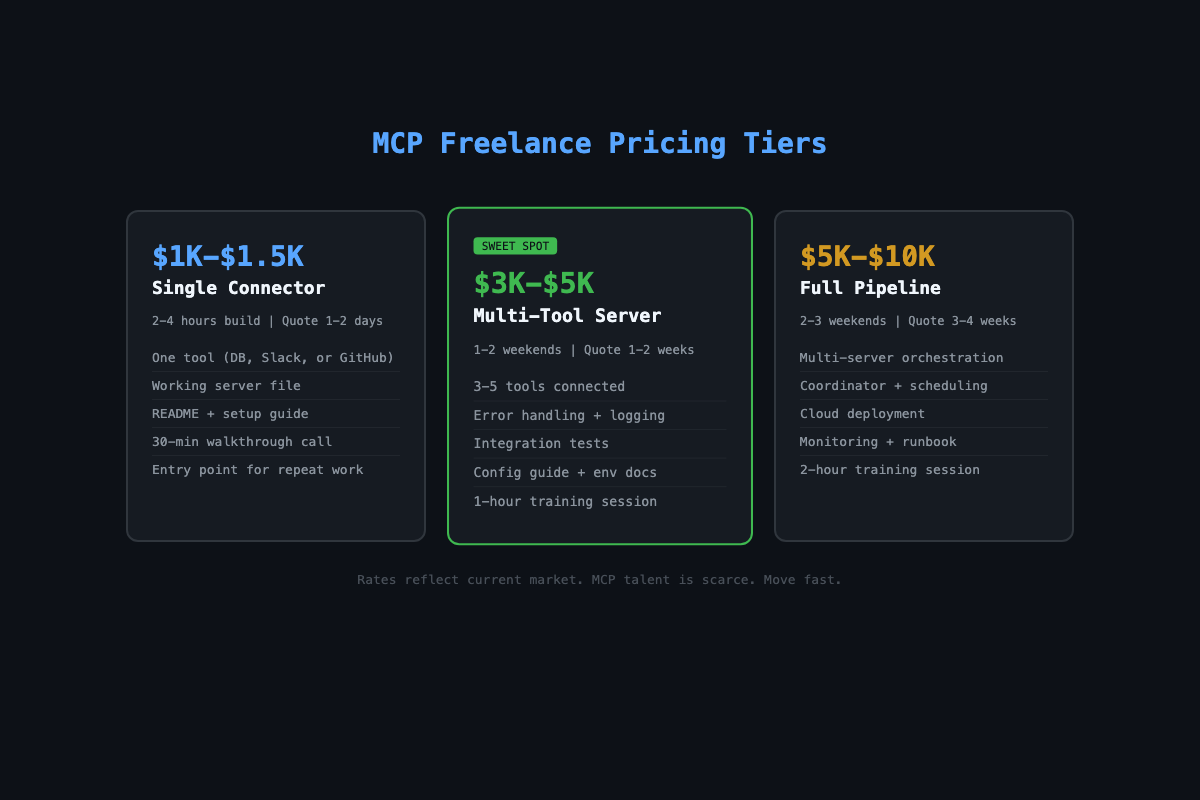
$1K-$1.5K for a single connector, $3K-$5K for a multi-tool server, $5K-$10K for a full automation pipeline. Those are the three tiers, based on what builders are actually closing on r/mcp and Upwork right now.
| Tier | Scope | Price | Build time | Quote |
|---|---|---|---|---|
| 1: Single Connector | One tool (database, Slack, or GitHub) | $1,000-$1,500 | 2-4 hours | 1-2 business days |
| 2: Multi-Tool Server | 3-5 tools + error handling + docs | $3,000-$5,000 | 1-2 weekends | 1-2 weeks |
| 3: Full Pipeline | Multi-server orchestration + deployment + monitoring | $5,000-$10,000 | 2-3 weekends | 3-4 weeks |
Tier 1 is your entry point. Fast to deliver, easy to scope. The client often comes back for Tier 2 within a month. Deliverable: working server file, README, 30-minute walkthrough call.
Tier 2 is the sweet spot. High enough to signal quality, low enough to get approved without a procurement process. Deliverable: production-ready server (error handling, logging, validation), integration tests, config guide, 1-hour training session.
Tier 3 is where repeat business comes from. Once a client sees one pipeline working, they want three more. Deliverable: full pipeline (servers + coordinator + deployment), monitoring setup, runbook, 2-hour training.
These prices reflect a market where MCP talent is scarce. They will compress as more developers learn the protocol. Moving fast matters.
Rate sourcing: These ranges align with current Upwork AI automation listings ($75-200/hr for workflow builds) and Toptal’s AI consulting tier ($150-300/hr). Rates shift fast in this market. Check current listings before quoting.
How do you scope projects without losing money?
The number one way freelancers lose money on MCP projects is underscoping. The client says “connect our CRM” and you quote Tier 1. Then you discover their CRM has a rate-limited API, requires OAuth with PKCE, and their data model is 47 tables.
Ask these five questions before quoting:
- Which tools? List every system they want connected. Get specific API names.
- Which operations? Read-only or write access? “Show me customers” is Tier 1 complexity. “Create and update customers” doubles it.
- Who uses it? One person means stdio and Claude Desktop. A team means HTTP transport and user authentication.
- Where does it run? Laptop or cloud? Cloud adds deployment, monitoring, and ongoing costs.
- What data sensitivity? PII, financial data, health records? Sensitive data changes error handling, logging, and access control requirements.
If any answer surprises you during discovery, adjust the tier before quoting.
How does the sales conversation work?
Do not sell MCP. Sell the outcome. The client does not care about JSON-RPC or stdio transport.
You: “I build AI integrations. Your team asks questions in plain English, and the AI pulls data from your database, creates tickets, sends updates. All the tools they already use, accessible through a chat interface.”
Client: “How does it work?”
You: “I write a server that sits between your tools and the AI. Takes about a weekend. I charge $3,000-$5,000 depending on how many tools you want connected.”
Client: “Can we see a demo?”
You: “Yes.”
The demo closes deals faster than any pitch deck. Open Claude Desktop with your multi-tool server running. Type “Show me customers who signed up this week.” Claude queries the database. Type “Create a GitHub issue to follow up with the enterprise accounts.” Claude creates it. Three minutes. The client says some version of “Can you do that with our database?” The answer is always yes.
What does the scope document look like?
Send this after the discovery call. One page. Protects both sides.
PROJECT SCOPE: [Client Name] MCP Integration
Date: [Date]

BUILDING:
- MCP server connecting [Tool A], [Tool B], [Tool C]
- Tools: [list each function]
- Transport: [stdio / HTTP]
- Deployment: [local / cloud platform]

INCLUDED:
- Working MCP server code
- Environment variable configuration
- README with setup instructions
- [N]-hour training call
- 30 days of bug fixes after delivery

NOT INCLUDED:
- Ongoing maintenance after 30 days
- New feature development
- Changes to client's existing systems
- API costs (client provides their own keys)

TIMELINE:
- Start: [date]
- Delivery: [date]

PRICE: $[amount]
PAYMENT: 50% upfront, 50% on delivery.
When the client asks “can you also add Jira?” after delivery, point to the scope document and quote the add-on separately.
What does deployment actually cost?
Real numbers from production MCP servers:
| Component | Monthly cost |
|---|---|
| Compute (Railway or Fly.io) | $5-$20 |
| Managed database (if needed) | $0-$25 |
| Claude API (daily analytics pipeline) | $1-$5 |
| Monitoring (UptimeRobot free tier) | $0 |
| Total per client | $10-$50 |
Charge clients $50-$100/month for hosting and maintenance. You are profitable on every client from month one. A typical MCP server handling hundreds of daily requests costs less than a streaming subscription to host.
Monthly maintenance contracts ($50-$100/month) are passive income after the initial setup. They cover SDK updates, breaking changes, and quick questions. The close rate on maintenance upsells is over 70% because the client already trusts you and has seen the value.
How do you track project profitability?
Track your time even on fixed-price projects. You need to know your effective rate.
# Quick project profitability calculator
def project_profitability(price, hours, hosting_monthly=0, months=12):
    """Calculate effective hourly rate and annual profit."""
    maintenance_revenue = hosting_monthly * months
    total_revenue = price + maintenance_revenue
    effective_rate = price / hours
    annual_hosting_cost = hosting_monthly * 0.3 * months  # ~30% is your cost
    annual_profit = total_revenue - annual_hosting_cost
    return {
        "effective_hourly_rate": f"${effective_rate:.0f}/hr",
        "total_first_year": f"${annual_profit:.0f}",
        "monthly_passive": f"${hosting_monthly - (hosting_monthly * 0.3):.0f}/mo"
    }

# Tier 2 example: $3,500 project, 14 hours, $75/mo maintenance
print(project_profitability(3500, 14, 75))
# {'effective_hourly_rate': '$250/hr', 'total_first_year': '$4130', 'monthly_passive': '$52/mo'}
If a Tier 2 project ($3,000) takes 25 hours, your rate is $120/hour. If it takes 60 hours, you are at $50/hour and you underscoped. This data improves every future estimate.
How do you package the deliverable?
The difference between a $1K freelancer and a $5K freelancer is not the code. It is the delivery.
client-project/
  server.py
  tools/
    db_tools.py
    github_tools.py
  config/
    example.env
  docs/
    README.md
    SETUP.md
  tests/
    test_db_tools.py
  demo.py           # Runs 3 example queries
Include a demo.py that connects to the server and runs three example queries. The client runs it to verify everything works after setup. Record the training session and send the video. When their new hire joins in three months, they watch the recording instead of calling you.
What mistakes cost you money?
Underscoping write operations. Read-only tools are straightforward. The moment a client wants write access (create issues, update records, send messages), complexity doubles. You need validation, confirmation flows, error rollback, and audit logging.
Not charging for deployment. Building the server is half the work. Deploying it, configuring environment variables, setting up monitoring, and training the client’s team is the other half. Include it in the quote or charge separately.
Giving unlimited revisions. “Can you also add…” is the most expensive phrase in freelancing. Two rounds of revisions are reasonable. After that, new features are new projects with new quotes.
Skipping the training session. You save an hour by not doing the walkthrough. Then you spend five hours answering questions that the training would have covered. Always do the training. Always record it.
Three scope creep traps: (1) “Can you also connect it to X?” after the contract is signed. Answer: “Yes, that’s a Tier 2 add-on.” (2) “The API changed, can you update it?” Answer: “Maintenance is covered under the retainer.” (3) “We need it to work differently now.” Answer: “Let’s scope a new engagement.”
3-minute demo script: (1) Show the workflow running live: real data in, real output. 30 seconds. (2) Show the monitoring dashboard: what happened, what it costs. 30 seconds. (3) Show a customization: change one parameter, re-run, different output. 60 seconds. (4) Show the failure case: what happens when the API is down. 30 seconds. (5) Answer questions. 30 seconds. Clients buy from demos, not proposals.
What should you actually do?
- If you have never sold MCP work: build a demo server connected to a database and GitHub. Record a 2-minute screen recording. Post it to Twitter and LinkedIn with “Built this in 2 hours. DM me if you want one for your team.”
- If you have technical skills but no clients: answer MCP questions on Reddit with real depth. Not sales pitches. Help. The clients find you when your answers are consistently the best.
- If you have one client: deliver the project, then ask during the training session what else they wish the server could do. Write it down. Follow up in two months with a specific proposal. That follow-up is your next project.
bottom_line
- The $3K-$5K multi-tool server (Tier 2) is the sweet spot. High enough to signal quality, low enough to skip procurement. Most MCP freelance projects land here.
- Scope before you quote. Five questions prevent the “$1K project that takes $5K of effort” disaster. If discovery reveals complexity, adjust the tier.
- The demo closes deals. Three minutes of Claude querying a live database converts better than any pitch deck or proposal. Build your demo server before your website.
Frequently Asked Questions
How much can you charge for MCP integration work?+
$1,000-$1,500 for a single connector, $3,000-$5,000 for a multi-tool server, $5,000-$10,000 for a full automation pipeline. These rates reflect the current market where MCP talent is scarce.
Where do you find MCP clients?+
Reddit (r/mcp, r/SaaS, r/startups), Twitter search for 'need MCP' or 'connect AI to', Upwork/Toptal under 'AI integration', and LinkedIn posts showing demos. Answer questions first, sell second.
How long does an MCP project actually take?+
A single connector: 2-4 hours of build time. A multi-tool server: 1-2 weekends. A full automation pipeline: 2-3 weekends. Always quote longer timelines to leave buffer.