How to Find Winning Stocks Before the Headlines With Claude
Find winning stocks before the headlines do, each with your buy price already set. A free screen returned 152 small companies growing sales more than 20% a year, four cuts took them to 20, and three ended with a sourced one-page write-up and a price from your own spreadsheet.
>This covers the cuts from 152 names to three and the sheet that sets the price. Build Your Own Wall Street Analyst with Claude adds how to anchor your assumptions to the company's own record, how to read what today's price already assumes, and the ten-minute routine for the day a name hits its price.

Build Your Own Wall Street Analyst with Claude
How to Find Winning Stocks Earlier and Grow Your Portfolio with an AI Research Team
Hello builders,
You can find winning stocks before they make the headlines, and have your buy price set on each one before the market gives you a reason to get excited. Ask a chatbot for picks and, as one Reddit commenter put it, “youre basically getting the names most discussed on Reddit.” So here’s how to find stocks with Claude in four cuts: we run the screen ourselves, Claude does the reading, and a spreadsheet sets the price.
The question behind this is a plain investing question from r/ValueInvesting: “Everyone knows Nvidia, Google, and Amazon. How do you find all the good companies that never make the headlines?” The top reply gets to its method about a hundred words in.
“I use AI to help here. For example, I was reading about LiDar the other day and thought “I wonder if robots will use Lidar”. Turns out, yes. So I started researching companies that manufacture lidar tech.”
The person supplied the idea and handed the reading to the model.
152 names from a free screen
Finviz has a free screener that needs no login, and the screen I ran is one web address with three filters set.
- small cap
- gross margin over 40%
- sales growth over 20%
The day I ran it, it returned 152 companies, and I’d heard of a handful. How many would you recognise? That number moves every day as companies report, so yours will differ.
Four rules cut it to 20
Now we cut with rules we’d defend, and these four are mine.
- profitable, or clearly close
- share count up less than about 5% in a year
- no going-concern language
- a business you can explain in one sentence
You can check the first three on sec.gov in a couple of minutes per company, using EDGAR’s company search and its full-text search for the phrase “going concern.” Twenty names is the target, so we tighten or loosen one rule until we land near it.
Five researched both ways
Twenty is still too many to read deeply, so we pick five and write one sentence on why each might be worth owning before Claude sees it. Each of the five gets a memo, which at its simplest is a sourced test of that sentence against its newest filing, and a case against from a second project that never sees our opinion. A name whose case against lands a reason we can’t answer from the filings is cut that day, before we’ve spent a weekend falling in love with it.
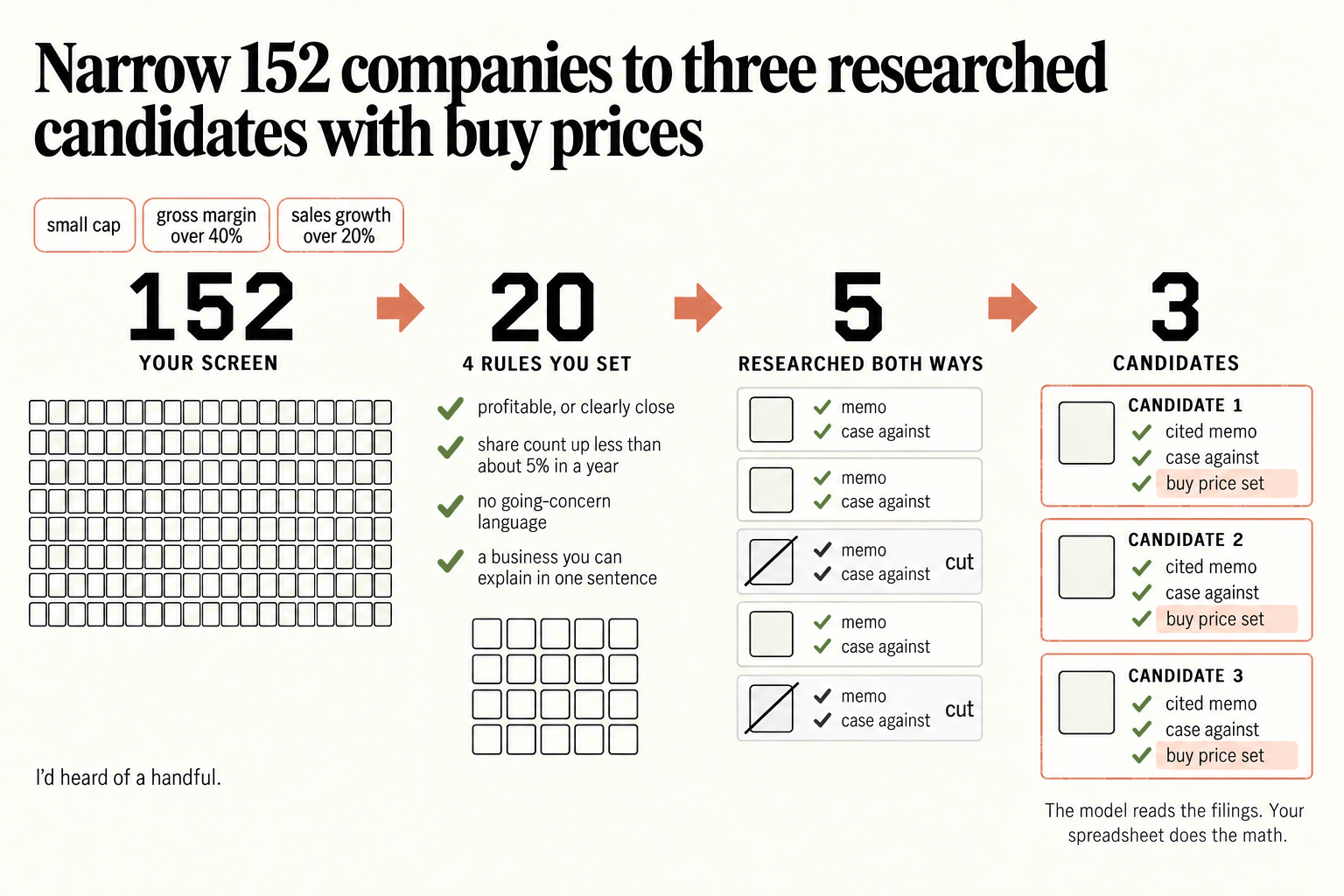
In the picture two of the five are cut, and the three candidates left each have a cited memo, a case against and, last, a buy price set.
The sheet sets the price
The model reads the filings. Your spreadsheet does the math. Why keep Claude away from the fair value? A valuation is mostly assumptions, and assumptions are where a model is most confident and least accountable. So for each survivor we save its newest 10-K and 10-Q from EDGAR as PDFs, attach them to a chat, and paste into that same chat a command that only fetches.
desk-inputs [TICKER]

Fetch these from the filings, each tagged (form · filing date ·
line · period):
1. Revenue and net income for the last full fiscal year (10-K).
2. Revenue and net income, this fiscal year-to-date, and the same
   period a year earlier (latest 10-Q).
3. Shares outstanding (cover page, with the "as of" date).
4. Cash, cash equivalents and marketable securities; total debt
   (latest balance sheet).
Don't add, subtract or estimate anything. I do the math in my sheet.
If a line isn't in the filing, write NOT FOUND.
Those numbers go into a spreadsheet laid out like this, where the numbers down the left are the sheet’s own row numbers and the labels go in column A. The clerk is my name for the fetching step, and TTM means the trailing twelve months, built as last fiscal year plus this year to date minus the same months a year ago.
VALUE-RANGE SHEET · [TICKER]            B: LOW   C: BASE   D: HIGH
INPUTS (tagged, from the clerk)
 2 TTM revenue ($M) = FY + YTD - prior YTD   [3 tags]   =same in B, C, D
 3 TTM net income ($M) = same build           [3 tags]
 4 Shares outstanding (M)     [tag, as of date]
 5 Net cash ($M) = cash + securities - debt   [tags]
YOUR ASSUMPTIONS
 8 Revenue growth per year, next 3 years
 9 Net margin in year 3
10 P/E you'd pay in year 3
11 Return you require per year
FORMULAS (the sheet, never the model)
14 Year-3 revenue        =$B$2*(1+B8)^3
15 Year-3 earnings       =B14*B9
16 Year-3 equity value   =B15*B10+$B$5
17 Value per share today =B16/$B$4/(1+B11)^3
BUY ZONE
19 At or below           =0.75*C17
Rows 2 to 5 are the same for every case, which is what the note on row 2 means, and the formulas read them from column B, so fill them in there. Rows 8 to 11 are yours, filled in for each of B, C and D before you look at the stock price, and that includes the required return. Row 3 feeds no formula; divided by row 2 it gives today’s margin, which is what you set row 9 against. Then copy rows 14 to 17 across to columns C and D. Take a made-up Company X with $400 million of sales, 50 million shares and $60 million of net cash. With growth of 8%, 15% and 22% a year, year-3 margins of 6%, 9% and 12%, P/Es of 14, 18 and 22 and a 10% required return, the low case values a share at $7.26, the base case at $15.71 and the high case at $29.72. The buy price is 0.75 times the base, or $11.78. How wide is a range like that? Four times from bottom to top on identical inputs, which tells us how much of any valuation is assumption. The 25% cushion is my choice, so pick your own and write it down.
I’d call a fair value computed by a model a coin flip with extra steps, because every number in it rests on a growth rate and a multiple the model made up.
Run the screen tonight and write your four rules at the top of the file, so next month’s screen uses the same ones.
Now go build something this weekend!
John Cook