How to Beat the Market to a 10-K Change With Claude
Beat the market to what a company changed in its 10-K, and know from one verb which of your stocks just got a green light, by having Claude compare one section across two filings. In the best study on it, companies that left their filings alone went on to beat the ones that rewrote them by up to 22% a year, and the market did not move on filing day.
>This covers the section compare and the verb ladder. Build Your Own Wall Street Analyst with Claude adds the insider-buying check, the 8-Ks and share count that belong beside it, and the one-page change report for every stock you own.
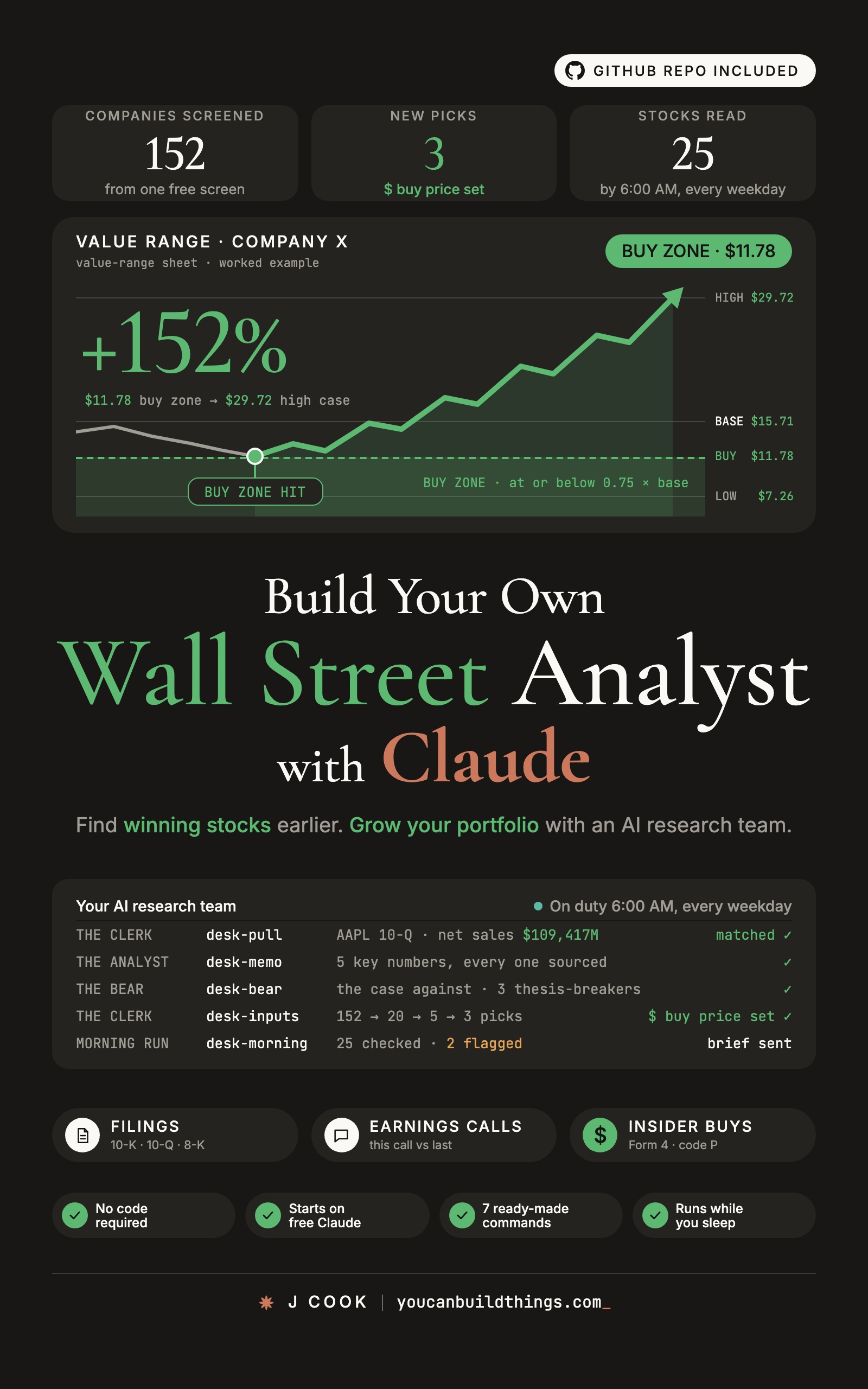
Build Your Own Wall Street Analyst with Claude
How to Find Winning Stocks Earlier and Grow Your Portfolio with an AI Research Team
Hello builders,
You can beat the market to what a company changed in its annual report, the week it lands, and know from a single verb which of your stocks just got a green light. Between Apple’s last annual report and its latest 10-Q one risk moved from the past tense to the present, and most AI 10-K analysis would have summarized both filings as “Apple faces component supply risks.” So we hand Claude the same section from two filings and ask only for what changed.
The best evidence I know that a wording change matters is a Journal of Finance paper called Lazy Prices, which followed companies after they changed the language in their reports.
“Changes to the language and construction of financial reports also have strong implications for firms’ future returns: a portfolio that shorts “changers” and buys “non-changers” earns up to 188 basis points in monthly alphas (over 22% per year) in the future.”
The authors also found “no announcement effect associated with these changes”, with the returns arriving later through news, events or earnings. So when the 10-K of a stock we own barely changed, I read that as a green light. When its risk section was heavily rewritten, we read every change that same week. It is a large-portfolio result, so I treat it as a pointer to where to look on a single stock. Which of your holdings filed an annual report this year that you have read beside the one before?
Compare one section at a time
One builder on Reddit described what happens when two whole filings go into a chat: “Claude will hallucinate, lose track of the context midway through, and miss the actual changes in the fine print.” So we compare one section. On sec.gov, use EDGAR’s company search, filter the company’s list to 10-K, then open this year’s and last year’s. Search each page for “Item 1A” and copy that section, Risk Factors, into its own text file named by year. If a 10-Q is newer than the 10-K, copy its Part II, Item 1A too and run it as NEW against the 10-K; it is usually short because it lists only what changed since the annual report. Attach both files to a Claude chat, or paste the two sections in, and paste this command with the forms and dates filled in.
desk-changes [TICKER] · NEW = [form, filing date, section]
                      · OLD = [form, filing date, section]

You get the same section from two filings, labelled NEW and OLD.
Compare them sentence by sentence. Use only these two documents.

Report:
1. ADDED: sentences or risk factors in NEW that aren't in OLD.
2. REMOVED: sentences or risk factors in OLD that aren't in NEW.
3. REWORDED: same idea, different words. Quote OLD, then NEW, and
   name what changed (a number, a country, a tense, "may" became
   "is", a new item in a list). Mark each one ESCALATED, SOFTENED
   or NEUTRAL, using the verb ladder: can/may -> at times ->
   has experienced -> is experiencing -> expects to intensify ->
   a number in the results.
4. MOVED: risk factors or list items that changed position.
   Give old position and new position.

For every item: quote the text and name the section and filing.
Ignore page numbers, formatting and cross-references.

End with CHANGE LEVEL for the section: QUIET (a few words),
SOME (a few sentences), or HEAVY (risk factors added or removed,
or many rewrites), and the one change most relevant to my thesis
card. No predictions, no buy/sell.
The last line mentions my thesis card, which is the one sentence I keep on why I own the stock, so paste yours under the command or cut that clause. Then we pick two of the reported changes and look for them in the filings ourselves. Can you find each one in the NEW file? A “change” that isn’t there is the model filling a gap, and it gets struck.
Read the verbs
A risk can also be reworded because the problem went away, so we need to know which way each one moved. Lawyers write risk factors on a ladder that runs from “this could happen to anyone” up to “this is happening to us, now,” and the command grades every reworded risk against it. Here are the six rungs, from mildest to most serious.
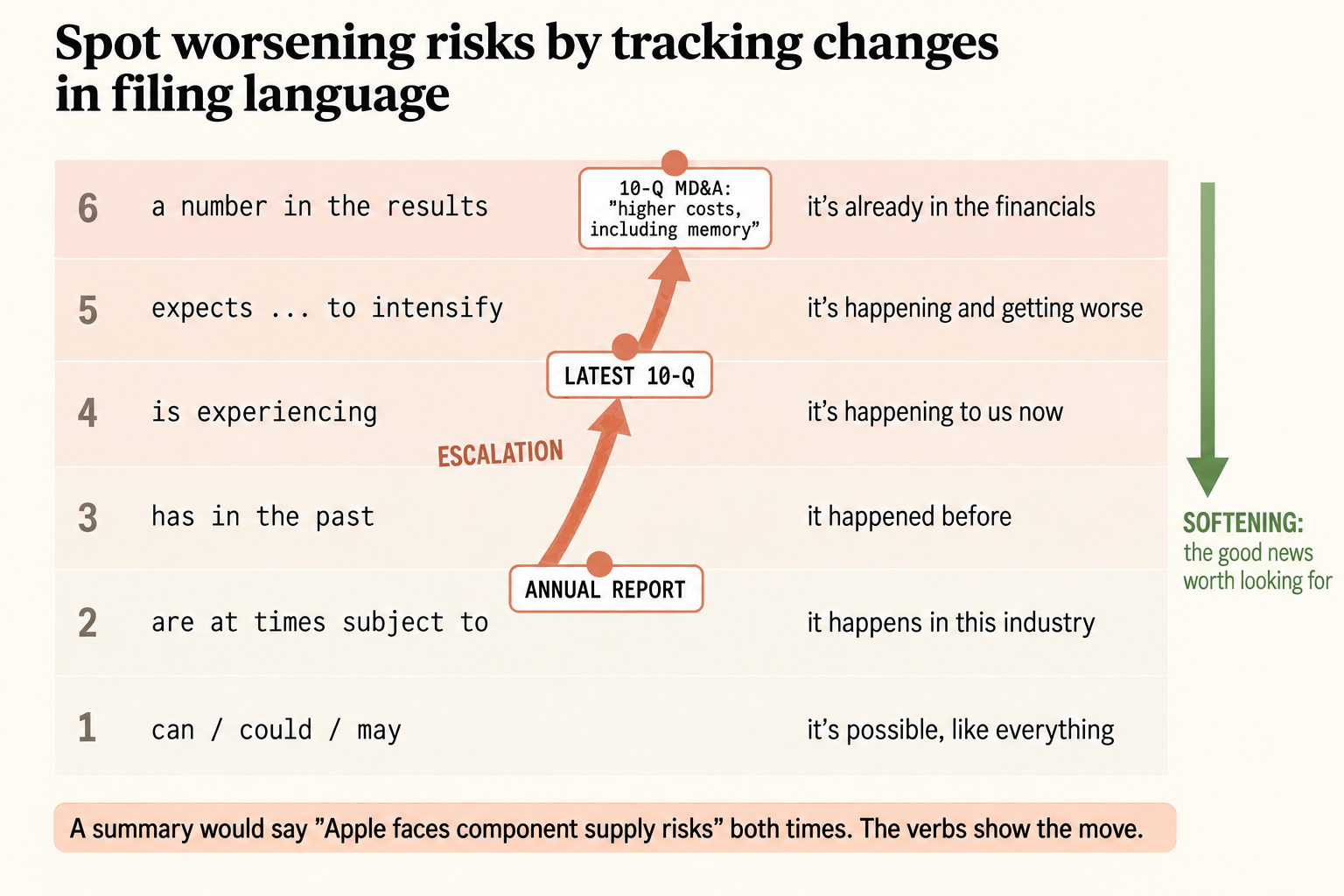
- can / could / may: it’s possible, like everything
- are at times subject to: it happens in this industry
- has in the past: it happened before
- is experiencing: it’s happening to us now
- expects … to intensify: it’s happening and getting worse
- a number in the results: it’s already in the financials
A change that moves a risk up the ladder is an ESCALATION, and a move down is a SOFTENING, which is the good news worth looking for.
Apple’s risk, climbing
Apple’s component risk makes a clean worked example. In the annual report, the risk factor said many components “are at times subject to industry-wide shortages and significant commodity pricing fluctuations,” and its example sat in the past tense: the global semiconductor industry “has in the past experienced high demand and shortages of supply.” That puts the annual report at rungs 2 and 3.
In the latest 10-Q the “at times” wording is unchanged, and the example now reads “the Company is experiencing a period of supply constraints and increasing costs for components.” The next sentence opens with “The Company expects these trends to intensify,” and that puts the same paragraph at rungs 4 and 5. The management discussion in that 10-Q had already tied memory to the numbers, saying the Products gross margin improved “partially offset by higher costs, including memory,” which I’d call a toe on rung 6.
A summary would say “Apple faces component supply risks” both times, and the verbs show the move. The wording got more specific and moved into the present tense, a change I’d never catch by skimming. Where does the risk you worry about most sit on that ladder today?
Softening works the same way in reverse. When “is experiencing” in one filing becomes “has in the past experienced” in the next, the problem is behind them in their own lawyers’ words, and I read that as a reason to feel better about a holding, and sometimes as a reason to add.
Run it on the stock you own the most of, this year’s Item 1A against last year’s, and put the top change beside your reason for owning it.
Now go build something this weekend!
John Cook