How to Catch the Earnings Surprise That Moves a Stock With Claude
Catch the earnings surprise that moves a stock on every name you own, the day it lands, and act before the crowd has read past the headline. General Mills' headline said it 'Reaffirms Full-year Outlook' while the drag on its reported sales growth moved from about 2 percent to about 4 percent, and you would have known that morning.
>This covers the two-call comparison and the release check. Build Your Own Wall Street Analyst with Claude adds the earnings-season note across four holdings, what to compare when nobody transcribes your stock, and the memo each change feeds.
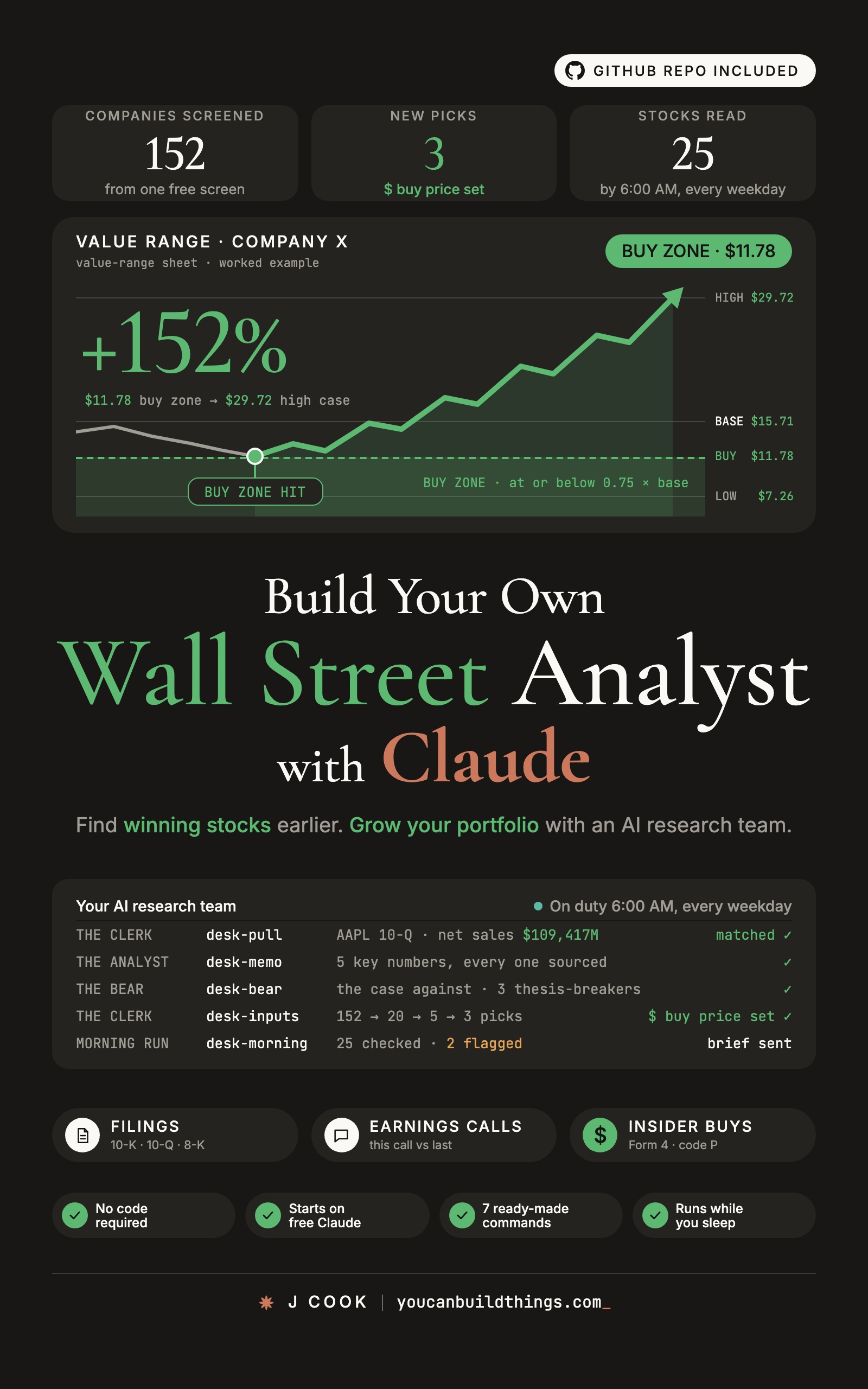
Build Your Own Wall Street Analyst with Claude
How to Find Winning Stocks Earlier and Grow Your Portfolio with an AI Research Team
Hello builders,
You can catch the earnings surprise that moves a stock on every name you own, the day it lands, and act on it before the crowd has read past the headline. General Mills’ latest release was headlined “Reaffirms Full-year Outlook,” and one line in its outlook had moved from “approximately 2 percent” to “approximately 4 percent,” a change that an AI earnings call summary of one call leaves out. So we give Claude this quarter’s transcript and last quarter’s, and we ask only for what changed.
A small-business owner on Reddit described the problem better than I can: “dont have 4 hours to go through 6 companies worth of calls,” and “ChatGPT just summarizes the summary.” Our reason for owning a stock moves on three things from a call: a guidance range that shifted, a cost now expected to rise faster, and a topic management stopped mentioning.
Get three files
The Motley Fool publishes free transcripts for the companies it covers, and for General Mills the page went up the same evening as the call. For this quarter and for last quarter, copy the part headed Full Conference Call Transcript into a text file, and leave out the blocks above it, which are a machine-written summary. If the Fool doesn’t cover your stock, look for a transcript on the company’s own investor page, which the command accepts. The third file is the company’s own results release: on sec.gov, use EDGAR’s company search, filter the list to 8-K, open the one filed on results day, open its press-release exhibit and print it to PDF. Attach all three to a new Claude chat and paste this command with your ticker and the two quarters filled in.
desk-calls [TICKER] · THIS = [quarter] · LAST = [quarter]

You get two call transcripts, labelled THIS and LAST, and the
company's results release (8-K Exhibit 99.1) if I attach it.
Use only these documents.

Report what CHANGED from LAST to THIS, in six groups:
1. GUIDANCE: any number given for the year or next quarter.
   Old vs new.
2. COSTS AND MARGINS: input costs, pricing, promotions, margins.
3. INVESTMENT: capex, plants, hiring, buybacks, debt.
4. SILENCE: topics that took real time on LAST and don't appear
   on THIS. Flag them. Don't explain them.
5. NEW: topics on THIS that weren't on LAST.
6. ASKED: topics analysts asked about on THIS, how many analysts
   asked each, and whether the same topics came up on LAST.

Rules:
- For every change, quote LAST and quote THIS, with the speaker's
  name. Quote numbers exactly; never paraphrase a number.
- If a group has no change, write NO CHANGE.
- Mark every guidance number CHECK AGAINST RELEASE. If the release
  is attached, check it and say MATCHES or DIFFERS, quoting both.
- Use only the section headed Full Conference Call Transcript (or
  the company's own transcript). Ignore any summary text.
- End with one line: the change most relevant to my thesis card.
- No predictions, no price reaction, no buy/sell.
The last rule mentions my thesis card, which is the one sentence I keep on why I own the stock, so paste yours under the command or delete that line.
What changed at General Mills
My worked example is General Mills, with its fourth-quarter call as LAST and its first-quarter call as THIS. What did the finance chief say about costs three months apart?
LAST, Kofi Bruce: “our inflation outlook of 4 to 5% assumes about $100 a barrel on oil on the uncovered portion of the year”
THIS, Kofi Bruce: “I would expect Q1, Q2, Q3 to be roughly similar and Q4 to be just a touch outside the range at around 6% based on everything in front of us right now.”
That is one row, and the picture carries the five that mattered to an owner. The command returns six groups, so a run also lists INVESTMENT and what the analysts ASKED, and it files brand news under whichever group fits. On my run of this pair the Wilderness line came back under NEW, and ASKED counted ten analysts.
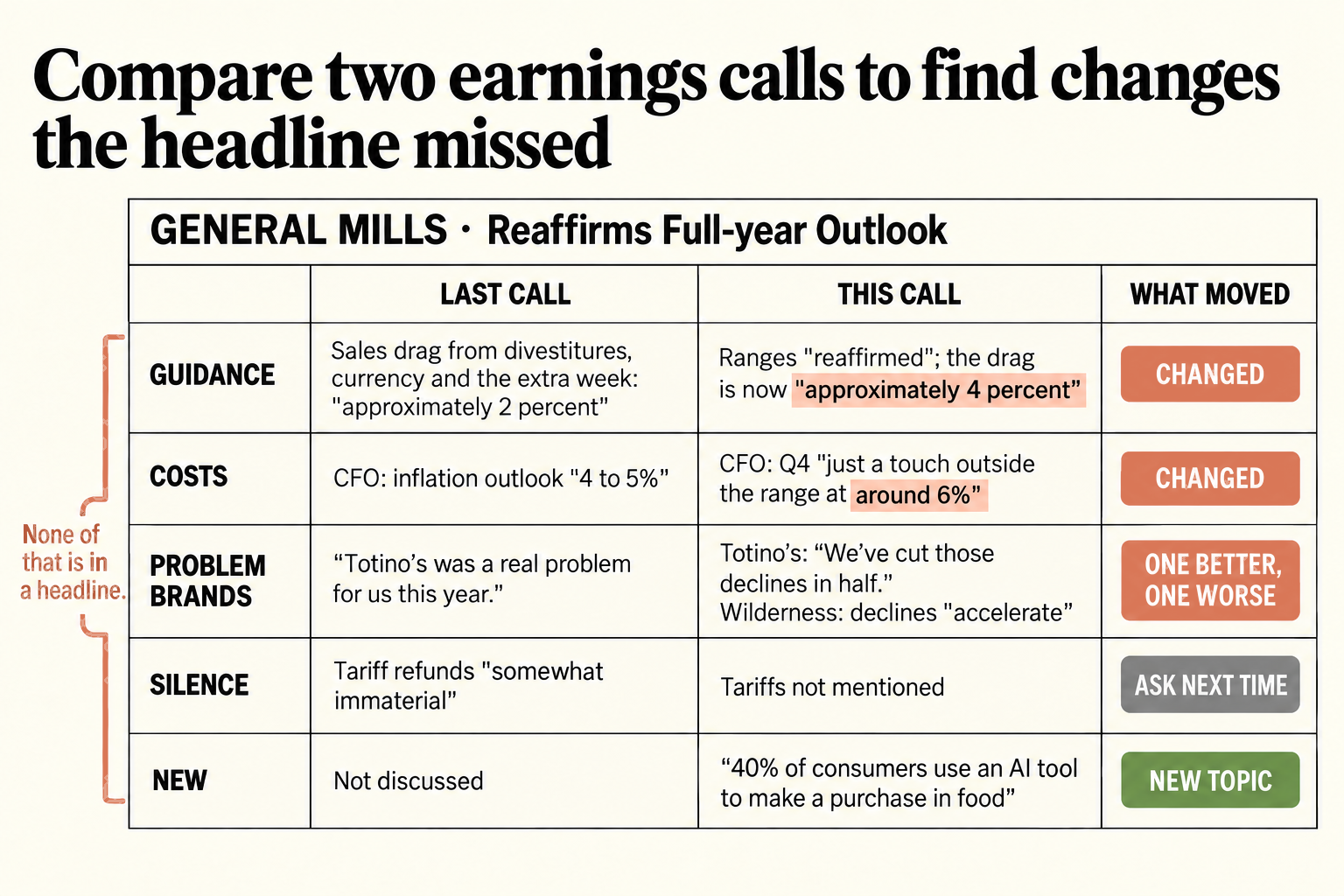
- GUIDANCE: the sales drag from divestitures, currency and the extra week was “approximately 2 percent”; now the ranges are “reaffirmed” and the drag is “approximately 4 percent” · CHANGED
- COSTS: the CFO’s inflation outlook was “4 to 5%”; now Q4 is “just a touch outside the range at around 6%” · CHANGED
- PROBLEM BRANDS: “Totino’s was a real problem for us this year”; now Totino’s “We’ve cut those declines in half” and Wilderness declines “accelerate” · ONE BETTER, ONE WORSE
- SILENCE: tariff refunds were “somewhat immaterial”; now tariffs not mentioned · ASK NEXT TIME
- NEW: not discussed; now “40% of consumers use an AI tool to make a purchase in food” · NEW TOPIC
None of that is in a headline. An owner who stopped at the headline missed that the last quarter of the year is expected to run hotter on costs and that one problem brand is getting worse. And what do we do with the silence row? Tariffs went unmentioned on the second call because nobody asked, which makes it a question for the next call.
Check guidance against the release
Guidance is the one change we verify every time, because it is the one most likely to move a decision and transcripts are imperfect. The command marks every guidance number CHECK AGAINST RELEASE, and with the release attached it answers MATCHES or DIFFERS and quotes both. We still open the outlook section of the release and match each number ourselves, and if the two differ the release wins. That check is where the 2-to-4 percent line turned up, under a headline that said reaffirmed, and a note reading “guidance: no change” would have been wrong. How many holders stopped at the headline that morning?
We check one more thing before trusting a result, which is that every change quotes both calls. We reject any change that quotes only one, and send it back with “Quote both calls for item 3.”
Four before lunch
Run it on your top four holdings, one chat per holding, and from then on it’s one line per stock with three files attached. The General Mills comparison takes about two minutes to read.
Reading every call on my own holdings the day it happens is the edge I’d take every time. Which of your four reported most recently? Start there and run its last two calls today.
Now go build something this weekend!
John Cook