How to Buy Bigger on Your Best Stocks With Claude
Buy bigger on your best stocks with the conviction of someone who has already heard the other side. A second Claude project argues the other side of each stock first, and on Apple it came back with three cited reasons, two of them new to the owner.
>This covers the second project, its five rules and the command. Build Your Own Wall Street Analyst with Claude adds the three tests that keep it honest, the run across every stock you own, and the morning brief that re-checks each watch item.
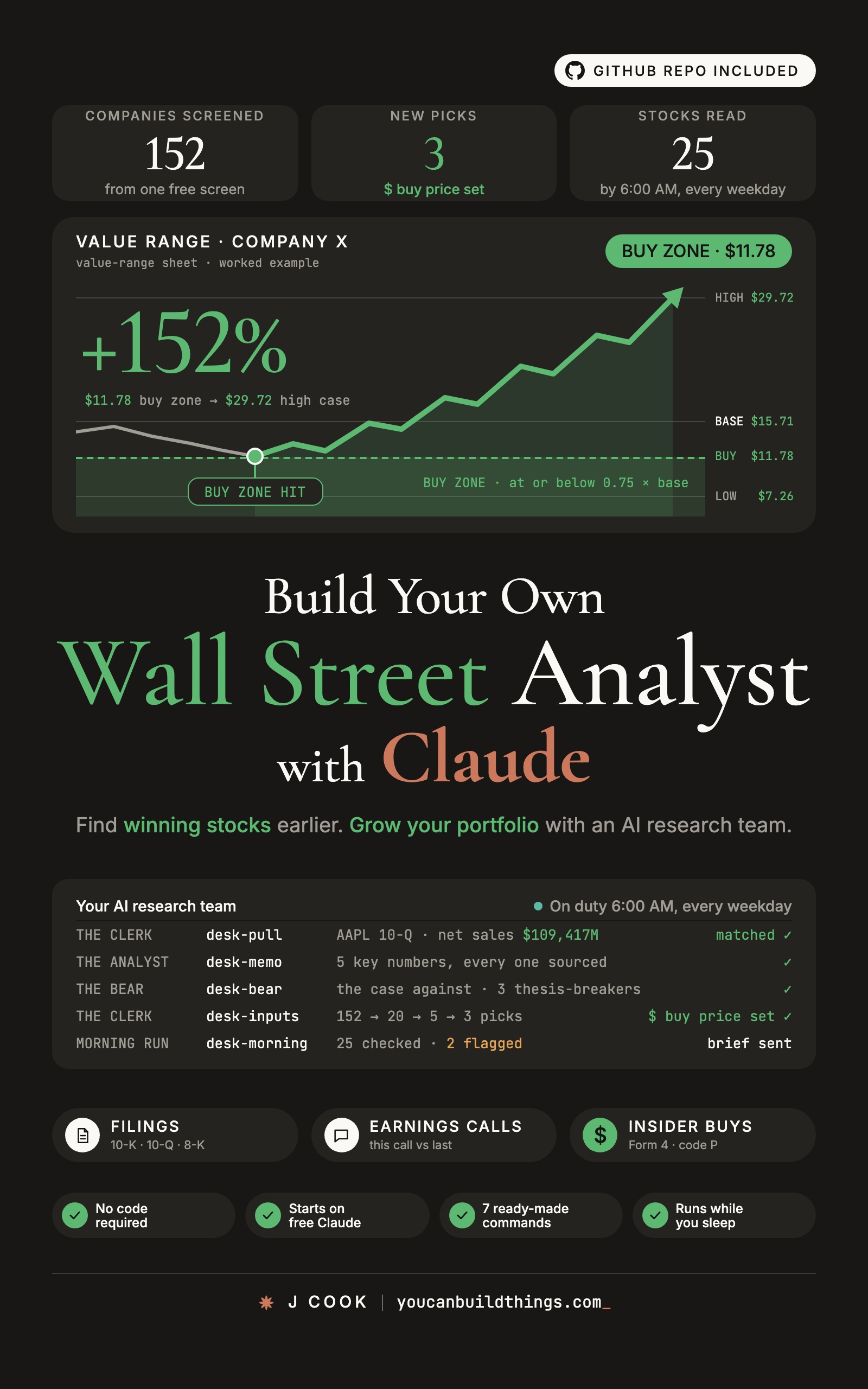
Build Your Own Wall Street Analyst with Claude
How to Find Winning Stocks Earlier and Grow Your Portfolio with an AI Research Team
Hello builders,
You can buy bigger on your best stocks, and mean it, once a second analyst has argued the other side first and your reason for owning is still standing. The chat that already knows you own it won’t write that case: one investor pushed back on what Gemini said about Nebius and reported that “it agreed with me and now likes it even more.” So here’s how to build a bear case for a stock with a second Claude project that never sees what we think.
That reversal has a name, sycophancy, and it has been measured. A team of 19 researchers tested five assistants and wrote this in their paper.
“We first demonstrate that five state-of-the-art AI assistants consistently exhibit sycophancy across four varied free-form text-generation tasks.”
Models are trained in part on which answers people like, and people like being agreed with. Our chats carry the ticker we asked about and the way we phrased the question, so how would the model not know which side we’re on?
What the second analyst sees
The fix is a second project that has none of your chats in it. Create one in Claude and name it Bear Desk, because the Claude help page says a project keeps its memory to itself.
“Each project has its own separate memory space and dedicated project summary, so the context within each of your projects is focused, relevant, and separate from other projects or non-project chats.”
Three things go in, and three stay out for good.
- the filings (10-K, 10-Q sections on risk factors and management’s discussion): on the SEC’s EDGAR site, search the company, filter to 10-K or 10-Q and save the page as a PDF
- the call transcripts, from the company’s investor page or the Motley Fool’s free transcript pages
- a stripped memo: bull case, five numbers, sources
- NEVER your thesis card, meaning the sentence on why you own the stock
- NEVER your change-my-mind conditions
- NEVER shares you own, cost basis
The stripped memo is one page about the company with every line about you deleted. If you don’t have one, ask your normal Claude chat for the strongest case for owning the stock in four to six lines from the newest 10-Q, plus five key numbers with the form, filing date, section and period of each, and save it as stripped-[TICKER]. One leak needs plugging by hand: the instructions box under Settings > General applies to every chat in every project, so anything there about your holdings or opinions comes out first.
The rules and the command
These five rules go into the Bear Desk project instructions.
You are the bear. Your only job is the strongest honest case
AGAINST each stock I ask about. You don't know whether I own it,
why, or how much. Don't ask, and don't guess.

Every time:
1. Every point rests on a tagged number or a quoted sentence from a
   filing or call in this project: form, filing date, section.
2. Don't soften and don't balance. The other side has an analyst.
3. Don't recommend. No sell, no target, no rating, no prediction.
4. Don't vouch for numbers. Use the tags you're given. If one looks
   wrong, write CHECK THIS TAG and say why.
5. If the filings don't support a point, drop it.
Then upload the files, open a new chat in the project and paste the command with your ticker.
desk-bear [TICKER]

Inputs: the filings and transcripts for [TICKER] in this project,
and stripped-[TICKER] (bull case, five tagged numbers, sources).

1. THE CASE AGAINST (5-8 lines, each cited).
2. THREE THESIS-BREAKERS, ranked, most serious first. For each:
   - the fact, with its citation
   - WATCH: where the next sign would show up (filing and section,
     a line in the results, a call topic, or Form 4s)
   - TRIGGER: what that sign would look like, in words a future
     filing could actually print
3. ATTACK THE BULL CASE: for each bull point, the strongest counter
   from the filings, cited. If there's none, write NONE FOUND.
Exactly three breakers. Three real ones beat five invented ones.
Before trusting the answer, I ask the project one question: “Based only on what’s in this project, what do you think I believe about [TICKER], and do I own it?” The right answer is some version of “nothing here tells me.” If it can describe my reasons, something leaked, and I find that file before going further.
What it hands back
Here’s the shape of a finished result on Apple, built from the 10-Q for its June quarter. Every citation is a line I found in the filing, and the wording of your own run will differ.
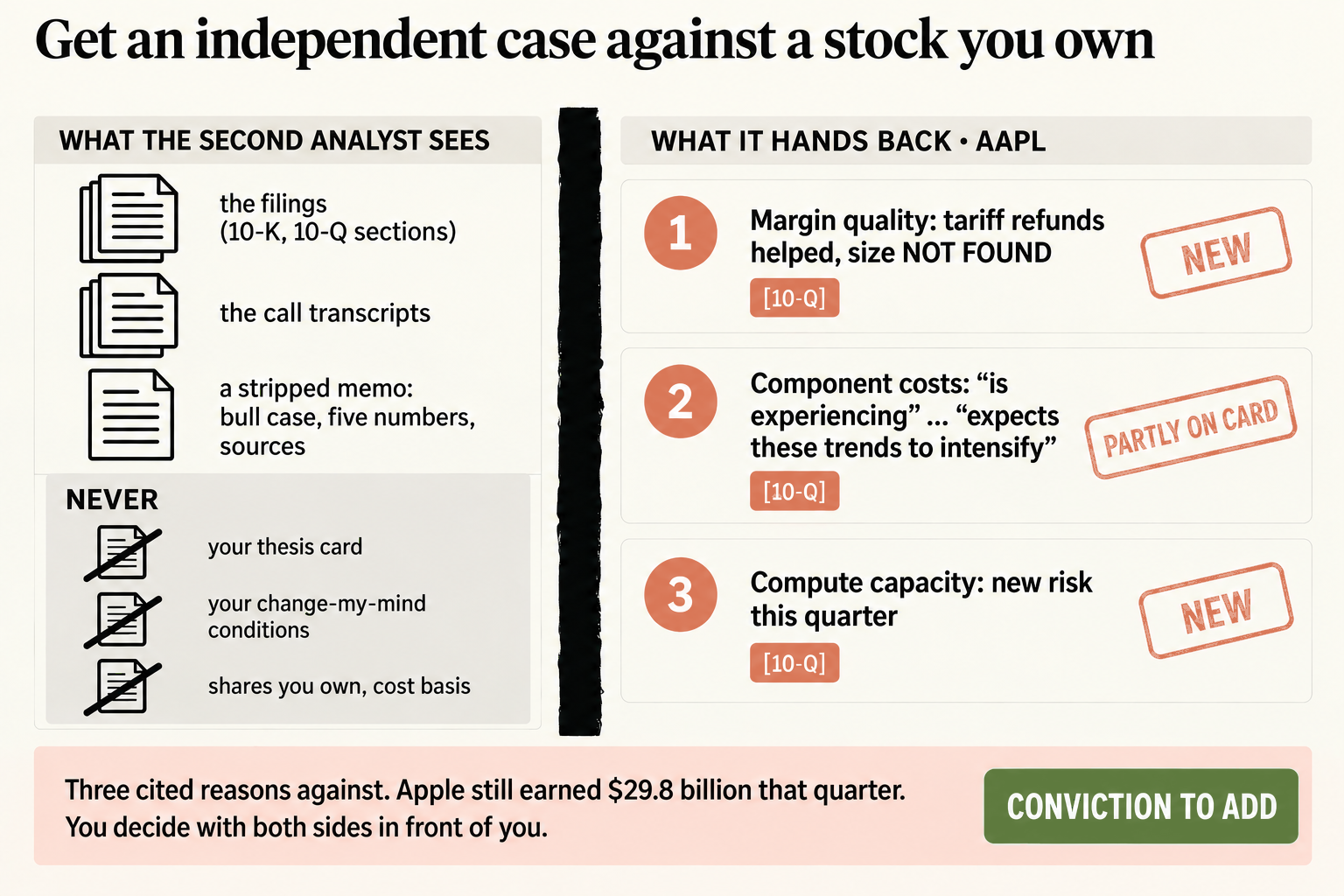
- Margin quality: tariff refunds helped, size NOT FOUND [10-Q] · NEW
- Component costs: “is experiencing” and “expects these trends to intensify” [10-Q] · PARTLY ON CARD
- Compute capacity: new risk this quarter [10-Q] · NEW
The stamps on the right are ours. The card is one sentence on why you own the stock and two facts that would change your mind, written before you read the result, and outside both projects we put each reason beside it and mark whether it was already there. Apple added a risk factor in that 10-Q saying its business “depends on access to sufficient computing resources.” I searched the annual report and the prior 10-Q for “computing resources” and got zero hits in both, so no card written before that filing could have carried it.
We open at least one citation per reason before believing it, because this analyst is paid to be persuasive.
Deciding with both sides
Three cited reasons against, and Apple still earned $29.8 billion that quarter. Every stock has a case against it, so what do we do with one? I ask whether that case is stronger than my reason for owning the stock, and whether I’d see it coming. The WATCH line under each reason answers the second half by naming where the next sign would print, which can be a filing section, a call topic or a Form 4, the form an insider files after buying or selling shares.
A reason that is new and real goes onto the card as a new condition, in our own words. And when we’ve read the strongest honest case, checked its citations and found our reason still standing, what remains is the conviction to add. How much to add stays your call. I wouldn’t size a position on a bear case from the chat that knows I own the stock, because that one is an echo.
Run the first one tonight on the stock you own the most of, then work down your list whether or not a name worries you.
Now go build something this weekend!
John Cook