How to Find the Winning Stocks You Already Own With Claude
Find the winners already sitting in your portfolio and know which ones to buy more of, by putting your one-sentence reason for owning each stock beside the company's newest 10-Q. On Apple the test showed hardware sales growing 18.1% while Services grew 12.1%, three quarters running, so the stock was winning for a different reason than the one its owner wrote down.
>This covers the card and the test. Build Your Own Wall Street Analyst with Claude adds the full one-page memo with a bull and a bear case, the five-source check, and the saved command that writes one for every stock you own.
Build Your Own Wall Street Analyst with Claude
How to Find Winning Stocks Earlier and Grow Your Portfolio with an AI Research Team
Hello builders,
You can find the winners already sitting in your portfolio in one sitting, and know which ones to buy more of, and all it takes from you is one sentence per stock. On Apple, an owner whose sentence said Services grows faster than hardware would have been wrong three quarters in a row, +12.1% against +18.1% in the latest, and a ticker typed into a chatbot would never have said so. Here is the Claude stock analysis I would run on every holding: we write down why we own the stock, then we have Claude test that reason against the newest 10-Q.
Write the reason first
Before Claude sees anything, we fill in this card by hand for one stock we own.
THESIS CARD · [TICKER] · written [today's date] · by me
Why I own it (one sentence):
What would change my mind #1 (a fact, findable in a filing):
What would change my mind #2:
What would make me buy more (optional):
Give a model a rough sentence and it hands back a smoother, more confident one, and from then on the test is checking the model’s idea, so we write the card by hand. Both change-my-mind lines have to be facts a quarterly report would print, because “I’ll sell if it feels wrong” gives Claude nothing to check. The card in the picture further down is a made-up owner’s card for Apple that I use to show the shape, and it isn’t a recommendation. The picture prints only the first of its two change-my-mind lines.
- Why I own it: Services grows faster than hardware
- Change my mind if: Services grows slower than Products two quarters in a row
Run the test
The newest 10-Q is free. Search the company on the SEC’s EDGAR site, filter the list to 10-Q, open the top one and save the page as a PDF. Most companies post the same PDF on their investor page too, which is where the Apple 10-Q used below comes from. Attach the PDF to a new Claude chat, paste your filled card, and paste this under it with your ticker.
Test my thesis card for [TICKER] against the 10-Q filing or
filings attached to this chat. Use only those. Copy my thesis
word for word. Never write or improve it.

NUMBERS
- Pick five key numbers that show whether my reason still holds.
  Use the metrics my thesis card names first.
- Tag each one [S1]...[S5]: form · filing date · section or line ·
  period (start and end dates).
- Compare like with like: this quarter vs the same quarter a year
  earlier. Never compare a quarter with a year-to-date figure.
- Anything you calculate (a growth rate, a share of sales): label
  it CALCULATED and show the two inputs, each tagged.
- A figure you can't tag: mark it [UNSOURCED]. Don't drop it
  quietly and don't guess.

THE CARD TEST
- For each "change my mind" condition on my card, write TRIPPED,
  NOT TRIPPED, or CAN'T TELL, with the tagged fact that decides it.
  If you need an older filing to decide, say which one.

NEVER
- No price target, rating, fair value, prediction, or buy/sell/hold.
What came back on Apple
On a run against that 10-Q, the two growth rates came back as Products +18.1% and Services +12.1%, each marked CALCULATED with its inputs beside it: Products net sales of $78,678 million against $66,613 million a year earlier, and Services of $30,739 million against $27,423 million. You can check both on a phone calculator in five seconds. Every figure carried a tag like [S1] 10-Q · Statements of Operations, which is the page to open when you check it. So did the condition trip? On one filing the answer was CAN’T TELL, because this quarter meets the condition, the condition needs two in a row, and the test named the earlier 10-Q it needed.
We attach the two 10-Qs before it to the same chat and send one line: “I’ve attached the two earlier 10-Qs as well. Run the card test again with all three.” This is what the three filings show.
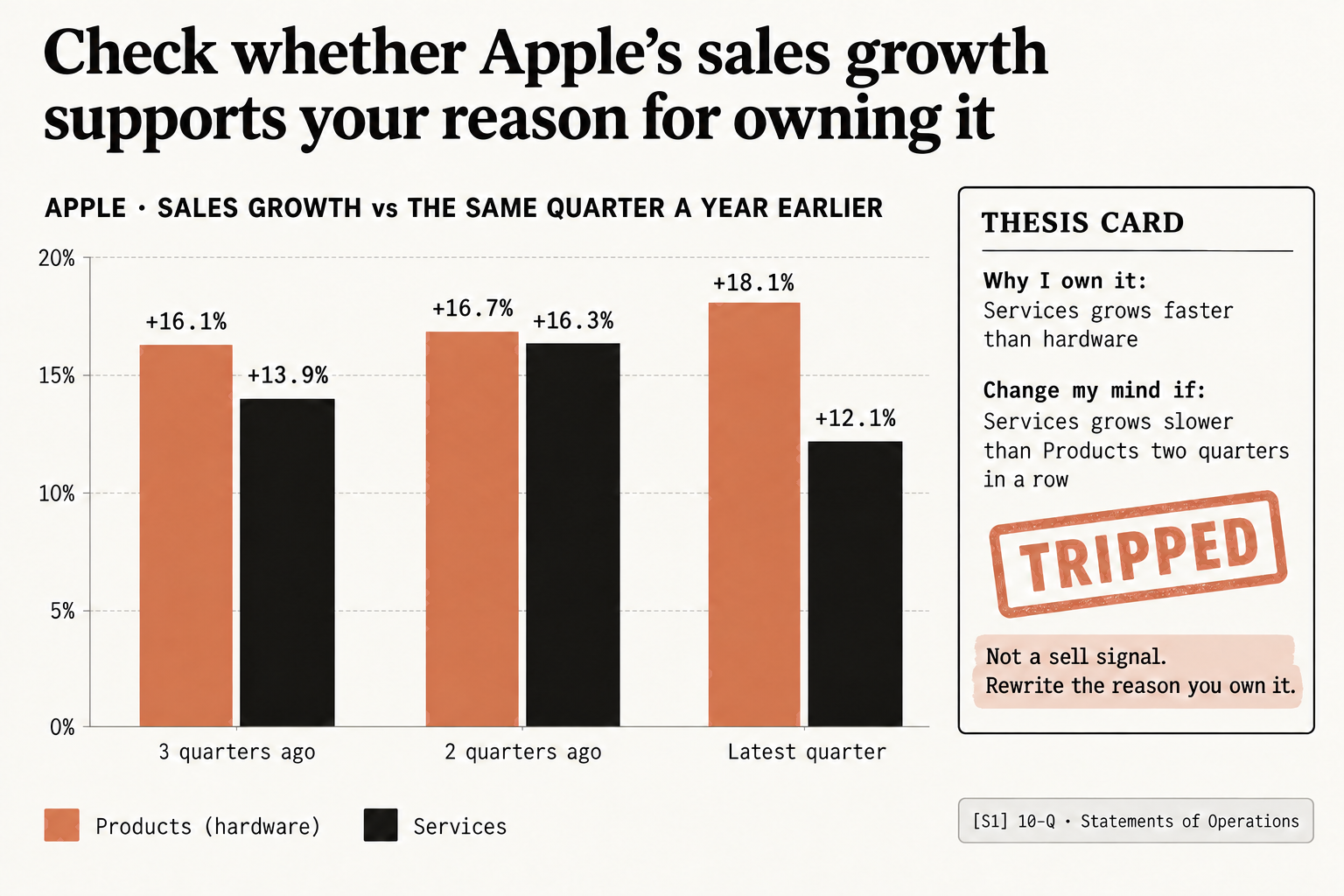
- 3 quarters ago: Products (hardware) +16.1%, Services +13.9%
- 2 quarters ago: Products +16.7%, Services +16.3%
- Latest quarter: Products +18.1%, Services +12.1%
Three quarters in a row hardware outgrew Services, each measured against the same quarter a year earlier, and the second run came back TRIPPED.
Tripped means rewrite it
A tripped card is not a sell signal. The business did something different from what the owner expected, and here different came with hardware sales growing double digits three quarters running. The owner was right that Apple was doing well and wrong about why. That is the most dangerous way to be right, because the next time the stock drops we would be holding it for a reason that isn’t true. So we rewrite the reason we own it. Maybe the new sentence is about a hardware cycle and the conditions move to Products growth, and then the next 10-Q tests that one.
Buy more of the winners
Now run the same test on every stock you own, one chat per stock, and read the card test before anything else. Which holdings came back NOT TRIPPED on every line? Those are your winners, the ones you still own for a reason the latest filing supports, and that is the list I would buy more from when there is new money to put to work. How much goes where stays your call, and anything marked TRIPPED or CAN’T TELL gets its card rewritten or its missing filing added first.
One trap sits in every 10-Q, which prints the quarter and the year-to-date figure side by side. How wrong can that make a number? The first time I pulled this quarter’s sales for Apple the number came back as $364,357 million, which is nine months, sitting beside the quarter’s $109,417 million, so more than three times too big. That’s why the prompt asks for start and end dates on every tag, and why we open the filing ourselves whenever a number is about to move money.
Start tonight with the three stocks you own the most of, and write the three cards before any AI sees them.
Now go build something this weekend!
John Cook