What Claude for Small Business Actually Saves You
How much does Claude save a small business? The honest before-and-after: $287 to $90 a month, the $20 counted honestly, and the bigger number nobody totals.
>This shows you how to build the teardown and read the real net number. Claude for Small Business: The Business That Runs Itself goes deeper on the back-office workflows that make those subscriptions redundant and the pricing check that adds revenue.
Claude for Small Business: The Business That Runs Itself
The 30-Day System for Automating Your Back Office, Inbox, and Marketing
Summary:
- The before-and-after receipt: an example stack going from $287 to $90 a month.
- Which tools to cut, which to keep, and why canceling the wrong one breaks your setup.
- Why you count the $20 Claude cost honestly, and what that does to the number.
- The bigger money the subscription math misses: hours saved and revenue gained.
The question every owner asks: how much does Claude save a small business? Two honest numbers answer it. The one you can circle on a spreadsheet is a couple hundred dollars a month in canceled subscriptions. The one you cannot circle, but matters more, is the hours. This is not the fantasy version where you fire your accountant and run everything on one $20 plan. It is the honest version, with real math, that survives scrutiny. Here is the receipt.
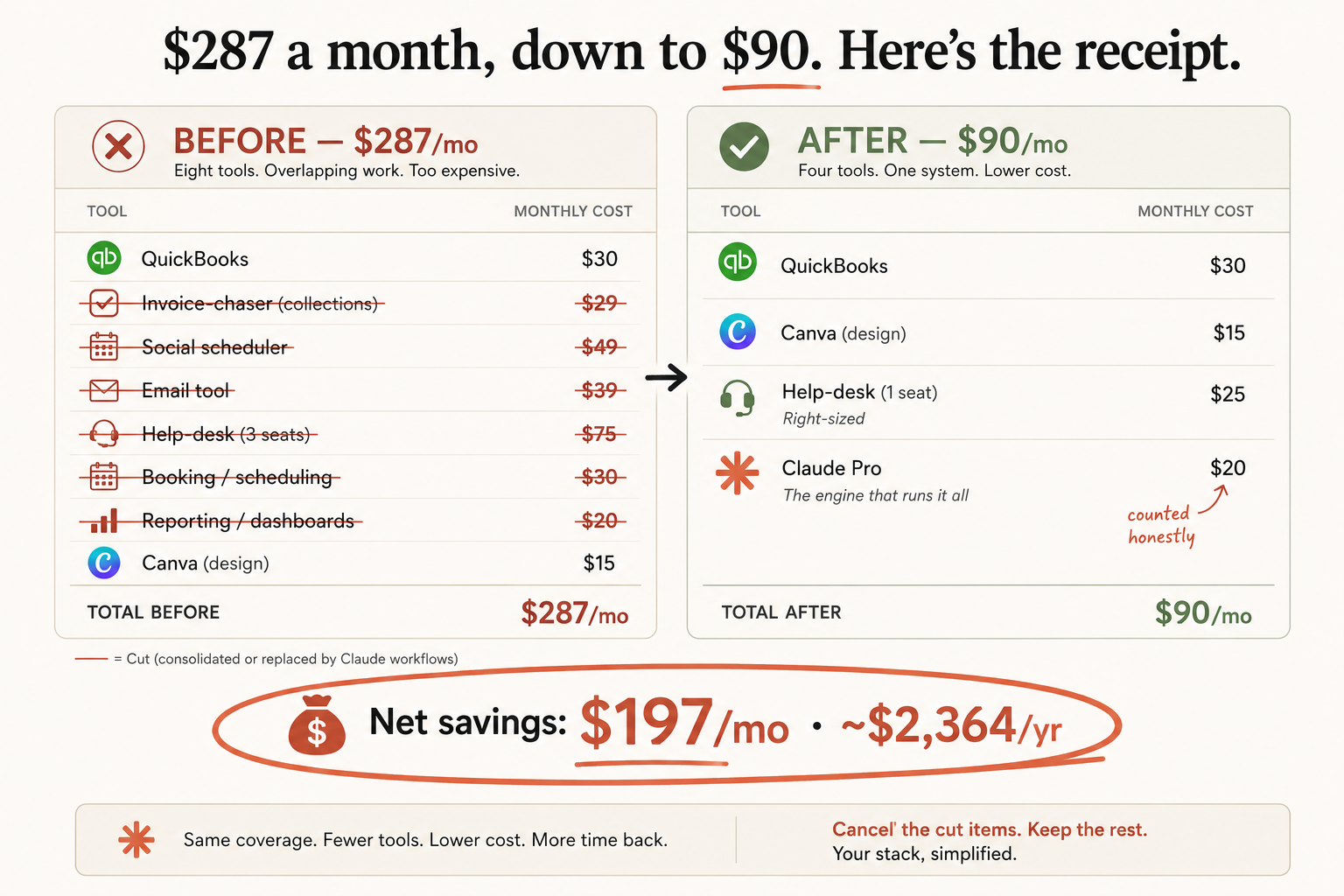
What does the teardown actually look like?
It looks like canceling the bolt-on apps your workflows now replace, while keeping the core tools they connect to. Here is an example stack for a small service business. Your numbers will differ; the shape holds.
| Tool | Before | Keep / cut / downgrade | After |
|---|---|---|---|
| QuickBooks | $30 | Keep (connector) | $30 |
| Standalone invoice-chaser | $29 | Cut → invoice-chase workflow | $0 |
| Social scheduler | $49 | Cut → /run-campaign | $0 |
| Email-marketing tool | $39 | Cut → /run-campaign | $0 |
| Help-desk (3 seats) | $75 | Downgrade to 1 seat | $25 |
| Booking / scheduling app | $30 | Cut → calendar + growth loop | $0 |
| Reporting / dashboard | $20 | Cut → /monday-brief | $0 |
| Canva | $15 | Keep (connector) | $15 |
| Claude Pro | n/a | Add (the engine that runs it all) | $20 |
| Total | $287 | $90 |
That is $287 down to $90, a net savings of $197 a month, about $2,364 a year for this example business. Not “thousands a month,” because I am not going to lie to you. But two-plus grand a year, every year, for canceling subscriptions you were barely using, while the work those tools did still gets done. That number is almost always bigger than the owner guessed before they did the math.
What do you cut, and what do you never touch?
You cut the point-solutions; you keep the connectors. Get this backwards and you break your own setup.
Keep the tools Claude connects to and works inside: QuickBooks, your payment processor, your CRM if it is HubSpot, and Canva if you use the design workflow. Cancel QuickBooks and you have unplugged the thing the money workflows run on. Cut the single-purpose apps you bolted on to patch one gap each: the standalone dunning app, the social scheduler, the email tool you use at five percent of capacity, the reporting dashboard, the booking widget. Each does one thing a workflow now does instead. Downgrade what you still need but use less, like dropping a help-desk from three seats to one.
Keep:      connectors the system runs on (QuickBooks, Canva, your CRM, your payment processor).
Cut:       point-solutions a workflow now replaces (dunning apps, schedulers, booking, reporting).
Downgrade: tools you still need but use less (help-desk seats, a cheaper email tier).
Rule:      don't mark a tool "cut" until a workflow has done its job for one real cycle
           and you verified the output. Cancel on the day the replacement proves itself,
           not the day you read this.
A subscription you cancel on faith, before its replacement has worked even once, is how you open a gap in your own business to save twenty-nine dollars. Cautious beats clever when you are canceling things your business runs on.
Why count the $20 on the ledger?
Because the honest number is the net, not the gross, and the credibility of your whole teardown depends on it. Notice the Claude Pro charge sits in the after column, not off to the side. Some breathless write-ups will tell you that you are “saving $287 a month.” You are not. You are spending $90 where you used to spend $287. The Claude subscription is a real cost and it belongs on the ledger, same as everything else.
If you tell yourself, or a client, a fantasy number, the first careful look blows it up. If you tell the true net number, it survives scrutiny, and it is still a great number: a couple thousand a year in your pocket, less busywork, and one subscription to manage instead of a dozen to forget about. You do not need to inflate that. It sells itself.
Rebuild the receipt with your own numbers in any spreadsheet, one row per subscription:
Tool | Monthly cost | What it does | Keep/cut/downgrade | What replaces it | After cost | Monthly savings | Cancel byPull your last two or three months of statements and do not skip the small ones; the $15 forgotten trials are where the surprises hide.
Does it only save money, or make it too?
It makes money, and this is the half the “consolidate your subscriptions” framing misses. The pricing-check workflow looks at your real unit economics and tells you whether you are charging enough, which most owners are not. Run a pool company’s numbers and you might get back:
Your standard service is $150/month.
Real cost to deliver (chemicals, fuel, labor at current rates): about $108. Margin: 28%.
Comparable services in your area: $165 to $185.
A move to $165 lifts margin to 35% and adds about $32,400 a year
across your 180 accounts, with minimal churn risk at that gap to market.
Sit with that. Thirty-two thousand dollars a year, from a fifteen-dollar increase you were too busy to calculate, surfaced by a workflow that took thirty seconds to run. That is not savings, it is new revenue, and it dwarfs the subscription line.
Then there are the hours, the number that never hits a bank statement. Most owners spend five to ten hours a week on the work the system now handles: the books, the invoice-chasing, the inbox, the marketing, the reports. Call it six. Even at a conservative $50 an hour, six hours a week is about $14,000 a year of your time handed back. You cannot deposit “time saved,” but you can reinvest it into work that earns or stop working at 10 p.m. on Sundays. The subscriptions are the small, circle-able number. The hours are the big one.
What should you actually do?
- If you want the fast win → build the teardown table above with your real subscriptions, then cancel one obviously redundant tool this week. Banking one cancellation turns a spreadsheet into money.
- If you are tempted to cancel QuickBooks or Canva → don’t. Those are connectors the system runs on, not bloat. Keep every tool Claude connects to.
- If a write-up quotes you a gross “savings” number → net the $20 out. The honest figure is what you spend now versus before, not the sum of what you canceled.
- If the subscription savings feel small → count the hours and the pricing check instead. Those are where the real money is; the canceled apps are the rounding error.
The bottom line
- The real number is the net: an example stack goes from $287 to $90, which is $197 a month, about $2,364 a year. Count the $20 Claude cost honestly or the figure does not survive a second look.
- Keep the connectors, cut the point-solutions, and never cancel a tool until its replacement has done the job once. Saving twenty-nine dollars by opening a gap in your business is a bad trade.
- The subscriptions are the number you can circle. The hours saved and the revenue a pricing check surfaces are the numbers that actually move your year.
Frequently Asked Questions
How much does Claude for Small Business actually save you?+
Two numbers. For one example stack, the subscription teardown nets about $197 a month, roughly $2,364 a year, after the $20 Claude cost. The bigger number is the hours: five to ten a week of admin handed off, which converts to far more than the subscriptions.
Can I cancel QuickBooks to save money?+
No. QuickBooks, Canva, and your CRM are connectors the workflows run on; the plugin works inside them. You cancel the redundant point-solutions your workflows replace, like a standalone invoice-chaser or social scheduler, not the core tools they connect to.
Does Claude for Small Business make money or just save it?+
Both. It cuts redundant subscriptions, and it makes money too. The pricing-check workflow can surface a defensible price increase; a $15 bump across 180 accounts is about $32,400 a year in new revenue, which dwarfs the subscription savings.