How to Build a Micro-SaaS with Claude Code in a Weekend
Go from idea validation to live Stripe payments in 10 hours using Claude Code. Exact prompts, real API costs ($15-30), and the honest revenue timeline.
>This covers the SaaS build. Claude Code: Ship 12 Real Projects in 30 Days goes deeper on production-readiness, cost control, and multi-agent workflows for scaling.
Claude Code: Ship 12 Real Projects in 30 Days
The Hands-On System for Vibe Coding & AI Agents
Summary:
- Validate a SaaS idea in 30 minutes using Reddit pain points and competitor gaps.
- Build the core feature, auth, and Stripe payments with exact Claude Code prompts.
- Deploy to Railway with a live URL, health checks, and production config.
- Get the realistic revenue timeline: $47 month one, compound from there.
A developer in Austin posted his Stripe dashboard on Twitter. $4,200 in monthly recurring revenue. His product: a scheduling tool for dog walkers. Built in two weekends with Claude Code. Development cost: $23 in API credits and a $20/month Railway plan.
He wasn’t an outlier. A college student in Seoul built a receipt scanner for freelancers. $800/month within six weeks. A retired teacher in Portland made a parent-teacher conference booking tool. She charges schools $29/month. Twelve schools signed up in her first month. She’d never written a line of code before picking up Claude Code.
The window where a single person can build, deploy, and sell a software product in a weekend is open right now.
How do you validate the idea in 30 minutes?
Most Micro-SaaS builders fail before writing code. They pick ideas nobody pays for, or ideas too big for a weekend, or ideas where the competition has 10 years and millions in funding.
Step 1: Find a pain point (10 min). Open Claude Code with a web-connected MCP server:
Search Reddit for posts in r/smallbusiness, r/freelance, r/entrepreneur
where people describe manual processes they hate. Look for "I spend hours
doing", "is there a tool for", "I've been using spreadsheets to".
Give me 10 specific pain points with links.
Pick the one that makes you think “people are really still doing that manually?” That’s your signal.
Step 2: Check competition (10 min). Zero competition usually means zero demand. You want competition that’s too expensive, too complex, or missing an obvious feature.
Step 3: Price validation (10 min). Run the unit economics. For an invoice reminder tool: Twilio SMS costs under $1/month per user. Price at $9/month. Gross margin over 85%. If 0.001% of 60 million US freelancers pay, that’s $64,800/year.
An idea that FAILS validation: a better to-do list app. Thousands of Reddit posts about productivity tools. But Todoist, Notion, TickTick, Things 3, and 400 others already exist. The market is massive and the gap is zero. Kill it in 3 minutes and move on.
How do you build the core feature?
Build one feature. The core. Not auth, not payments, not a dashboard. The thing that solves the pain point.
Hour 1: Project setup and data model.
Create a new Next.js project with TypeScript and Tailwind CSS.
Set up Prisma with PostgreSQL. Create a schema with two models:
- User (id, email, name, createdAt)
- Invoice (id, userId, clientName, clientPhone, amount, dueDate,
  status, lastReminderSent)
Run the initial migration.
Create a CLAUDE.md with the project architecture and conventions.
Hour 2: Core feature.
Build the core feature:
1. A form page at /dashboard where users add invoices
2. A list view showing all invoices with status
3. A "Send Reminder" button next to each overdue invoice that sends
   SMS via Twilio
4. SMS text: "Hi [name], reminder that your invoice for $[amount]
   was due on [date]. Please send payment. - [user's name]"
Use environment variables for Twilio credentials.
Keep the UI functional, not fancy.
Claude scaffolds everything in 15-20 minutes. The first version might get the Twilio API version wrong. Tell it: “Run the app and test the Send Reminder flow with a real Twilio test number. Fix any errors.”
Hour 3: Edge cases and polish.
Audit the core feature:
- What happens if the phone number format is invalid?
- What happens if Twilio is down?
- What happens if the amount is negative or zero?
- What happens if the due date is in the future?
Fix all edge cases. Add input validation on frontend and backend.
Add success/error toast notifications.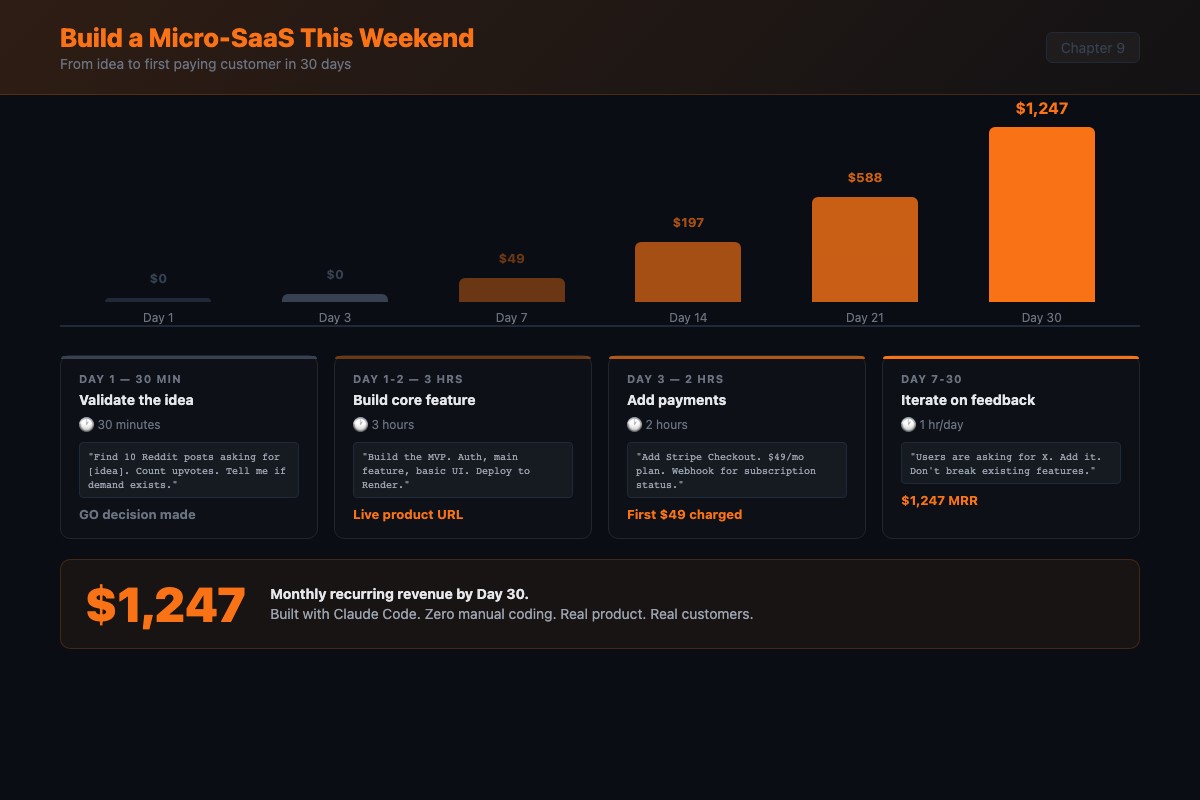
What broke during Stripe integration?
Stripe is the most complex part of the build. Three gotchas waste an hour each if you don’t know them.
Gotcha 1: Webhook signature verification. Claude sometimes skips this. Always include in your prompt: “Make sure the Stripe webhook verifies the signature using STRIPE_WEBHOOK_SECRET. Never process an unverified webhook event.”
Gotcha 2: The raw body problem. Stripe verification needs the raw request body, but Next.js parses it as JSON by default. If verification keeps failing, tell Claude: “Make sure the webhook route reads the raw request body for signature verification. Do NOT parse as JSON before verifying.”
There’s about a 50/50 chance Claude parses the body first and breaks verification if you don’t mention this upfront.
Gotcha 3: Test the full flow. The Stripe CLI lets you trigger webhook events locally with stripe trigger payment_intent.succeeded and forward them to your dev server with stripe listen --forward-to localhost:4242/webhook. Triggering one event often fires related events automatically, so test the full chain, not individual hooks.
Here’s the exact sequence:
# 8-step Stripe integration test
def test_stripe_flow():
    """Run these manually with Stripe test mode"""
    steps = [
        "1. Create test user through Clerk",
        "2. Verify paywall (can add invoices, can't send reminders)",
        "3. Subscribe with test card 4242 4242 4242 4242",
        "4. Verify webhook fires, user status changes to 'active'",
        "5. Verify user can now send reminders",
        "6. Cancel subscription in Stripe test dashboard",
        "7. Verify cancellation webhook fires, user loses access",
        "8. Test declining card (4000 0000 0000 0002)",
    ]
    # If all 8 pass, your payment system is solid
    return steps
If any step fails, fix it before moving on. Payment bugs cost real money and real reputation.
How do you deploy to production?
Configure for Railway deployment:
- Add a Dockerfile
- Set up a start script for production mode
- Document all required environment variables
- Add a /health endpoint
- Make sure Prisma migrations run on deploy
Deploy through Railway’s dashboard. Set environment variables there (Clerk keys, Stripe keys, Twilio keys, DATABASE_URL). Run migrations against production. Buy a domain. Railway provides free SSL.
Total first-month cost breakdown:
| Item | Cost |
|---|---|
| Claude Code API credits | $15-30 |
| Railway hosting | $5/month |
| Twilio phone number | $1/month |
| Twilio SMS (~100 messages) | $0.79/month |
| Clerk auth | Free (up to 10K users) |
| Stripe | 2.9% + $0.30 per transaction |
| Domain | $10-15/year |
| Total month 1 | Under $50 |
At scale: At 100 users, budget $15-25/month (managed database, more compute). At 1,000 users, budget $50-100/month plus CDN and monitoring. The $20/month estimate covers the first 50 users.
What does the revenue timeline actually look like?
The $4,200/month developer took four months to get there. Month one was $47.
Week 1 (launch): $0-50. Signups from your network. Most are free trial. A handful convert.
Month 1: $50-200. Organic growth from niche communities. You’re posting in relevant subreddits, answering questions, mentioning your tool where it fits. You’re fixing bugs real users find.
Month 2: $200-500. Word of mouth starts. Churn stabilizes. You might spend $50-100 on targeted ads.
Month 3: $500-1,500. Product is stable. Users recommend it.
Month 6: $1,500-5,000 for a well-positioned niche.
Success criteria by phase:
- Weekend build: core feature works, one paying test user, Stripe webhooks pass all 8 steps
- Month 1: 10+ signups, 3+ paying users, zero payment bugs in Sentry
- Month 3: positive unit economics (revenue > hosting + API costs), churn under 10%
The honest part: most Micro-SaaS products fail. Not because the code is bad. Because the founder gives up in month 2 when MRR is $87 and it feels pointless. The whole point of building in a weekend is that failure is cheap. A weekend and $30 in API credits. Make more guesses.
What should you actually do?
- If you have an idea but haven’t validated it: spend 30 minutes with the Reddit search + competition check. If the gap is real and the unit economics work, build this weekend.
- If you’ve built the core feature but stalled on payments: follow the Stripe integration prompts above. Watch for the raw body gotcha. Test all 8 steps before calling it done.
- If you launched but growth is flat: kill it if nobody signs up in the first month despite active marketing. Build a different product next weekend. Speed of iteration beats perfection of any single attempt.
bottom_line
- Validate in 30 minutes, not 30 days. Reddit pain points + competitor gaps + unit economics. If it doesn’t pass all three, don’t build it.
- The Stripe raw body parsing issue and webhook verification are the two bugs that waste the most time. Mention both upfront in your prompts.
- Failure costs $30 and a weekend. The Austin developer’s $4,200/month product was his third attempt. The first two died in month 2. Keep iterating.
Frequently Asked Questions
How much does it cost to build a Micro-SaaS with Claude Code?+
API credits run $15-30 for the full build. Add $5/month for Railway hosting, $1/month for a Twilio number, and $10-15/year for a domain. Your first paying customer covers it.
Do I need to know how to code to build a SaaS with Claude Code?+
You need to describe what you want clearly and review what Claude produces. You don't need to write code by hand. But you do need to understand the output well enough to spot when something is wrong, especially around payments and auth.
What's the most common reason weekend SaaS projects fail?+
The founder gives up in month 2 when MRR is $87. The builders who win keep showing up after launch dopamine fades. If nobody signs up in the first month despite active marketing, kill it and build again next weekend. Failure costs $30.