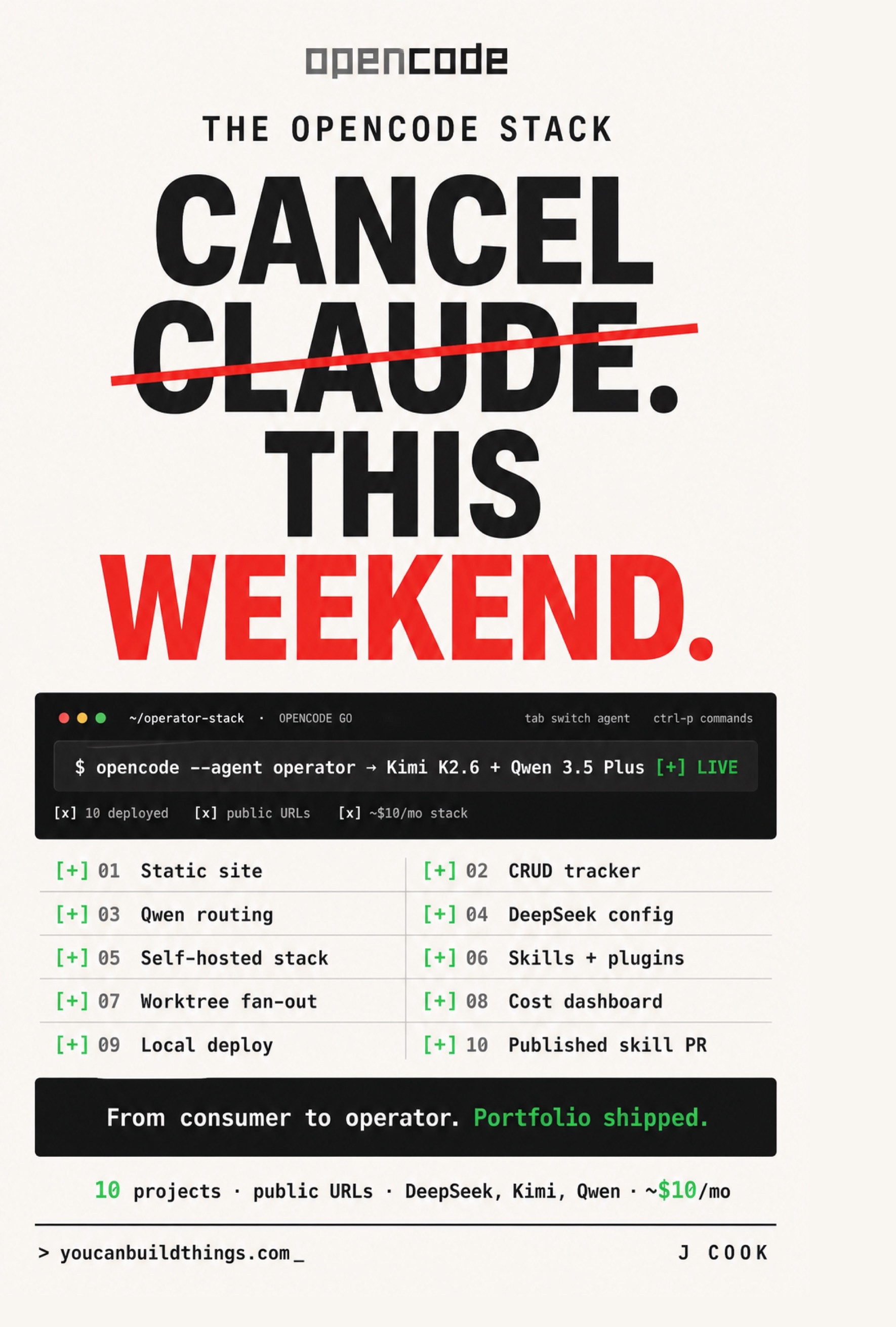
The opencode Stack
Cancel Claude This Weekend. Ship 10 Real Projects on $10/mo with DeepSeek, Kimi, and Qwen
You hit a Claude rate limit this morning. Then again at lunch. Then again at 3pm. The answer is not another vague AI coding workflow. It's the opencode Stack: opencode CLI, OpenCode Go, model routing, reusable skills, parallel worktrees, local model fallback, and a cost dashboard that keeps your build sessions under $1/day. By Friday night, opencode is installed and your first deployed project is live. By Sunday, you have a repeatable system for shipping projects without living inside Claude Max. Ten deployed projects. Ten dollars a month. One weekend.
This is for Claude Code users who are tired of rate limits, surprise token bills, and paying premium prices just to wait. You do not need another subscription. You need a stack: install, route, self-host, and ship 10 deployed projects by Sunday night.
What You'll Build
Three exit ramps from Claude Max and why opencode is the most cost-flexible of them. The $500/mo → $80/mo case study.
OpenCode the SST product vs "open-source code generally": the distinction that decides where your wallet goes.
The 4-5 components inside the harness and why a +13% quality lift came from the harness, not the model.
macOS / Linux / Windows install. OpenCode Go signup. First deployed static site at a public URL.
What OpenCode Go actually includes (Kimi K2.6, Qwen 3.5/3.6, DeepSeek V4) and a 7-day cost log proving the $10 claim.
K2.6 as orchestrator, Qwen 3.5 as fixer. Two routing configs with an A/B comparison log of cost, quality, speed.
Ollama or vLLM, DeepSeek V4 Flash or Qwen 3.6, opencode running against localhost, zero outbound API tokens.
Five skills that pay back this week. The 6-worktree fan-out where six cheap parallel attempts beats one expensive sequential run.
Token economics, where tokens leak, and a real-time dashboard that alerts when daily spend crosses $1.
Full-stack app with auth/DB/Stripe. Plus your own published opencode skill. The 10-project portfolio with public URLs and cost log.
Five failure modes: quantization regressions, /compact timeouts, context-fill quality decay, zod plugin boundary, install gotchas. Detection, fix, prevention.
Communities, GitHub watch-list, provider watchlist, and a 30-day calendar with one specific opencode action per day.
Free Articles from this Book
Install OpenCode and Ship in 10 Minutes
How to install OpenCode the right way, connect a provider, and ship a deployed public URL in ten minutes. Six steps, the three install gotchas, real token cost.
from: The opencode Stack
OpenCode Not Working? The 5 Failure Modes
OpenCode not working? The 5 documented failure modes with detection, cause, one-line fix, and prevention. Plus the weekly health-check script that catches them.
from: The opencode Stack
OpenCode Orchestrator + Fixer Routing, Wired
The opencode orchestrator fixer pattern: two models, two slots, one opencode.json. Three task-class routing recipes and an A/B receipt that cuts the bill 10x.
from: The opencode Stack
Self-Host OpenCode With Zero Outbound Tokens
How to self-host OpenCode with a local model and prove zero outbound API tokens with tcpdump. Hardware tiers, the provider config, and the silence receipt.
from: The opencode Stack
Keep OpenCode Under $1 a Day: Cost Dashboard
Build OpenCode token cost tracking that alerts at the $1/day line. The SQLite schema, the parser, the run-rate readout, and the four levers that cut spend.
from: The opencode Stack