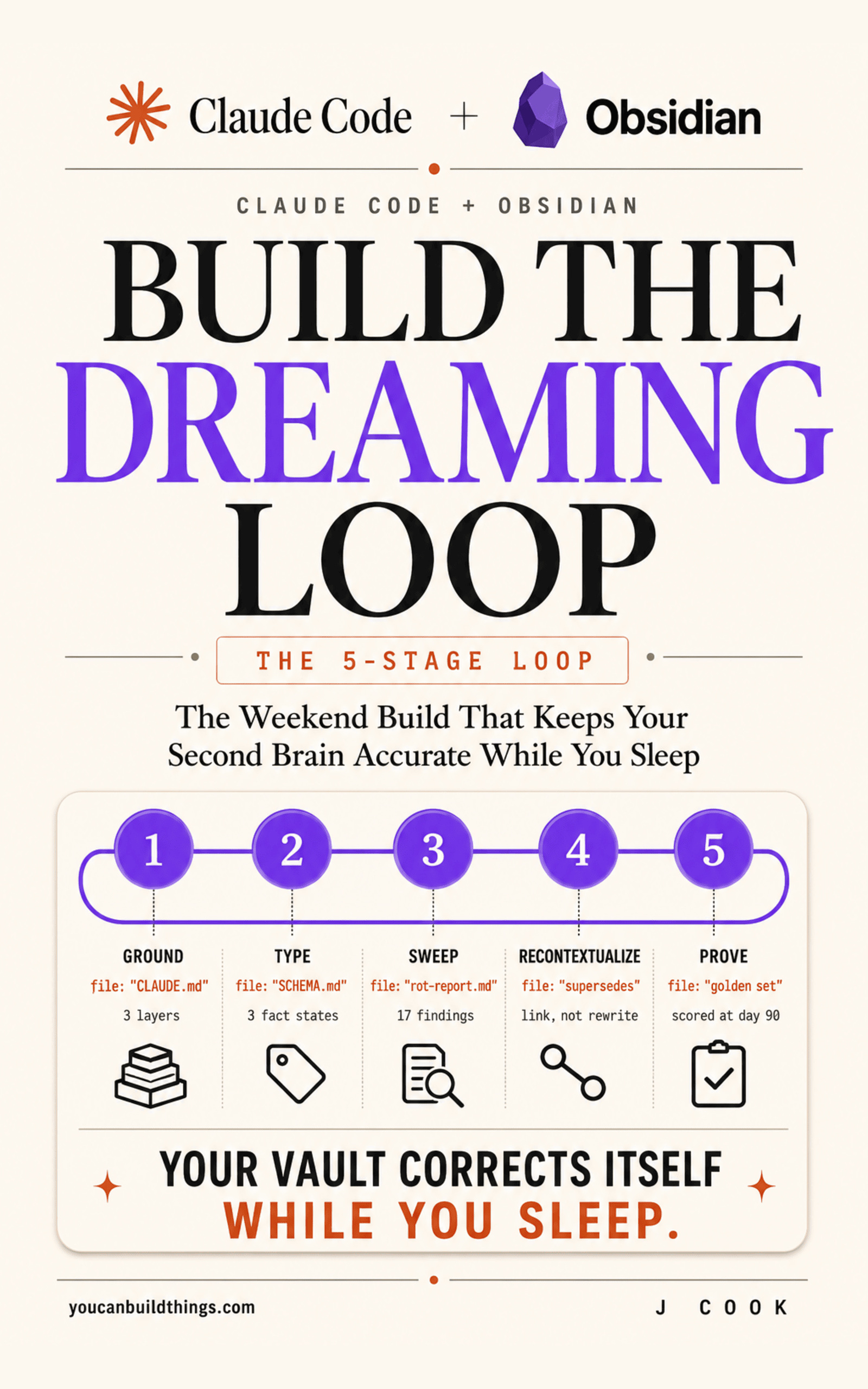
Obsidian + Claude Code Build the Dreaming Loop
Keep Your Second Brain Accurate While You Sleep
You open Claude Code, it reads your vault, and it answers with a fact that stopped being true in March. Nothing errors, nothing turns red, and the answers keep arriving in the same confident tone whether they are true or four months dead. This book gives you the loop that catches it. Saturday you build the constitution and the fact schema. Sunday your first rot report names the pages your vault is already wrong about. By next weekend the loop runs unattended and sweeps your busiest pages first. By day ninety a regression suite turns "is mine correct?" into a number you can defend.
Three people asked a stranger on Reddit to publish this protocol and nobody ever did. This is it, written out.
Seven of the eleven direct competitors on Amazon carry two customer ratings between them. One runs 563 pages and never names a single chapter. One is 64 pages. None of them schedules a single job. None ships a rot report that names the pages already wrong. None gives you a way to check any of it ninety days later.
Every artifact ships in a free companion repository: the constitution, the schema, the sweep, the hooks and the scheduled loop, at the paths the book uses, plus one dry-run command that shows what it would change in the vault you already have before it changes anything.
What You'll Build
See why a vault fails silently, and why the failure mode is a confident answer rather than an error.
Split sources/ from pages/, write the CLAUDE.md constitution the agent cannot write past, and install the deny rules that enforce it.
Write pages/SCHEMA.md: five properties per page, fixed types vault-wide, and three fact states the gate checks writes against.
Write SWEEP.md and produce rot-report.md, naming the stale and contradicted pages in your vault tonight with evidence per finding.
Build the staging area and the review gate in about forty lines: the agent proposes, you approve, nothing lands unreviewed.
Have the agent build INDEX.md, add the retrieval rule, and measure your own drop in session context.
Ship the vault-dream scheduled task so the sweep runs unattended, supersedes rather than overwrites, and reports whether it worked.
Build a twenty-question golden set with superseded traps and should-fails, then score every arm on recall at a fixed k.
Turn your own install into a sequence somebody else can run, then write the one-page client scope with your numbers in it.
Collect the four numbers you already have, price a run, and decide the cadence from the cost instead of a guess.
Write the restore list, then run the drill, because a runbook you have not executed is a wish.
Write OPERATING.md, the calendar that lives in the vault, and re-run the golden set to prove the second brain still answers accurately.
Free Articles from this Book
How to Charge Monthly for an Obsidian Vault You Set Up Once
The install is two hours and a free video gives it away, so the install is not the business. Here is the one-page scope that makes a monthly fee renew, and the audit you sell first so you can quote the engagement instead of guessing it.
from: Obsidian + Claude Code Build the Dreaming Loop
How to Stop Claude Code From Editing Your Important Files
Point an agent at a directory you cannot replace and know, because you watched a tool call get blocked, that it cannot touch the part that matters. A path rule written against Write is accepted at startup and ignored forever, and the fix is one word plus a hook that exits 2.
from: Obsidian + Claude Code Build the Dreaming Loop
Did Your Claude Code Agent Actually Do Anything Last Night?
Put real work on a schedule and wake up genuinely knowing what happened, because the job greps its own exit signal and tells you. Eleven consecutive green runs, and every one was four seconds of a job that could not find its input file.
from: Obsidian + Claude Code Build the Dreaming Loop
Which of Your Obsidian Notes Is Claude Getting Wrong?
Run one read-only pass and you can hand somebody a dated document naming the pages your vault is already wrong about. Seventeen findings across two hundred and fourteen pages, each one citing the two files that disagree and the typed field they disagree on.
from: Obsidian + Claude Code Build the Dreaming Loop
Why Claude Still Answers From the Obsidian Note You Replaced
Twenty questions from your own history end an argument four credible people could not, because it is the only evidence in the room about your data. The arm that wins on raw recall is also the one that hands back the fact you retired.
from: Obsidian + Claude Code Build the Dreaming Loop