How to Charge Monthly for an Obsidian Vault You Set Up Once
The install is two hours and a free video gives it away, so the install is not the business. Here is the one-page scope that makes a monthly fee renew, and the audit you sell first so you can quote the engagement instead of guessing it.
>This covers the scope and the audit-first sale. Obsidian + Claude Code goes deeper on deriving the setup fee from your own retrofit rate, the three ways a first engagement goes bad, and the cost model behind the retainer line.

Obsidian + Claude Code Build the Dreaming Loop
Keep Your Second Brain Accurate While You Sleep
Hello builders,
An afternoon’s install that anybody can undercut turns into a fee that renews the moment you can name what arrives every month, which is the difference between selling a setup and running a practice. Here is the whole install, as a free video gives it away: “You just install obsidian and run that prompt.” That is not wrong, and it is why an AI knowledge base retainer has to be sold on the sentence that is never in the video, which is who fixes this in month six.
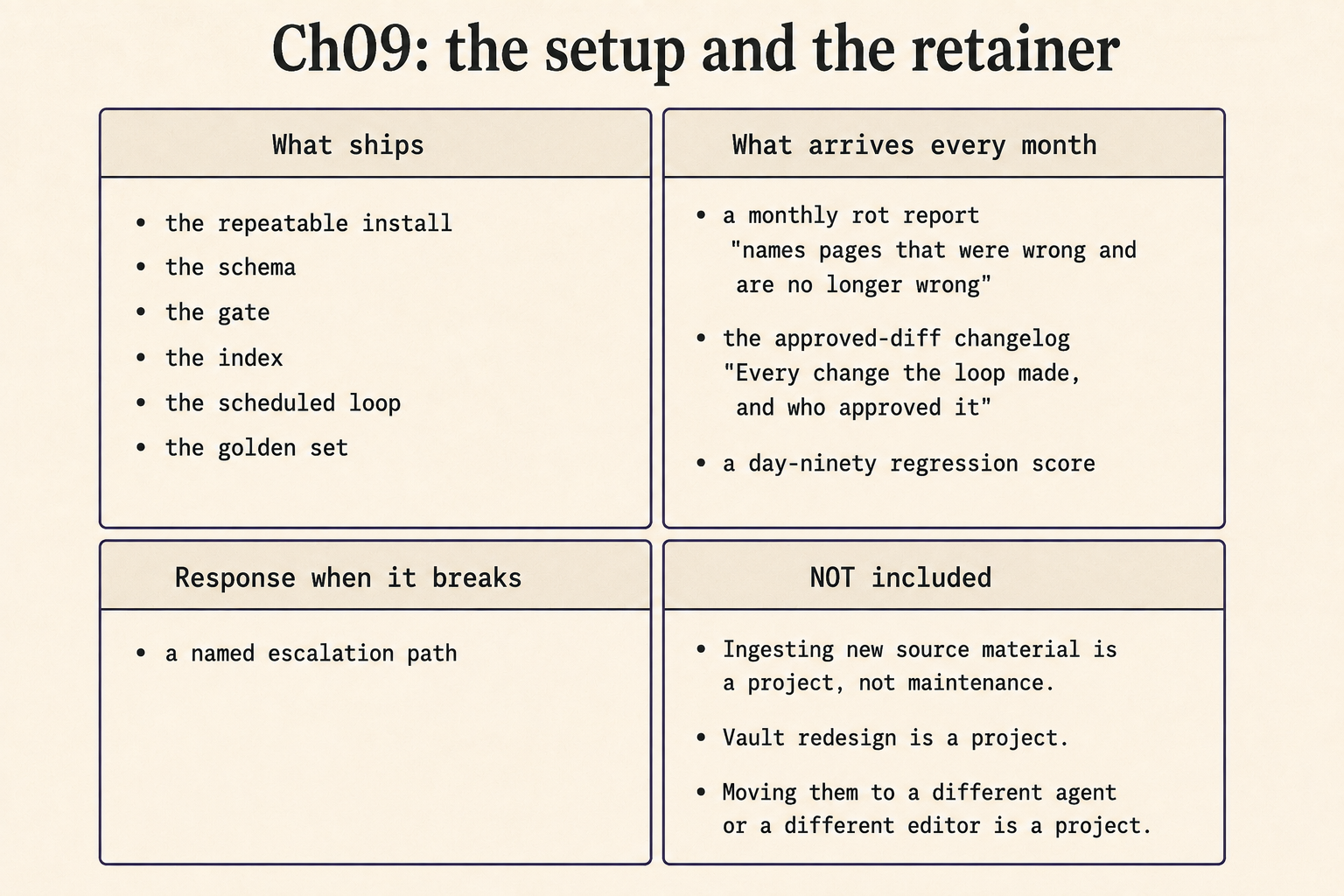
Write the scope as outputs
The one-time half of that scope is six things, and none of them is the reason a client keeps paying: the repeatable install, the schema, the gate, the index, the scheduled loop and the golden set. They ship once, they take a weekend, and a competitor can undercut every one of them.
“Ongoing maintenance” is unbillable because it is invisible. Three artifacts arriving on a schedule is a thing somebody renews, so that is what I put on the page.
A monthly rot report. A dated file with findings by class and confidence, and what was corrected. This is the one that makes our value visible, because it names pages that were wrong and are no longer wrong.
The approved-diff changelog. Every change the loop made, and who approved it. This answers the question a client asks first and asks nervously, and we hand them the answer every month without being asked for it.
A day-ninety regression score. Recall against their own golden question set, this month against last month, with the failures named. Almost nobody in this market can produce that, and it is the strongest renewal argument we will ever have, because it is the difference between “trust me, it is working” and a number that moved.
Underneath those goes a named escalation path: what happens when the loop breaks, how fast we respond, and what we actually do about it. I keep mine to three lines.
The panel that protects the fee
Now the panel everybody leaves off, drawn on my scope at the same size as the deliverables, which is deliberate. I write down what is not included, in these words:
- Ingesting new source material is a project, not maintenance
- Vault redesign is a project
- Moving them to a different agent or a different editor is a project
Each one gets quoted separately. An unbounded retainer is how this business dies, and all three of those requests reach us in month two wearing the costume of a small favour.
What the free tool actually does
Your client will ask this in the first meeting, so we should have the answer ready. A naming correction first, because saying the old name dates us: the product is now Gemini Notebook, and Google’s help centre redirects the old address to the new one.
Its free tier is generous. The comparison table on Google’s upgrade page gives Standard users 50 sources per notebook, 50 chats a day and 100 notebooks, and the sources page adds 500,000 words or 200MB per uploaded file. Worth knowing that those countable figures now live only on the upgrade page: the usage-limits page has moved to compute-based quotas that “factor the complexity of your prompt, the models and features you use,” refreshing every five hours against a weekly ceiling.
And then the sentence that decides the whole conversation, from Google’s own sources article:
Gemini Notebook can’t delete or edit your original files in Drive.
It is a reader. What we build maintains a corpus the client owns: thousands of files, not fifty, edited and superseded and version-controlled under git, readable by every tool that can open a directory. If a client’s actual need is “let me ask questions about these forty documents,” sell them nothing and point them at the free thing. You will get the next job.
Sell the audit before you quote
Everything above assumes we can estimate retrofit hours, and on a first engagement we cannot, because the two things that decide the fee are the two things a client describes inaccurately: how many pages there are, and what state they are in. Every client says their vault is a mess. Roughly half are wrong in each direction.
So do not quote the engagement. Quote the audit.
Sell a dated rot report on their vault as a fixed-price first step. It takes an afternoon, it needs nothing from them but read access, and it buys us four things we cannot get any other way: their real page count, their findings-by-class breakdown, a measured retrofit rate on their own material, and a document naming pages they believed were correct.
That last one is the entire sales conversation, and you do not have to make an argument. Say in writing that the audit credits in full against the setup fee if they proceed. If they take the report and walk, you were an afternoon wrong instead of thirty hours wrong.
Then the fee comes off our own stopwatch. I time my schema migration per page, multiply by their page count, and add a third, because somebody else’s vault is always messier than my own. Mine ran a shade under four minutes a page once the contract existed, so a four-hundred-page client vault is a bit over twenty-six hours of retrofit before anything else is touched. That number tells you whether a quote is generous or insulting, and no tweet can.
Nobody renews a retainer for maintenance. They renew for a number that says last month’s vault was more accurate than the month before.
Now go build something this weekend!
John Cook