How to Know If Outsourcing Claude Design Work Pays
Know in one number whether handing a Claude Design stage to a freelancer pays you or quietly costs you double. Here are the three gates it has to clear, the term everybody leaves out of the sum, and the two stages that never leave your hands.
>This is the bench chapter cut short. The Claude Design Studio writes the playbook it sits in, and is honest that most weeks you keep it in a drawer.
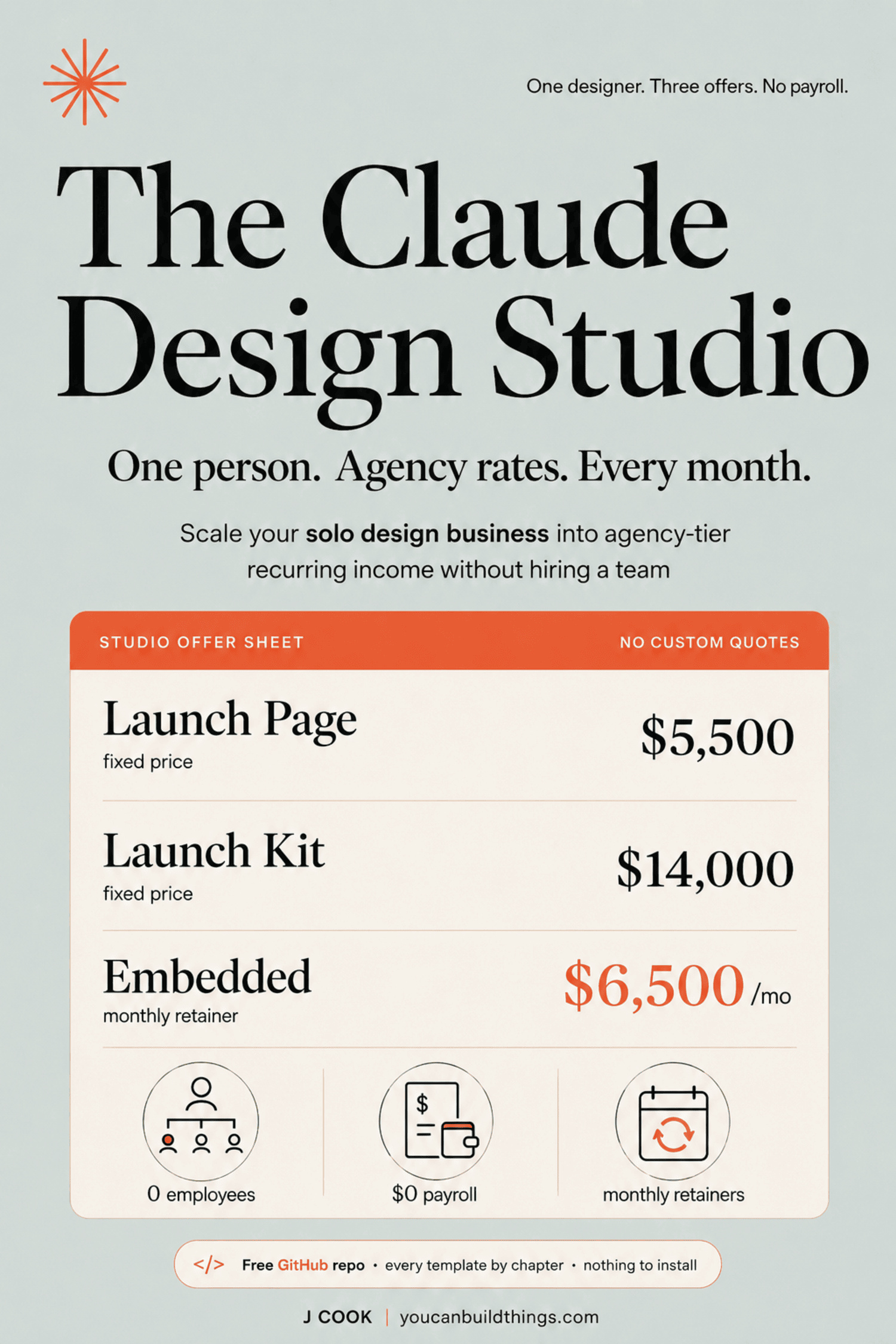
The Claude Design Studio
Scale Your Solo Design Business Into Agency-Tier Recurring Income Without Hiring a Team
Hello builders,
By the end of this you will know, in one number, whether a stage of your delivery pays when somebody else does it. Every answer to when to outsource design work that currently ranks is a soft signal published by a company that wants the work, so today we replace all of it with a test that returns yes or no.
First, why your last attempt did not work, and it was not the rate. Every designer who tries this runs the same arithmetic we all ran. I charge $5,500 for the page, a freelancer will produce it for $1,500, so that is $4,000 of margin for doing nothing. Then they try it, it does not work, and they conclude that good freelancers do not exist.
The arithmetic was wrong. It was missing two terms, and a designer on Reddit named both of them in one sentence while describing why they will not outsource: “review their work, often fix their work.”
Both of those are line items, and both are missing from every naive outsourcing calculation ever done.
The sum everybody gets wrong
The real cost of moving a stage off your desk has three terms rather than one, and we are going to write all three down:
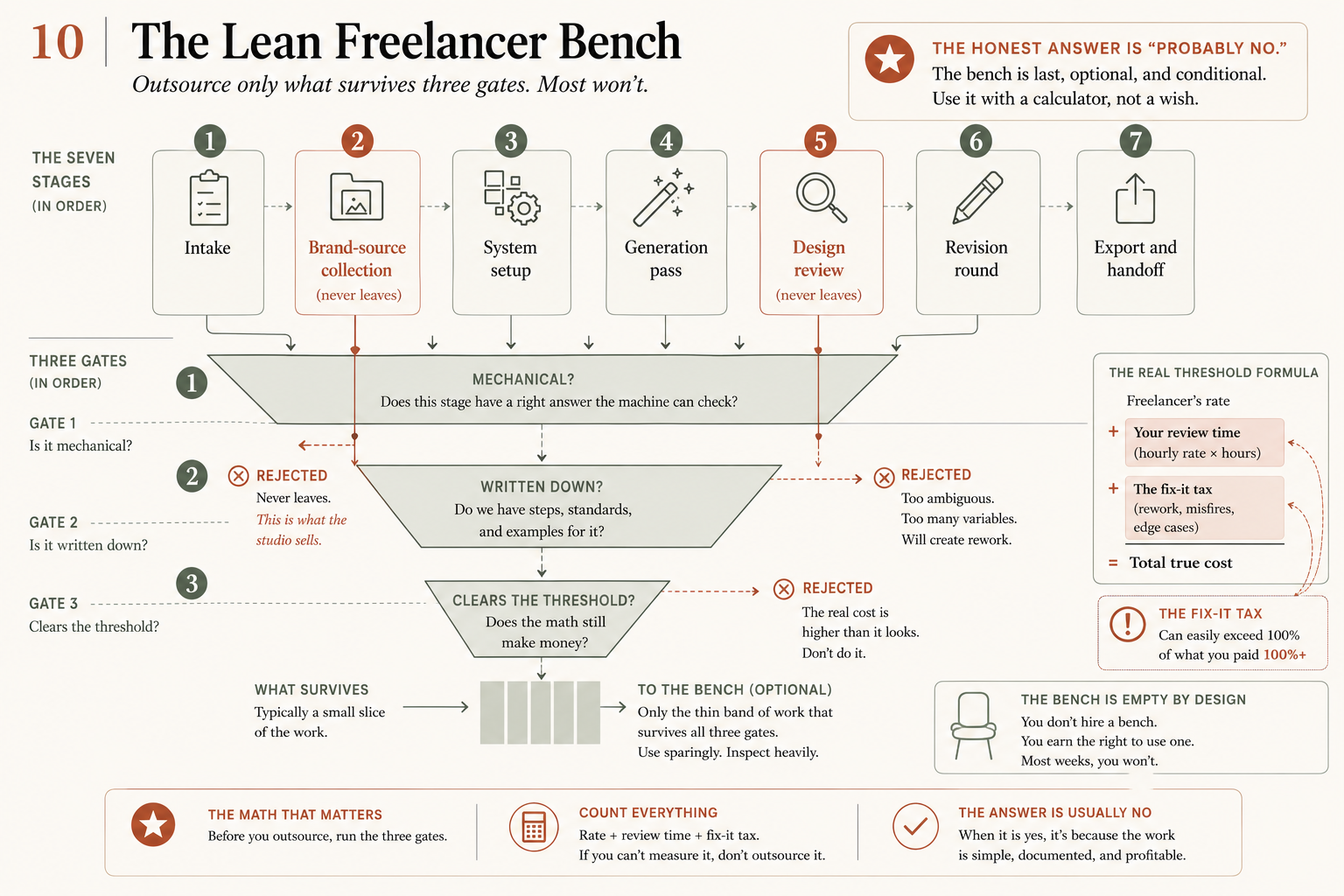
Cost to delegate a stage = the freelancer’s rate + your review time, priced at your own hourly rate + the fix-it tax
The third term is the one that ruins people, and it is nonlinear. Fixing somebody else’s work is often slower than doing it yourself, because first you have to understand what they did, then decide what is wrong with it, then undo it, and you are doing all of that inside a decision framework you never wrote down. It can easily exceed 100% of what you paid them.
Every term of that sum points back at whether the stage is written down. A stage with a real exit condition gets checked in seconds. A stage without one has to be judged, and judging is the expensive thing. Outsourcing an unwritten process is just hoping with an invoice attached.
Three gates, in order
Take one stage off your delivery line and we walk it through these. All three, in this order, and a miss at any of them means the stage stays yours.
- Gate 1, is it mechanical? Does this stage have a right answer somebody else can check? If not it is rejected here, and the rejection note is the whole business: never leaves, this is what the studio sells.
- Gate 2, is it written down? Do steps, standards and examples for it exist on paper today? If not it is rejected as too ambiguous, too many variables, and it will create rework.
- Gate 3, does it clear the threshold? Run the three-term sum against that stage’s share of the tier price. The share is yours to estimate: take the fixed price of the offer, split it across the seven stages by how much of the job each one honestly is, and use that stage’s slice. If the real cost comes in higher, do not do it.
Two stages never reach gate 1 at any volume and for any rate. Brand-source collection is where the client’s system gets decided, and it takes ten minutes of your own attention. Design review is the product. Those two are what we sell, so they cannot be the things we buy.
Which leaves the mechanical middle, and here is the uncomfortable part: if you have already tagged that middle to the machine, what is left for a human freelancer is the narrow band that is too judgment-heavy for the machine and not judgment-heavy enough for you. That band is real. It is just thin, which is exactly why the panel on that figure says the bench is empty by design.
The gate is a process, not a permission
Now the thing we were all quietly assuming, which is that you will set permissions, lock the client’s design system so a freelancer cannot break it, and check the log afterwards.
Two of those three are not available to you. From the admin guide:
“The Claude Design Admin permission is available on the Enterprise plan through custom roles.” … “By default, any member with access to Claude Design can publish a design system, set the organization default, and delete design systems.”
So on the plan a lean studio actually runs, you cannot lock a client’s design system against your own freelancer. They can overwrite it, and nothing stops them. Same page, on logging:
“Claude Design doesn’t support audit logs yet.”
There is analytics, and it is worth knowing exactly what we get from it: the admin guide points you at Analytics > Claude Design for “daily, weekly, and monthly active users for your organization.” Active users, not consumption. So any per-freelancer cost in your threshold is an estimate rather than a measurement, and you should know your model has a soft number in it rather than discover that later. One more, from the known limitations: “Two or more people editing a design project at the same time is still basic and may not work reliably.”
Sources: Claude Design admin guide and Get started with Claude Design.
Take those together and the conclusion is unavoidable. The platform will not enforce our quality gate, so you will, and the gate is one sentence: nothing reaches the client without passing your review against the scope document. That reviewer is you, permanently, because that gate is the design review stage and the design review stage is the product.
Run the threshold honestly on one stage this week, with the fix-it tax at a real number rather than the number we all want it to be. Most readers find that at their current volume, nothing clears. That is not the test failing. That is the test working, and a studio with an empty bench and a full queue was always the point.
Now go build something this weekend!
John Cook