How 4 Claude Design Retainers Replace Your Whole Year
Four Claude Design retainers at $6,500 a month is a $300,000-a-year studio run by one person with nobody on payroll. Here is the four-row model, the two numbers you write on a sticky note, and why two clients already clear the ceiling your own hands built.
>This is the retainer chapter cut short. The Claude Design Studio builds the offer it converts from, prices it, and shows you what breaks when it wobbles.
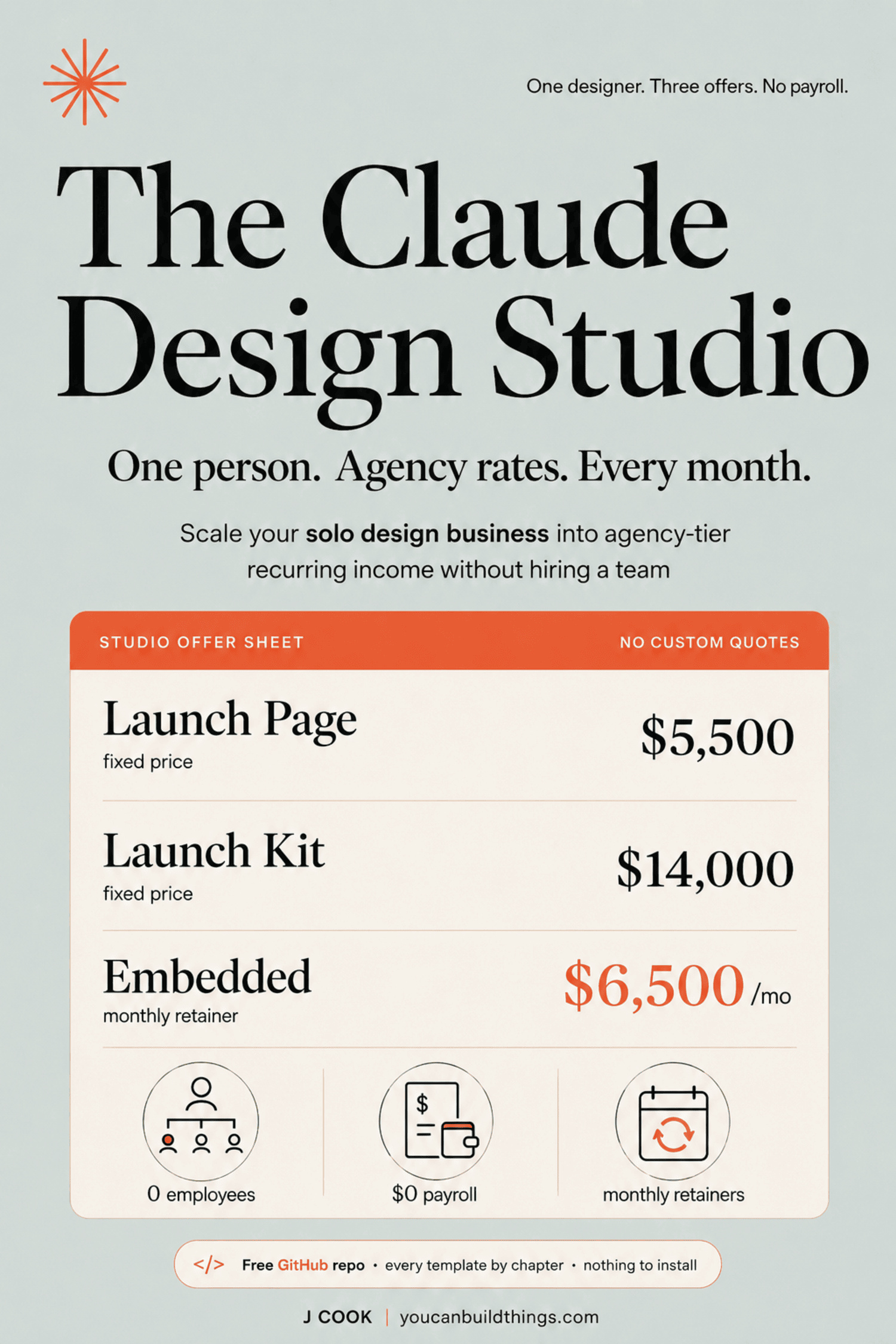
The Claude Design Studio
Scale Your Solo Design Business Into Agency-Tier Recurring Income Without Hiring a Team
Hello builders,
Four clients on a standing arrangement at $6,500 a month is a $300,000-a-year studio run by one person with nobody on payroll. Design retainer pricing is not your hourly rate with a discount stapled to it. It is a change of shape, and the model that gets you there is four rows in a spreadsheet.
Start with the shape, because that’s the part nobody names. Your best month last year was probably double your worst month, and you couldn’t tell me why in a way that would let you cause it again. Something landed, or two things landed at once. The good month felt like competence and the bad month felt like failure, and both of them were weather.
Project income spikes and returns to zero. Every month your revenue starts at nothing and you rebuild it from nothing, so a great March buys you exactly no April. The client who paid you $14,000 and loved the work owes you nothing next month and, worse, has no mechanism to give you more even if they want to. They’d have to start a new conversation, get a new quote, get new approval. So they don’t.
Retainer income stacks instead. Month two starts wherever month one ended, and client three does not replace client two, it adds to it. The line goes up not because you are working more but because nothing resets.
Which is why your ceiling was never really a price problem. You’ve been trying to fix it by charging more, and charging more is real and it helps, but if the number returns to zero every month you’re still re-earning your whole income from scratch on a treadmill that got slightly faster. You cannot out-price a shape.
Convert the tier you own
The good news is that you’ve already built this thing. It’s the top rung of your offer sheet, and what we do to it is almost boring:
- same lane, same buyer, same deliverable envelope, because we are not inventing a product
- same name it has had since you wrote the sheet
- priced monthly rather than per project, $6,500 in this example
- one active request at a time, plus a standing slot each week
- pause or cancel anytime, stated on the page as a feature
That last line will make you flinch, so we deal with it now. Your instinct says a cancel-anytime subscription is a subscription that gets cancelled, and that real businesses lock people in with annual contracts and notice periods.
Think about the buyer instead. Signing a twelve-month design contract needs a real approval and a meeting with somebody above them. Starting a month-to-month thing they can pause is barely a decision at all. Remove the lock and we remove the deliberation, which is the thing standing between you and the sale.
Pause is doing separate work from cancel, which is why both words belong on the card. A client whose budget freezes has two options: leave permanently, or go dormant with their Claude Design system still sitting in your organization. Without pause, every temporary problem becomes a permanent loss.
The math is four rows
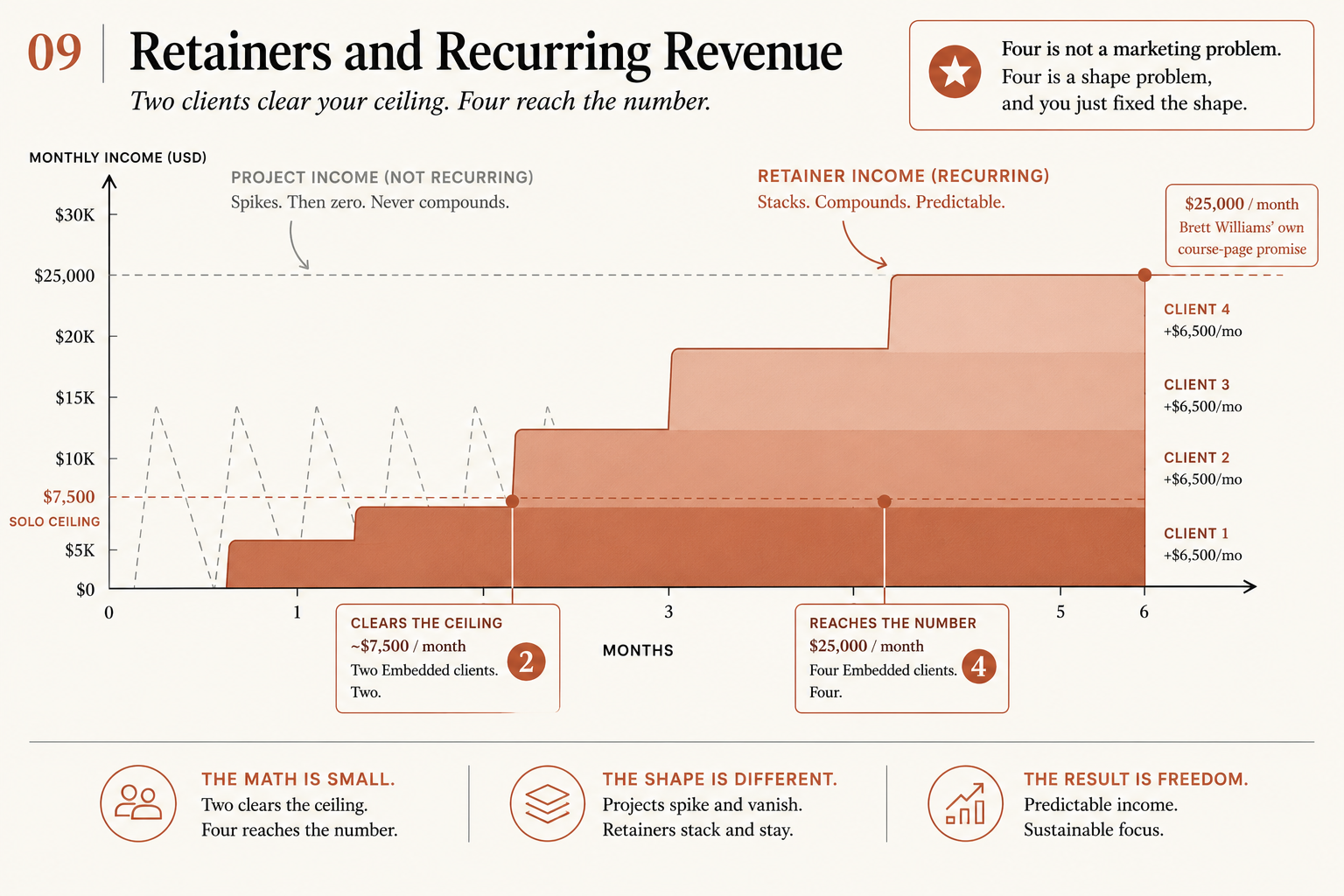
Here’s the whole model we build, and it’s embarrassingly simple, which is exactly why you should build it:
- retainer price: your number
- clients: start at 1
- monthly plan cost: your number
- metered credits: measured on a real job, not guessed
- baseline: (price × clients) minus costs
Then we do the one thing that makes it worth building. Change the client count from 1 to 6, watch the baseline move, and write down the two rows that matter.
The first is the row that passes your ceiling. You know your number: it’s the one your income hits and doesn’t pass without you working more, and for a competent solo designer selling projects it lands somewhere around $7,500 a month. Not because that’s a law, but because that’s what your hands hold when your hands are the factory. At $6,500 a month, two clients clear it.
The second is the row that reaches $25,000 a month. That figure isn’t mine and I keep attributing it on purpose: it’s the headline on Brett Williams’ own course page, sold to a designer sitting exactly where you are. At $6,500 a month, four clients reach it.
Four. Not forty. If your model says thirty, your price is wrong and you have a job rather than a studio.
Put a real cost row in it
The costs row is the one people leave blank, and leaving it blank is how we end up with a business that feels fast and doesn’t make money.
Your delivery cost has a documented shape, so let’s go read it. Past your plan’s included limits you move onto usage credits, and the Claude Help Center states the terms plainly:
“Your subsequent usage will be billed at standard API pricing rates.” … “You’ll then need to prepay to cover usage beyond your plan limits.” … “Click ‘Adjust limit’ to control costs with a monthly spend limit. You can also select ‘Set to unlimited’ if you prefer no spending restrictions.” … “There is a daily redemption limit of $2000.”
Source: Manage usage credits for paid Claude plans. Read that as an owner rather than a user. Nobody hands us a ceiling: auto-reload is off unless you switch it on, the monthly limit is one you impose, and the only hard figure is that daily cap. A person costs you a floor you cannot lower in a bad month. Compute costs you a ceiling you choose.
So fill the row on your next real job rather than guessing at it. Note what your plan costs, note where your usage sits before you start, do the work, note where it sits after. That difference plus the apportioned plan is your cost of goods for that deliverable, it takes fifteen minutes once, and you never have to guess again.
One last thing, because it will cost you a client. Some month a retainer client will pay the invoice and send nothing, and it’ll feel like the best month of your life. It’s a cancellation with a delay on it. A client with a full queue can see what they’re getting, and a client with an empty queue can only see the invoice. Go find the work and put it in their queue yourself.
Now go build something this weekend!
John Cook