How 1 Designer Delivers Like 5 With Claude Design
One designer can hold a studio's worth of delivery when only two stages of the work still route through them. Here are the seven stages of a Claude Design deliverable, the five that go to the machine, and the ten-minute one you never hand over.
>This is the production map chapter cut short. The Claude Design Studio builds the SOP it is drawn on, prices what it delivers, and runs the outsourcing math on what is left.
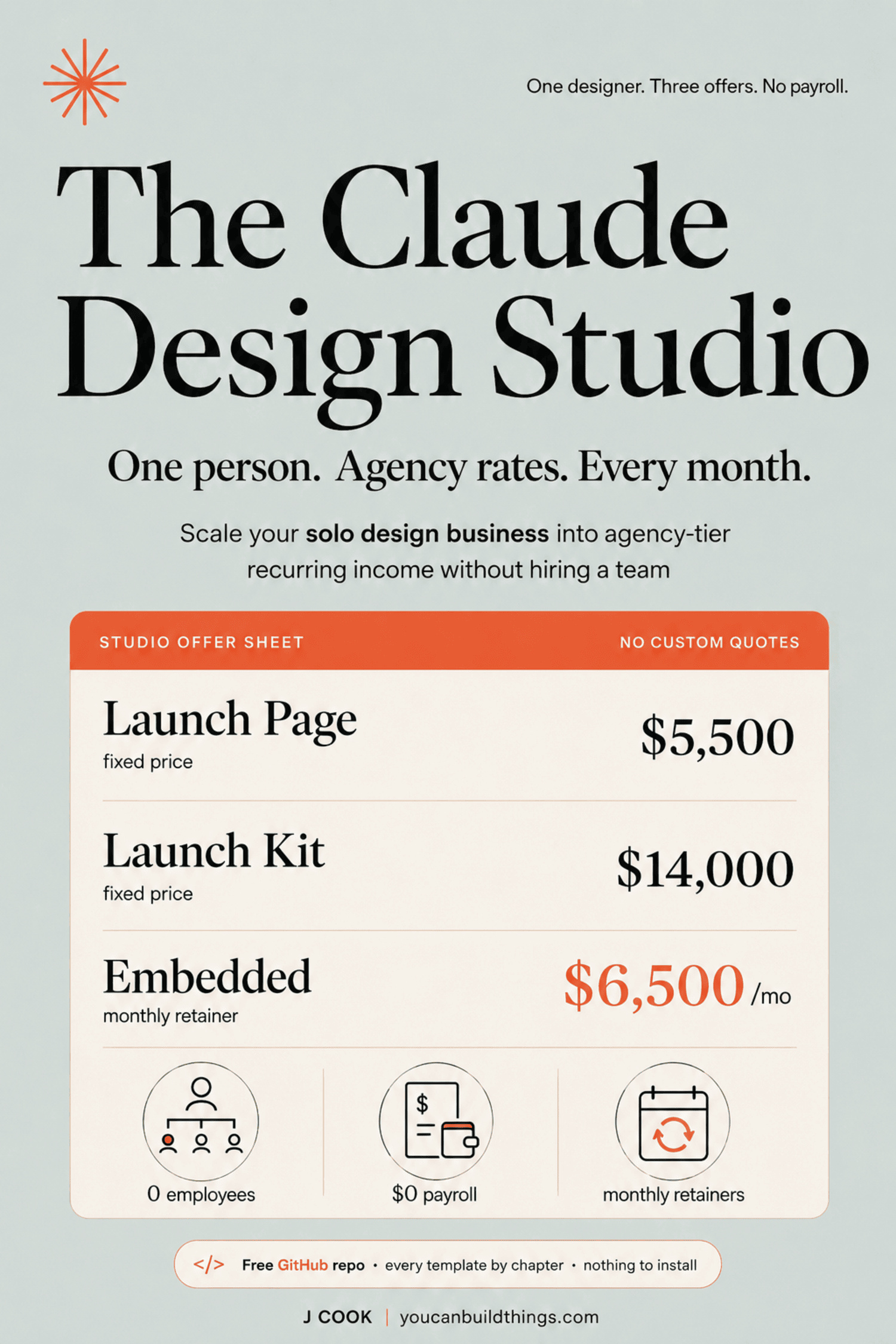
The Claude Design Studio
Scale Your Solo Design Business Into Agency-Tier Recurring Income Without Hiring a Team
Hello builders,
Two stages of your own attention is all a studio’s worth of delivery actually needs. Almost every one person design agency post you have ever read is a profile of somebody’s revenue, and not one of them tells you which parts of the week stopped being theirs. Today we cut a single deliverable into its seven real stages and then we give five of them away.
We start with the hostile witness, because he deserves the floor first. A real agency owner, with clients and payroll and a reputation, picked up the tooling, used it on live work, and reported in public that he “became less satisfied with its design output.” He is a practitioner with money on the line, reporting a result, and if you have spent any time with these tools you have had his afternoon.
He was right. The reason he was right is a decision he made ten minutes before he ever saw the output, and it is fixable.
Two piles, and only one moves
Go get the delivery process for your smallest offer and cut it into named stages, then read them again and notice that they’re not the same kind of work at all.
Pile one is mechanics. Collecting the assets, setting up the system, producing the first pass, assembling the deck, exporting the files. This work has a right answer, it doesn’t need your taste, and it is most of your week. It’s also, and this is the part that stings, most of what you’ve been charging for by the hour.
Pile two is taste. Looking at what exists and knowing it’s wrong, and knowing why it’s wrong. Knowing that the hero section is technically correct and still says template, that the type is fine but the hierarchy is lying about what matters, that this one looks like a company that raised money and that one looks like a company that will close money.
Only pile one is assignable, and that is the whole thing, because everything after it is detail.
Delivering like five people has never meant a machine does the designing. What happens is that the mechanics stop eating your week, so the taste, which was always the product, finally gets the week instead.
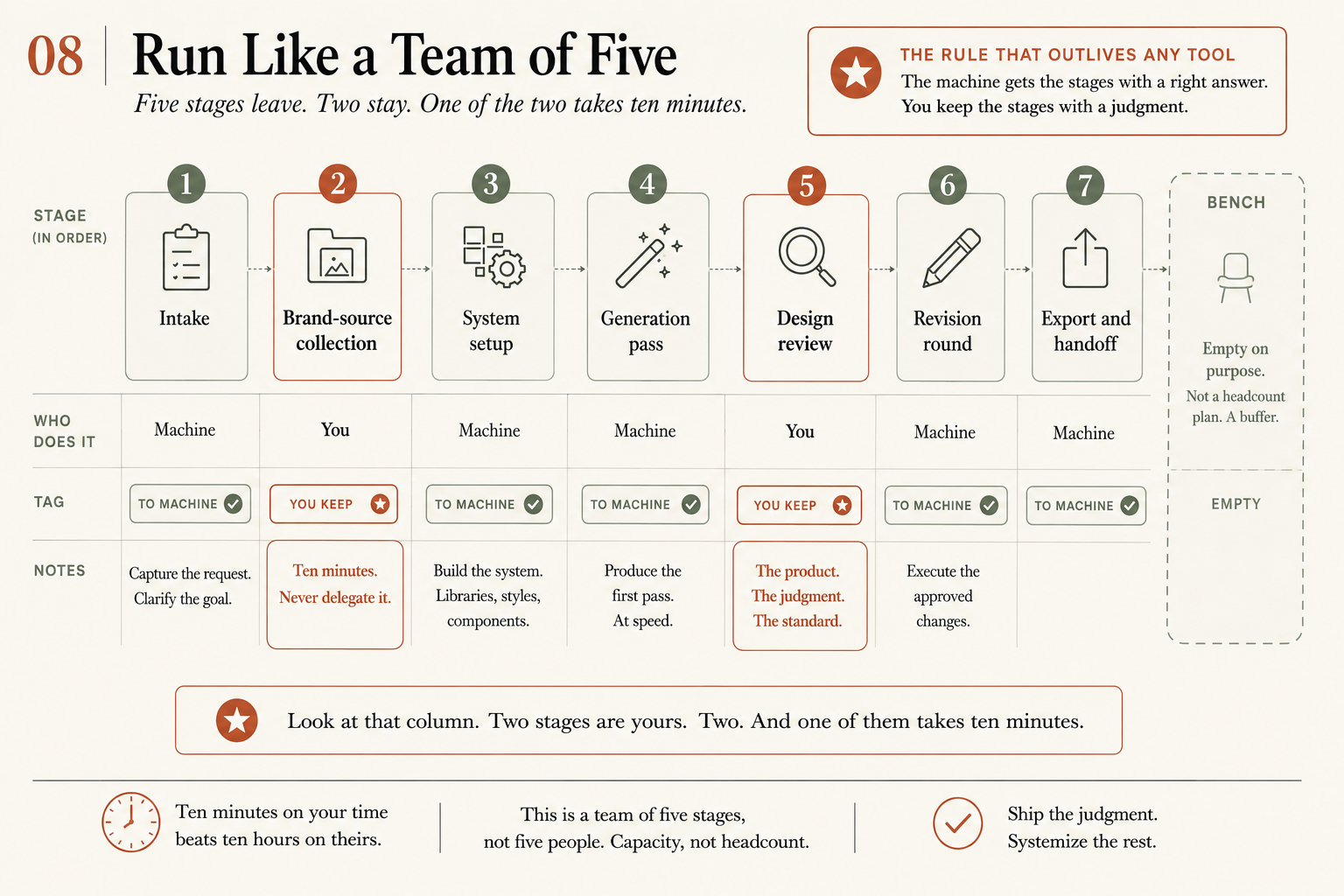
Tag every stage machine or you
Here is the line we tag, for a one-page marketing site built on Claude Design, and the rule is the boxed one: the machine gets the stages with a right answer, you keep the stages with a judgment.
- 1. Intake, to the machine: it is a form, and it should already have been a form
- 2. Brand-source collection, stays with you: ten minutes, never delegate it
- 3. System setup, to the machine: configuration, once the source exists
- 4. Generation pass, to the machine: the part everybody thinks is the whole job
- 5. Design review, stays with you: the product, the judgment, the standard
- 6. Revision round, to the machine, directed by you: your call, its hands
- 7. Export and handoff, to the machine: a file operation
Look at that column. Two stages are yours. Two, and one of them takes ten minutes.
Note the column on that map marked bench, and note that we leave it empty on purpose, because this is a team of five stages rather than five people. Capacity, not headcount.
Why his output came out generic
Now back to the agency owner, because his diagnosis is also the reason we never let stage 2 leave your hands.
He opened the tool and asked for design. The tool had no source, so it gave him the average of everything, which is exactly what it should do when you have told it nothing, and the average of all design is the most generic artifact there is. He read that as the ceiling of the tool, when it was the ceiling of the input.
The vendor documents this behavior plainly, in the known limitations:
“Design system import is only as good as its source. A messy codebase or an incomplete file will show up in the output.”
Source: Get started with Claude Design. And the bar for a good source is far lower than the internet has told you. The setup guide lists what it accepts as at least one of a codebase with your design system, a slide deck or document that reflects your visual identity, or brand guideline assets such as logos, colour palettes and typography specs, then says it outright:
“You only need one source to get started, but providing multiple gives Claude more to work with.”
Source: Set up your design system in Claude Design. One deck. One logo and a short written note on tone and how the interface should feel. Every client you will ever pitch can clear that bar on the afternoon they sign, which is why stage 2 takes ten minutes instead of a two-week brand immersion.
So slop is not what the machine produces. Slop is what the machine produces when nobody decided anything, and every generic output you have ever received was a mirror.
Which is also your moat, and it is why we treat the tagging rule as a business decision. If output quality were a property of the tool then everyone with the tool would get your quality and you’d have nothing to sell. The moment you tag stage 5 to the machine you have moved yourself into the half of this trade racing toward free, against everybody on earth with the same subscription.
Now go build something this weekend!
John Cook