How to Price a $5,000 Productized Claude Design Service
The bottom rung of your offer sheet belongs above $5,000, and it can be a price on a page instead of another quote written from scratch. Here are the three tiers, what Claude Design lets you promise in each, and the line that keeps the top one from eating your weekends.
>This is the offer sheet chapter cut short. The Claude Design Studio prices all three tiers, defends them out loud, and turns the top rung into a retainer.
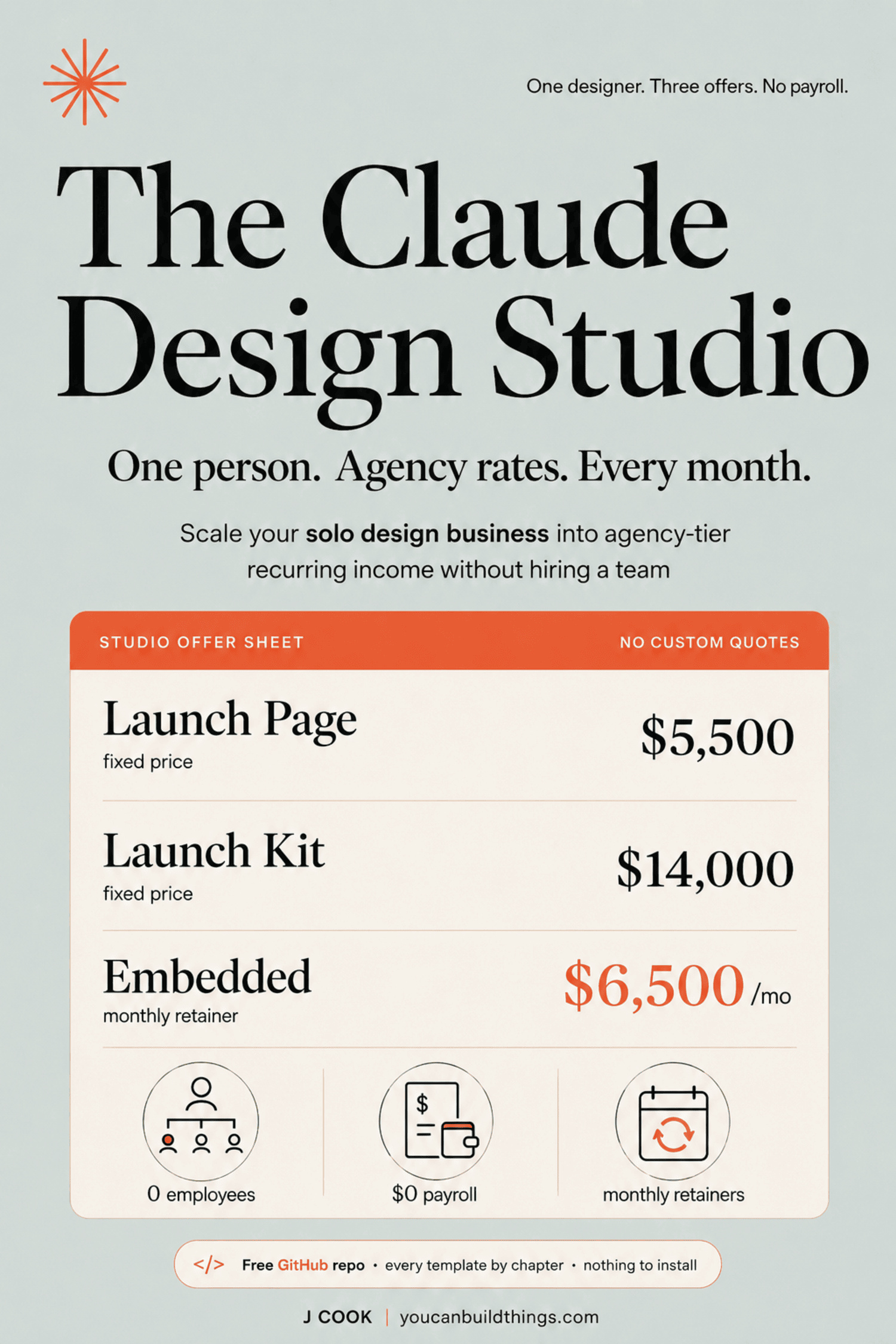
The Claude Design Studio
Scale Your Solo Design Business Into Agency-Tier Recurring Income Without Hiring a Team
Hello builders,
The next good lead in your inbox can close at $5,500 without you ever opening a blank document. That is what productized design service pricing actually means: three named rows on one page, priced before the buyer exists, sent instead of your labor. Today we build that page and then we go price it.
First, what the blank document costs you, because it has never once appeared on an invoice. A discovery call at forty-five minutes, then an hour or two writing up what you heard in deliverable language, which is your best thinking of the week. Then you invent a scope and attach a number to it: another hour, plus the twenty minutes at midnight where you change the number and change it back. Four to six unpaid hours before a single pixel exists. Close one deal in three and that is twelve to eighteen unpaid hours per signed client, out of a week that holds forty.
None of it gets reused, because the scope was bespoke, so it dies with the deal and the next founder arrives with the counter at zero. That is not a pricing problem a bigger number fixes. Your factory rebuilds the assembly line for every unit it makes.
Price off a published price
Before we pick numbers, one discipline that saves you from the genre of advice you are about to go read.
There are two kinds of numbers in this market and you must never confuse them. The first is a revenue screenshot, and it is somebody’s marketing: I found four different monthly figures for one studio circulating at once, from a blog, a viral post, and twice from the owner’s own bio. You cannot build a price on a number nobody can check.
The second kind is published, which means it sits on a live page under a payment button and a business has to honor it the moment someone clicks. Designjoy is a one-person design studio, and here is its card as it reads right now:
Monthly Club — $4,995/month, regular $5,995 one request at a time · avg. 48 hour delivery · unlimited brands · Webflow development · unlimited stock photos · up to 2 users · pause or cancel anytime
That is off designjoy.co, where the risk reversal underneath is deliberately partial: try it for a week, and if you are not loving it, get 75% back.
Read what that card is telling you. One generalist, no employees, charging roughly five thousand dollars a month per client, in public, where anyone can check. That is not a designer’s wish. It is what a buyer holding a credit card already agreed is reasonable, and you’ve been quoting $3,000 projects next to it.
Three rows and one floor
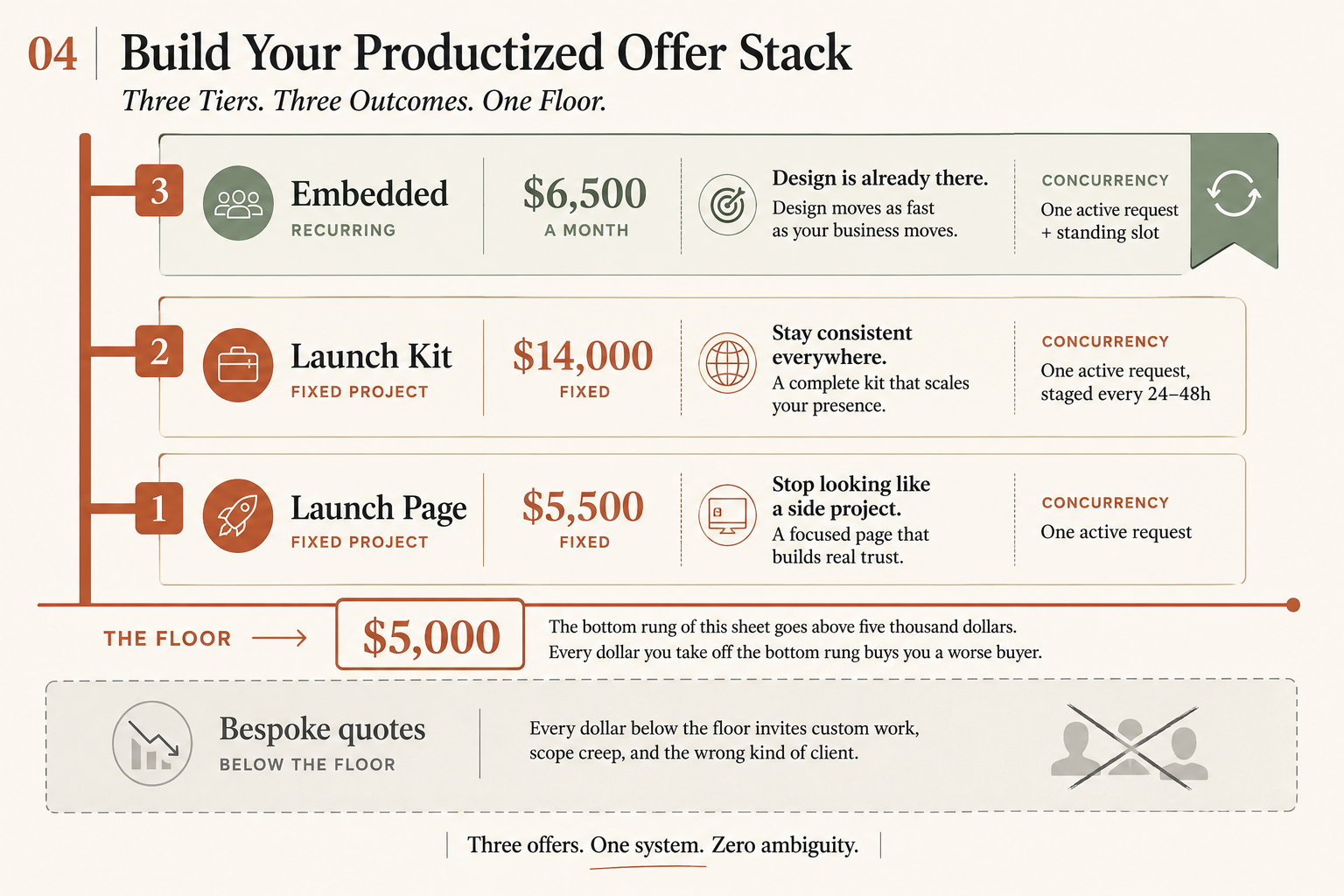
Copy the shape rather than the numbers. Every row we write needs the same six things: a name a founder could say to another founder in a Slack message at 11pm, a fixed scope, an exclusions list, a fixed price, a delivery format, and a concurrency line.
The exclusions are not yours to invent either. Claude Design ships prototypes and mockups, decks, microsites and landing pages, and it does not deploy and does not build backends, so every tier says the same thing in plain language: we deliver the files and the handoff, you deploy.
Launch Page, $5,500, fixed
- outcome: stop looking like a side project
- in the box: a one-page marketing site and a starter design system built from their own brand assets
- excluded, on the sheet and not on a call: deployment, backend, logo, copywriting
- concurrency: one active request
Launch Kit, $14,000, fixed
- outcome: stay consistent everywhere
- in the box: the full marketing site, the complete design system their engineers build against, the pitch deck with that system applied, the handoff bundle
- excluded: the same four
- concurrency: one active request, staged, so they see work every 24 to 48 hours until the whole thing is done
Embedded, $6,500 a month, recurring
- outcome: design is already there
- in the box: ongoing requests against the system you already hold
- excluded: deployment, backend
- concurrency: one active request plus a standing slot each week
Notice what did not change between the second row and the third: not the lane, not the exclusions, not the concurrency. The same factory makes all three, which is why one person can sell all three.
Now the floor, which sits at $5,000 with the bottom rung above it. Your instinct is to put tier one where your current work is, and your current work is what capped you. Everything below that line is what we already outgrew: bespoke quotes, a buyer who counts revisions, and a number you invented on a call. Every dollar you take off the bottom rung buys you a worse buyer.
Never discount, trade instead
Here is how this fails, and it will not happen in a room. It happens in your inbox at 9pm.
Your first buyer at the new number says yes to everything and then adds: any flexibility on that? And you will discount. You’re telling yourself right now that you won’t, and you will, because they are nice and $12,000 is more than you have ever charged.
So don’t rely on nerve. Nerve is exactly the thing that runs out at 9pm. The mechanism we use instead is simple: the price never moves and the scope does. They are not telling you that you are expensive. They are telling you they have a different budget than the rung you showed them, and those are completely different sentences.
Say it out loud, at conversational speed, like this:
The Kit is $14,000. If that’s not this quarter’s budget, the Launch Page is $5,500 and it’s the same quality on one page instead of the whole system. Most people start there anyway.
You did not defend the price and you did not get smaller, and half the time they’ll say let’s do the Kit anyway, because they were testing whether the number was real.
A discount is a bespoke quote wearing a costume. The moment one client pays $14,000 and another pays $11,000 for identical work you do not have a product, and we are back in the blank document.
Test the sheet the only way that counts. Could a stranger read it with you nowhere in the room and know what they get and what it costs? If they would still need a call, it is not finished, and the call is the thing we came here to delete.
Now go build something this weekend!
John Cook