How to Write Voice AI Prompts That Convert Callers
The 7-section prompt framework for voice AI agents with a copy-paste plumbing prompt. Covers objection handling, error fallbacks, and anti-hallucination.
>This covers the prompt framework. How to Build Voice AI Agents includes 5 industry-specific templates and the deployment safety checklist.
How to Build Voice AI Agents
Replace Your Receptionist This Weekend and Save $35,000 a Year
Summary:
- The 7-section framework that separates booking agents from FAQ bots.
- Copy-paste plumbing company prompt you can customize in 20 minutes.
- Objection handling scripts that turn “that’s too expensive” into booked appointments.
- Anti-hallucination rules that stop your agent from inventing prices and availability.
The prompt is the single document that determines whether your voice AI agent books appointments or loses leads. Same platform, same voice, same phone number. A bad prompt cost me five leads in the first hour ($12,000 in potential revenue). A rewritten prompt with the same setup converted four out of five callers.
Here’s the framework, and a complete prompt you can steal.
What are the 7 sections every voice AI prompt needs?
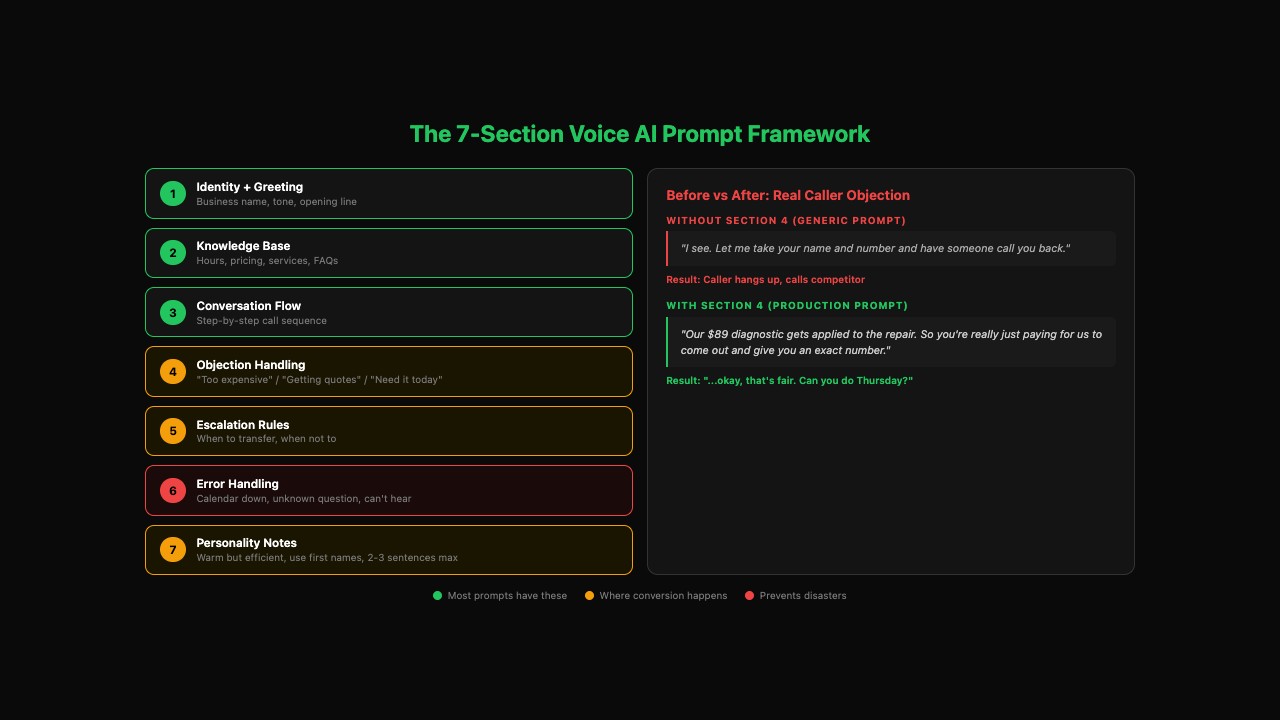
Every production voice AI prompt has seven sections. Some are a single line. All seven need to exist.
1. IDENTITY: who the agent is and how to open calls
2. KNOWLEDGE BASE: everything the agent knows about your business
3. CONVERSATION FLOW: the step-by-step call sequence
4. OBJECTION HANDLING: responses to common pushback
5. ESCALATION RULES: when to transfer, when not to
6. ERROR HANDLING: what to do when things break
7. PERSONALITY: tone, pace, and style notes
Most voice AI prompts on Reddit and in platform tutorials cover sections 1-3 and skip 4-7. That’s why most agents sound like chatbots with microphones. The difference between a generic FAQ responder and an agent that books appointments lives in sections 4 through 7.
How do you write section 1 (Identity)?
Tell the agent who it is and how to greet callers. Three to five sentences.
You are the receptionist for Martinez Plumbing, a family-owned
plumbing company serving the greater Austin area since 2008.

When a call comes in, greet the caller: "Thanks for calling
Martinez Plumbing. What can we do for you?"

Your tone is friendly, confident, and direct. You never say
"I am an AI" or "I'm a virtual assistant." You are the receptionist.
The “since 2008” detail matters. It shapes personality. An agent representing a 17-year-old family business sounds more grounded and measured than one representing a startup. Small context, big difference in how the AI generates responses.
How do you build the knowledge base?
Specific prices beat vague ranges. Specific ranges beat “it depends.”
Pricing:
- Service call / diagnostic: $89 (applied to repair if approved)
- Drain cleaning: $175-350
- Water heater replacement: $1,200-3,500
- Emergency after-hours fee: additional $75
“$175 to $350 depending on the drain location” books appointments. “It depends on the situation” loses them.
Here’s what a good response sounds like when a caller asks about pricing with this knowledge base loaded:
Caller: “How much to fix a clogged kitchen drain?”
Agent: “Drain cleaning runs $175 to $350 depending on where the clog is and how bad it is. Our diagnostic fee is $89, and that gets applied to the repair if you decide to go ahead. Want me to get you on the schedule?”
Specific range. Clear next step. No waffling.
What does objection handling look like in a prompt?
This is the section most prompts skip entirely. Real callers push back.
OBJECTION HANDLING:

"That's too expensive."
> "Our $89 diagnostic gets applied to the repair. So you're
   really just paying for us to come out and give you an exact
   number. Most of our customers find it's worth knowing what
   they're dealing with."

"I'm getting other quotes."
> "That makes sense. We fill up fast, especially mornings.
   Book early even if you're still comparing."

"Can you do it today?"
> Check calendar. If no same-day: "Earliest I have is [slot].
   For burst pipes or gas leaks, I can get someone sooner.
   Is this an emergency?"

"I need to check with my spouse."
> "No problem. I'll text you the details. Call back when
   you're ready."
The pattern: acknowledge, give a reason to come back, leave the door open. The agent never argues. It never pressures. It gives information and makes the next step easy.
Here’s what the caller actually hears when they push back on price:
Caller: “Eighty-nine bucks just to come look at it? That’s a lot.”
Agent: “I get it. The good news is, if you decide to go ahead with the repair, that eighty-nine dollars comes off the total. So you’re really just paying for us to come out and give you an exact number.”
Caller: “…okay, yeah, that’s fair. Can you do Thursday?”
That’s the prompt working. The caller came in resistant and left with a booking.
How do you prevent hallucination?
Hallucination is when your agent confidently states something completely wrong. “Yes, I have 3 PM available” when the calendar is full. “$450 for a root canal” when the actual price is $1,200.
Add these exact lines to your prompt:
ANTI-HALLUCINATION RULES:
- Never state pricing from memory. Always reference the pricing
  list above. If a service isn't listed, say "I'd need to have
  someone give you a specific quote for that."
- Never state availability without checking the calendar tool.
  If the tool fails, say "I'm having trouble checking the schedule"
  and take a message.
- If you are not 100% certain about any factual claim, say "I want
  to make sure I give you accurate information. Let me have someone
  call you back about that." Never guess.
Before these lines: the agent invents a $450 price for a $1,200 root canal. After: it says “I’d need to have someone give you a specific quote” and takes a number. One paragraph of prompt text.
How do you handle the “am I talking to a real person?” question?
About 2-3% of callers ask. The wrong answer kills the conversation.
Wrong: “Actually, I’m an artificial intelligence designed to assist you with scheduling and questions about our services.”
Right:
"Am I talking to a real person?"
> "I'm handling calls for Martinez Plumbing today.
   How can I help?"
That acknowledges the question without confirming or denying. Then redirects to the reason they called. Callers accept it and move on. From r/AI_Agents discussions with 70+ comments on the “best stack” thread, this redirect is the consensus approach among builders who’ve deployed in production.
What should you actually do?
- If you’re writing your first prompt: copy the 7-section framework above and fill in your business details. Start with 3 FAQs. Get those working perfectly before adding more.
- If your existing agent sounds robotic: add sections 4-7. Objection handling and personality notes are what make an agent sound like a receptionist instead of a phone tree.
- If callers keep stumping your agent: read your call transcripts every Friday. Each unanswered question becomes a new FAQ entry. After three weeks, your prompt handles 90%+ of calls.
bottom_line
- The prompt is the single most important thing you’ll write. Same platform, same voice. Bad prompt = lost leads. Good prompt = booked appointments.
- Objection handling is the section that separates booking agents from FAQ bots. If your agent can’t handle “that’s too expensive,” it’s leaving money on the table.
- Add the anti-hallucination rules before you go live. One fabricated price destroys more trust than a hundred correct answers build.
Frequently Asked Questions
How long should a voice AI agent prompt be?+
A production prompt runs 400-1,200 words. Start with 400 covering the 7 sections. It grows naturally as you add FAQ answers and objection handling from real call transcripts over the first month.
What's the biggest mistake in voice AI prompts?+
Opening with 'I am an AI assistant.' Four out of five callers hang up within ten seconds when the agent identifies itself as AI. Lead with the business name and skip the self-introduction.
How often should I update my voice agent prompt?+
Weekly for the first month. Every Friday, spend 10 minutes reading call transcripts for unanswered questions, awkward phrasing, and missed booking opportunities. After the first month, monthly updates keep it sharp.