How to Get Cited by ChatGPT (Answer-First Content)
How to get cited by ChatGPT: put the answer in the first 50 words, add a comparison table, back every claim, then prove the citation moved on your scorecard.
>This makes one page quotable. Get Cited by AI goes deeper on entities, the off-site citations you don't own, and proving every rewrite on your own scorecard.
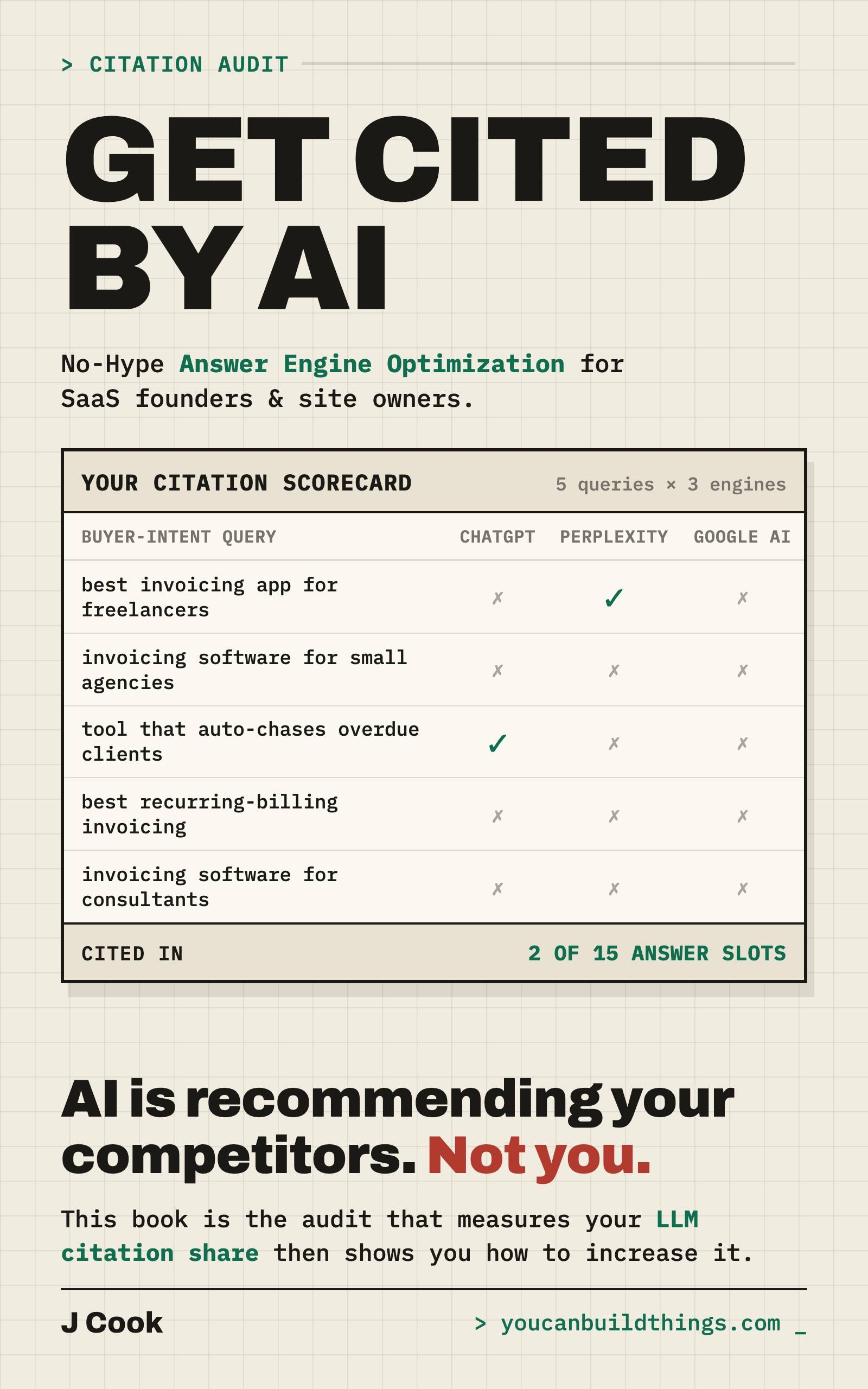
Get Cited by AI: Show Me the Number
No-Hype Answer Engine Optimization for SaaS Founders and Site Owners
Summary:
- The one change that wins citations: answer the question in the first 50 words under each heading.
- The before/after rewrite, with the exact sentence an engine will lift.
- Which formats actually get quoted, with real numbers from over a million AI citations.
- The readability-score trap that wastes a week, and how to spend that week winning instead.
Figuring out how to get cited by ChatGPT starts with a reframe that saves you from a week of wasted work. The goal is not to make some tool give your page a better grade. The goal is to become the exact sentence the engine lifts into its answer when your buyer asks. Those are completely different targets, and chasing the first is how people optimize a meter that is connected to nothing. Here is the work that actually moves the number.
How do you get cited by ChatGPT?
You write the answer first. Under every heading, answer the question in the first 50 words, then explain and sell underneath. The reason traces straight to how the engine builds a response: it pulls passages and grounds its answer in the cleanest, most directly-relevant text it found. A clear answer sitting right under the heading is trivially liftable, so the model lifts it. An answer buried in the ninth paragraph under brand story and a metaphor about cash flow loses to a competitor’s cleaner sentence. You do not lose the citation because your product is worse. You lose it because your answer was hard to find.
Answer-first: win the first 50 words
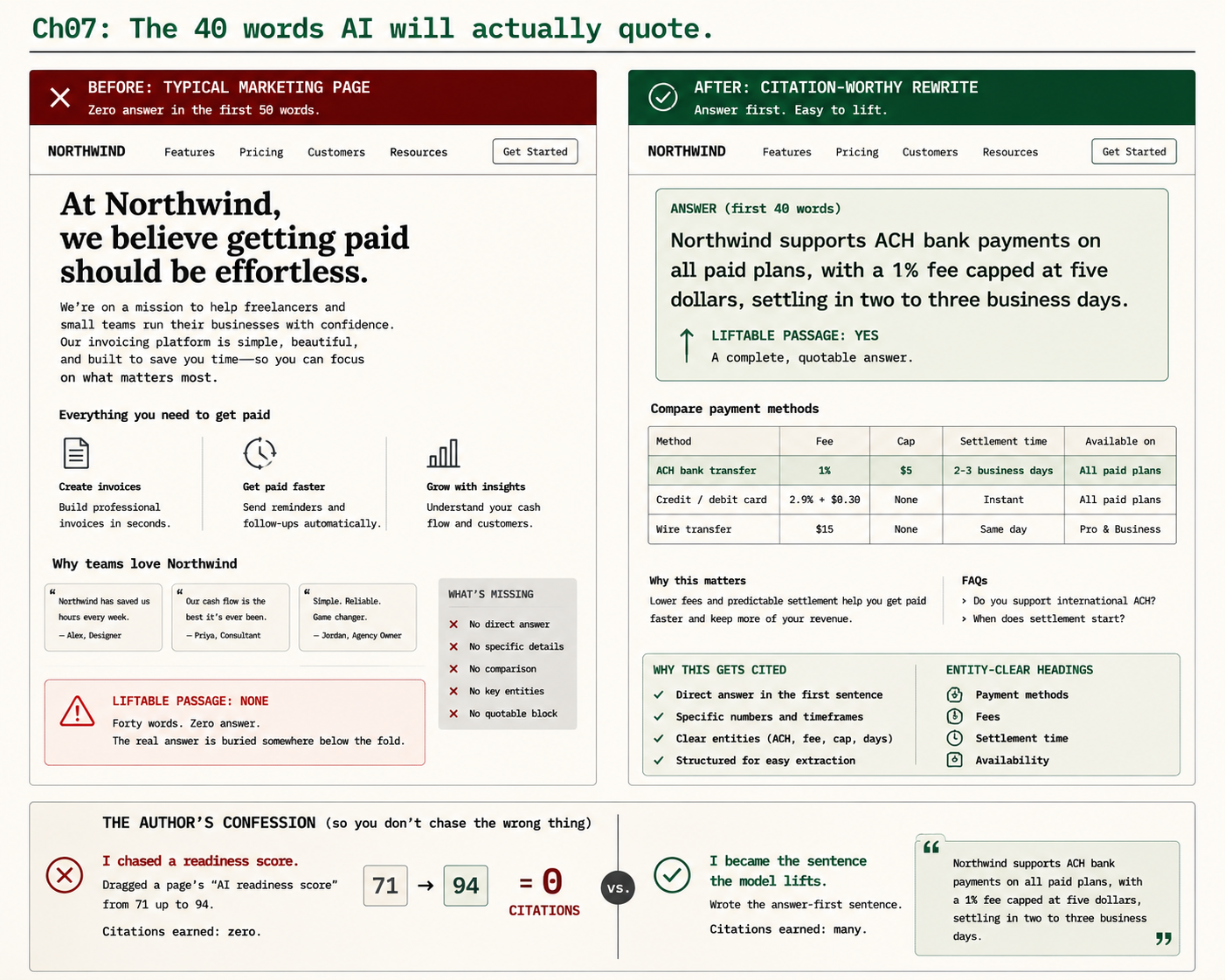
Watch the difference on one page section. Here is the typical marketing version, the kind of copy that fills most SaaS pages:
BEFORE (heading: "Recurring Billing")

At Northwind, we believe getting paid should be effortless. We built a
billing experience our customers love, so you can focus on what you do best.

  Listable passage: NONE. 40 words, zero facts, nothing an engine can quote.
Now the answer-first rewrite. The heading becomes the question a buyer actually asks, and the first 40 words answer it with facts:
AFTER (heading: "Does Northwind support recurring billing for freelancers?")

Yes. Northwind supports ACH bank payments on all paid plans, with a 1% fee
capped at five dollars, settling in one to two business days. You can set
weekly, monthly, or custom schedules and auto-charge saved cards or ACH.

  Answer first. Easy to lift. The model can quote it and stand behind it.
Same length. But now there is a fact-dense, liftable answer the model can attribute to you. Here is the template to apply to any page section:
ANSWER-FIRST TEMPLATE (use on every heading)

  Heading:  the exact question your buyer would type
            ("Does <product> support <feature> for <audience>?")

  First 50 words:  Yes/No, then the specific facts.
            <Product> <does the thing> on <which plans>, with <number>,
            <number>, <number>. One clean, quotable, checkable sentence.

  Then:     expand, add the comparison table, let the human voice sell.
Go read the first 50 words under each heading on your most important page right now. If it is a wind-up instead of an answer, you just found free citations sitting on the table.
The formats AI actually quotes
Some formats get cited more than others, and there is real data here as long as you respect the catch. An analysis of over a million AI citations by Wix Studio with Peec AI found citations skew toward certain content types:
| Content format | Share of AI citations |
|---|---|
| Listicles | 21.9% |
| Articles | 16.7% |
| Product pages | 13.7% |
Source: Wix Studio AI Search Lab, analyzing 1M+ citations across ChatGPT, Google AI Mode, and Perplexity. Those top three formats together drive about 52% of all citations.
Here is the catch the “lists always win” crowd drops: query intent, not format, is the real driver. The same study found about 40% of commercial-query citations go to listicles, while well-structured articles win informational queries. So the rule is not “make everything a listicle.” Match the format to the query intent. For your buyer-intent “best X” queries, a clean comparison table is exactly the shape the engine wants to quote:
| You | Competitor A | Competitor B | |
|---|---|---|---|
| ACH payments | Yes, all plans | Paid only | No |
| Auto-chase overdue | Yes | No | Add-on |
| Free tier | Yes | No | Yes |
A table like that, under a heading like “best invoicing tool for freelancers,” is already structured, already scannable, already a set of discrete facts the model can lift cleanly. Keep the facts honest and current, because the engine and the buyer can both check them.
What broke: the readability-score trap
Here is the failure mode that wastes the most time, told straight. The author of the source book once spent the better part of a week dragging a page’s AI readiness score from 71 up to 94. He added the markup the tool wanted, restructured the headings it flagged, ticked every box. The score went green. Citations earned from all that work: zero. Not one engine quoted the page any more than before.
That is the whole lesson. A high readiness score measures whether your page is tidy. Getting cited measures whether your page is quotable, and quotability is a content decision, not a checkbox. If you catch yourself optimizing for a greener dashboard instead of a higher number on your own scorecard, stop and re-aim. And do not buy the schema pitch either: a controlled study found that adding schema markup to pages already being cited did not lift citations. Schema helps engines identify who you are, which is worth doing once as site hygiene, but it is not the citation spell it gets sold as.
What to rewrite first
You cannot rebuild every page at once, so your scorecard tells you exactly where to aim. Sort your tracked queries into three piles:
SORT YOUR QUERIES, THEN START AT THE TOP

  WINNABLE GAP   competitor is cited, you are not
                 -> rewrite this, highest buyer-intent first.
                    The engine clearly WILL quote someone here.

  ALREADY WON    you are the recommended pick
                 -> leave it alone, maybe protect it.

  NO CITATION    nobody is cited; the engine answers from
                 general knowledge with no sources
                 -> skip for now, there is nothing to win yet.
Start at the top of the winnable-gaps pile. If a competitor is cited on a query, a citation is available and you simply are not earning it yet. That is a page you can win. Then run the loop the whole discipline rests on: rewrite the page, wait the window (weeks, not days, because the engine has to recrawl), re-run your citation audit on that page’s queries, and read the delta. If the number moved, you found a lever. If it did not, you spent nothing on a vanity score and you have a dated negative to learn from.
What should you actually do?
- If your page is a wind-up → move the answer to the first 50 words under each heading. This single habit is the closest thing to a reliable lever in the whole field.
- If you are targeting a “best X” query → add an honest comparison table. It is the format the engine wants for commercial intent, and it is inherently liftable.
- If a vendor pitches “add schema to get cited more” → decline the citation framing. Do clean
Organizationmarkup once for identity, not as a monthly citation service. - After any rewrite → log the date and your citation share as the “before,” wait the recrawl window, then re-measure. A rewrite you did not measure is a feeling, not a result.
The bottom line
- The single highest-payoff change is answer-first writing: put the liftable answer in the first 50 words under each heading. The model grounds in the cleanest passage it finds, so make that passage yours.
- Match format to intent. Listicles and comparison tables win commercial “best X” queries; structured articles win informational ones. “Make everything a listicle” is the lazy misread of the data.
- A readiness score is not the goal. The author moved one page from 71 to 94 and earned zero citations. Measure rewrites against your own citation scorecard, never a dashboard’s grade.
Frequently Asked Questions
How do you get cited by ChatGPT?+
Put the answer to each heading's question in its first 50 words, in plain, factual, liftable language, then add a comparison table for buyer-intent queries. The engine grounds its answer in the cleanest passage it can find, so make that passage yours.
What content gets cited most by AI?+
Structured, intent-matched content. Across a study of over a million AI citations, listicles took 21.9%, articles 16.7%, and product pages 13.7%. Listicles dominate commercial 'best X' queries; well-structured articles win informational ones. Match the format to the query.
Does schema markup get you cited by ChatGPT?+
No. A controlled study found that adding schema to pages already being cited did not lift citations. Schema helps engines identify who you are, which is worth doing, but it is not a citation booster. Quotable, answer-first content is.