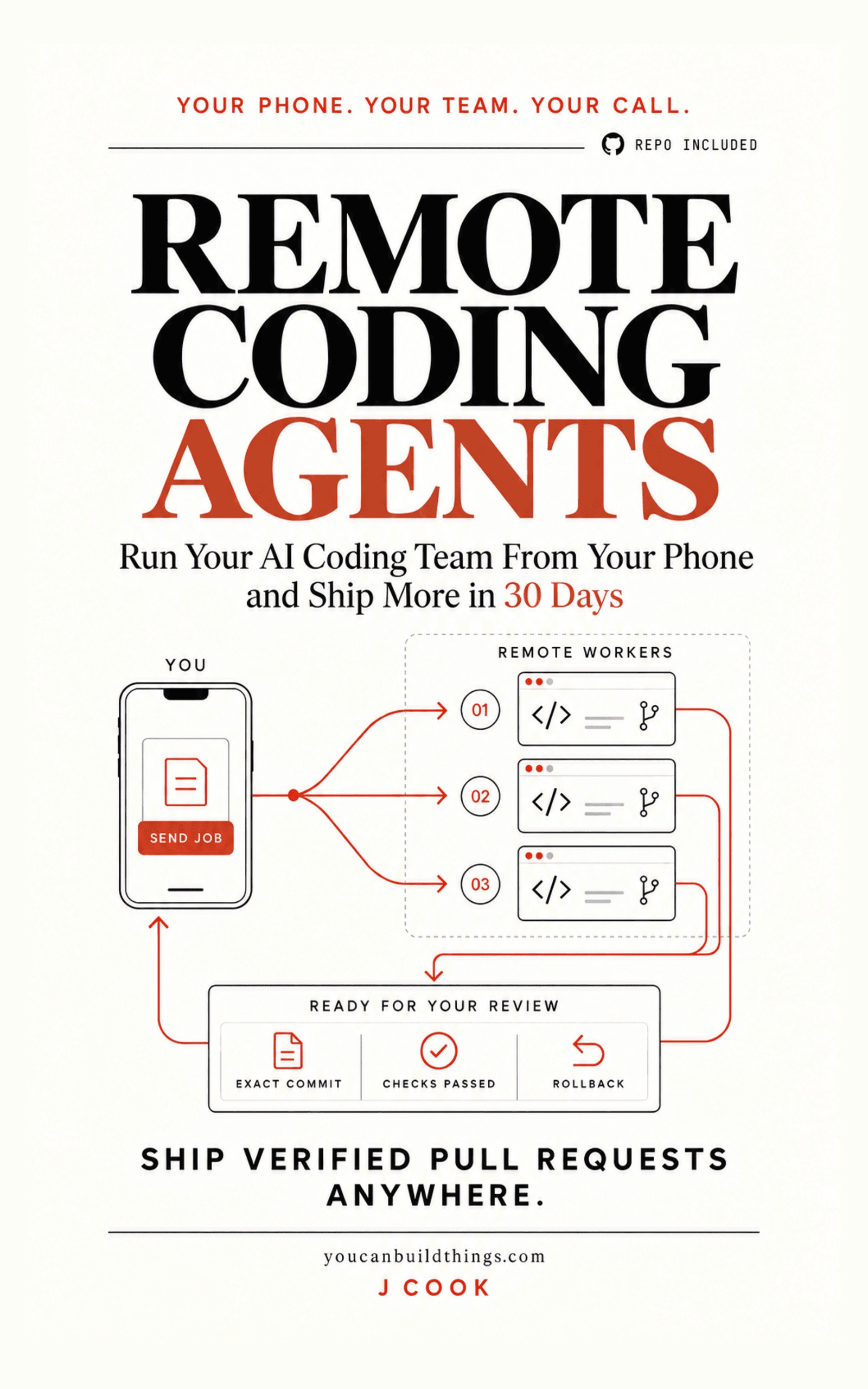
Remote Coding Agents: Ship Verified Pull Requests Anywhere
Run Your AI Coding Team From Your Phone and Ship More in 30 Days
Stop leaving the laptop half open so the agent keeps running. Send a job from your phone and get back a pull request with tests, a build receipt, and evidence you review in sixty seconds. Every job runs in its own workspace, reports to one board, and stops at a cost ceiling you set.
Developers are sending real repository work away from the desk and getting finished branches back. The difference isn’t more tokens. It’s a remote operating system that keeps every job visible, bounded, and reviewable.
This book builds that system: a job contract an agent can execute, a phone-to-PR route that survives a dropped connection, an isolated workspace for every job, a gate that blocks weak pull requests automatically, and a budget tied to accepted changes instead of tokens.
The free companion repo ships the complete remote-agent scaffold, runnable offline with no account, key, or network connection.
What You'll Build
The three receipts that separate a remote system from a remote trigger: a refusal, a returned change, and a priced decision.
Write a dispatch contract with permissions and stop conditions, and watch the validator refuse a bad job.
Run a paired trial of two runtimes on your own repo and write the runtime rules your measurements support.
Dispatch one change from your phone and get back its own branch with a commit-bound test and build receipt.
Build one status board for every live session, with leases, heartbeats, and a reconnect that survives a dropped connection.
Give every job an isolated workspace and a fail-closed policy, then capture the refusal when it reaches too far.
Gate every pull request on tests and builds with a check the authoring run cannot approve or merge.
Attach a hashed evidence bundle and a generated handoff you can review cold in sixty seconds.
Price cost per accepted change from a five-job ledger, find break-even, and set a hard monthly cap.
Add workers with transactional locks and a global stop, and find the highest concurrency that still pays.
Kill jobs on purpose, restore from backup, and replay the same job from a tested incident runbook.
Drop the scaffold into a fresh repo and roll it out through four go/no-go gates over thirty days.