How to Put 10x More Money Behind Your Winning AI Trading Strategy
Scale your AI trading agent from $100 to $1,000 a trade as its record earns each step, so the strategy that made $1.50 a trade at the bottom is making $15 a trade at the top. One Python command reads your own record against six gates and prints STAY or EARNED.
>This covers the money ladder. The AI Trading Agent Alpha Swarm Team builds the five agents that earn the record, the broker connection that places their trades and the scorecard that finds the strategies worth scaling.
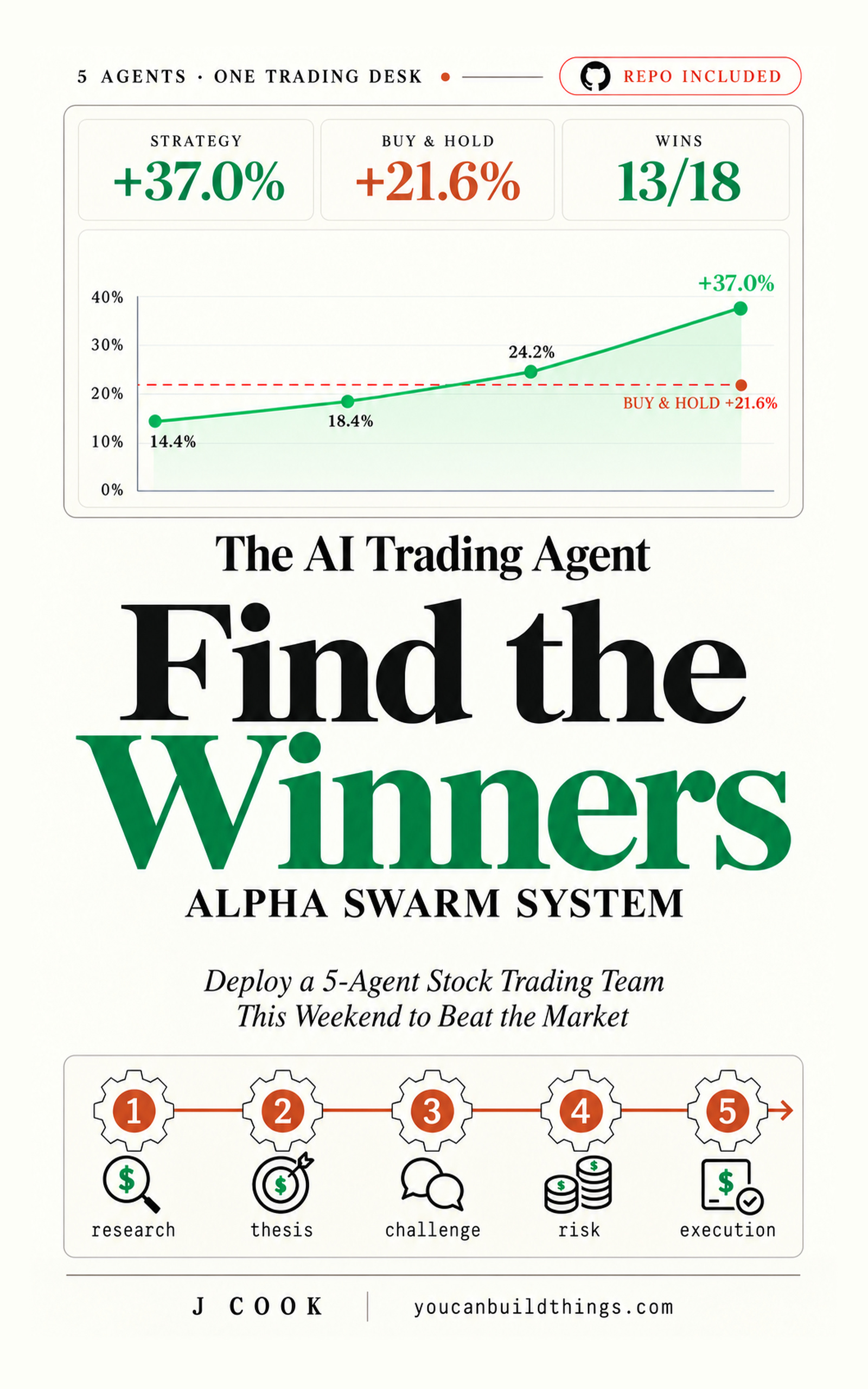
The AI Trading Agent Alpha Swarm Team
Deploy a 5-Agent Stock Trading Team This Weekend to Beat the Market and Find Winners
Hello builders,
The same AI trading strategy that makes $1.50 a trade at $100 makes $15 a trade at $1,000, and this is how your agent earns its way up to the bigger size. Most traders size by mood, doubling after two wins and halving after one bad day, so their size tracks the one input that is guaranteed to be wrong at the turning points. This is my answer to when to increase position size trading stocks with an AI agent: a file of rungs and gates, plus one command that reads your own record.
The best money plan I found while writing the book was a comment on r/investingforbeginners. The writer put “a small amount in the best looking ones and let them simmer for a while. Some worked, some died after a while. Then I started building up the winners.” We build that plan as a file, and our swarm keeps the count for you.
Five rungs and the gates
The ladder lives in ladder.json in the companion repo:
{
  "rungs": [
    {"name": "practice", "mode": "practice", "cap_usd": 100},
    {"name": "first money", "mode": "live", "cap_usd": 100},
    {"name": "second rung", "mode": "live", "cap_usd": 250},
    {"name": "third rung", "mode": "live", "cap_usd": 500},
    {"name": "top rung", "mode": "live", "cap_usd": 1000}
  ],
  "gates": {
    "closed_trades": 20,
    "min_net_per_trade_usd": 0.01,
    "max_drawdown_pct": 10,
    "max_unfilled_pct": 30,
    "max_order_pct_of_daily_volume": 1.0
  }
}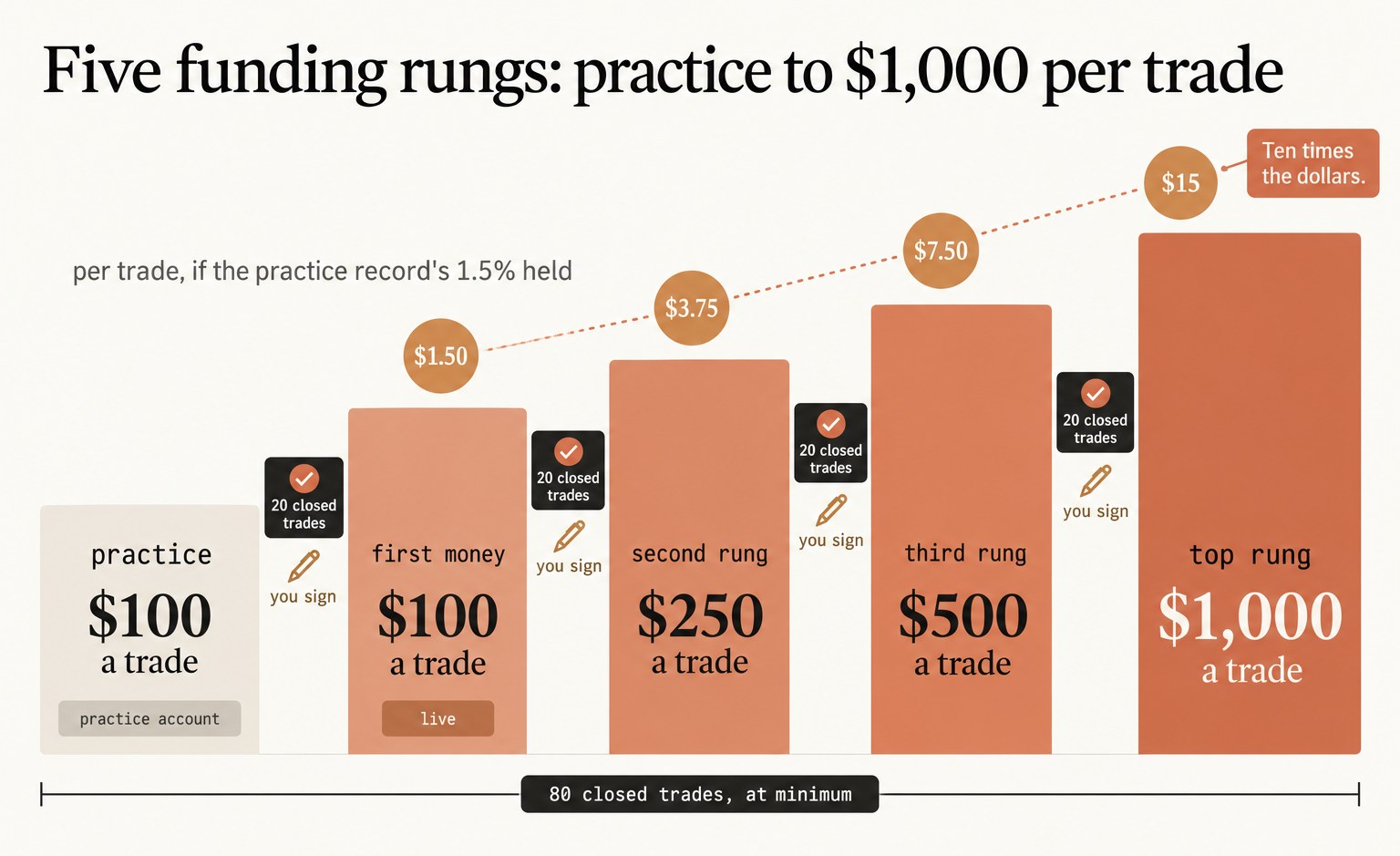
We start you on the practice account at $100 a trade, then go live at $100, $250, $500 and $1,000. Every step needs 20 closed trades at the rung below, where a closed trade is a buy and its sell, both filled. The record also has to show at least a cent of profit per trade after costs, a worst losing stretch under 10% of the rung’s size, no more than 30% of orders going unfilled, and no order bigger than 1% of the stock’s daily dollar volume. A sixth check sits in the code where you can’t edit it, and it requires the fingerprints on every ledger row to be clean.
Those numbers are mine, and nobody publishes an official rulebook for them, so change them if you have a reason. Do it before the count starts, never after you’ve seen how it’s going.
Watch the ladder read your record
You need Python 3.12 or newer and no account for this part. We clone the repo, copy in the mandate file you would sign, and ask where you stand:
git clone https://github.com/regardo911/alpha-swarm.git
cd alpha-swarm
cp chapters/05-connect-to-your-broker/mandate.json .
python ladder.py
rung: practice ($100 a trade, practice)
gate have need
closed trades 0 >= 20 NOT YET
net $ per trade 0 >= 0.01 NOT YET
drawdown % 0.0 <= 10 pass
unfilled % 0 <= 30 pass
order % of volume 0.0 <= 1.0 pass
ledger hashes 0 == 0 pass
STAY. Still open: closed trades, net $ per tradeThat is your own record on day one, with four gates passing and two waiting on trades. To see what earning a rung looks like, the repo ships a practice record of 20 made-up closed trades, and python ladder.py fixtures/record_DEMO.json runs the same gates against it.
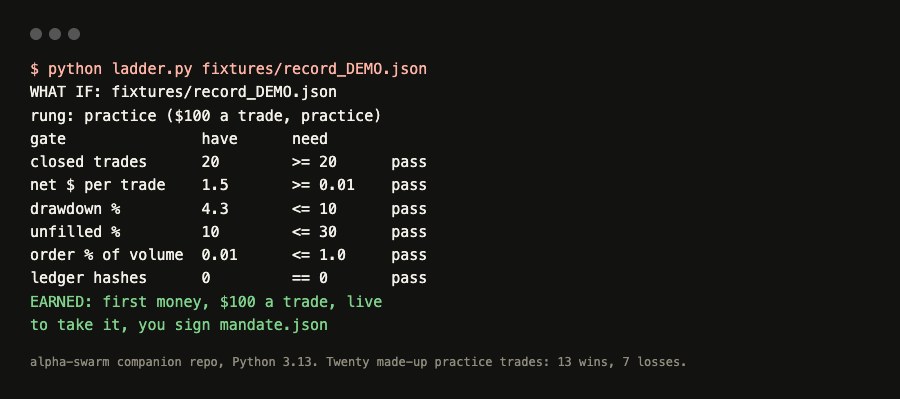
Thirteen of the twenty won, seven lost, and the record made $1.50 a trade after costs with a worst stretch of $4.30. I made that record ordinary on purpose, since thirteen winners averaging a dollar fifty a trade is what I would expect a working strategy to look like from the inside. Hold that same 1.5% and climb, and it becomes $3.75 a trade at $250, $7.50 at $500 and $15 at $1,000, ten times the dollars from the same strategy.
When our ladder says EARNED on your own trades, the money moves only after you make three edits: "mode": "live" and the date in mandate.json, a second pair of live Alpaca keys in keys.env, and the new cap in both cap_usd and max_position_usd. Each new signature also starts a fresh count, so twenty good trades at $100 earn the $250 rung and the next twenty have to happen at $250.
Small accounts trade fine
Two rules on the broker side help a small account. Alpaca’s margin page says:
In order to trade on margin or sell short, you must have $2,000 or more account equity. Accounts with less than $2,000 will not have access to these features and will be restricted to 1x buying power.
(Alpaca, Margin and Short Selling)
Every dollar on our desk is yours, and every setup in the book buys, so the short-selling limit costs us nothing. The old day-trading limit is gone too:
FINRA has adopted new intraday margin standards to replace in their entirety the outdated day trading margin requirements, including the day trade count requirements for designating a customer as a “pattern day trader” and the $25,000 pattern day trader minimum equity requirement.
(FINRA Regulatory Notice 26-10)
Brokers were given time to switch over, so check which rule your account is under. How long is 80 closed trades for you? Open your own walk-forward scorecard, divide each strategy’s trade count by the months it covers, and you’ll know roughly how many trades a month one strategy makes on one stock. Then run python ladder.py every weekend until it says EARNED.
Now go build something this weekend!
John Cook