Price and Sell AI Agents: Real Numbers, Real Clients
Pricing framework with three tiers, client acquisition playbook, and copy-paste service proposal template for selling AI agent services as a freelancer.
>This covers pricing and landing clients. Build AI Agents walks through building the agents themselves, from first build to multi-agent pipelines.
Build AI Agents
Ship Your First Agent This Weekend and Start Landing $3,000/Month Clients
Summary:
- Three pricing tiers: $500/mo (basic automation), $1,000-1,500/mo (integrated agent), $2,500-3,000/mo (multi-agent system).
- Six industries that buy: dental, real estate, e-commerce, agencies, law firms, local services.
- Five client acquisition channels ranked, with a cold email template you can send today.
- Copy-paste service proposal template ready to customize for your first prospect.
A guy on Twitter named Sharbel posted his numbers: $500 to $3,000 per month for agent workflows. Not project fees. Monthly recurring revenue. He’d build the agent in a weekend, deploy it, then charge for ongoing management. Three clients at $2,000 each and he had a $6,000/month business running on weekends.
Someone in the replies asked “what kind of agents?” Lead qualification for a real estate brokerage. Appointment scheduling for a medical practice. Customer support triage for an e-commerce store. Nothing that required a PhD. Just agents deployed for businesses that had a specific problem and were willing to pay to make it go away.
Who pays for AI agent services?
Businesses where someone does manual, repetitive work an agent could handle. You’re not selling AI. You’re selling hours back in someone’s day.
| Industry | Use Case | Why They Buy |
|---|---|---|
| Dental/medical practices | Scheduling, patient follow-ups | Front desk can never keep up |
| Real estate agencies | Lead qualification, showing scheduling | Filters tire-kickers from buyers |
| E-commerce (100+ orders/day) | Order status, returns, product Q&A | Support volume justifies retainer |
| Marketing agencies | Competitor monitoring, weekly reports | Saves analyst 10 hrs/week |
| Law firms | Document review, client intake | High hourly rate = huge ROI on non-billable work |
| Local services (plumbers, HVAC) | Inquiry handling, quotes, scheduling | Losing business to voicemail |
How do you price without leaving money on the table?
Three tiers. Charge monthly, not per-project. A project fee of $5,000 feels expensive. A monthly retainer of $1,500 feels manageable, and over 12 months it’s $18,000.
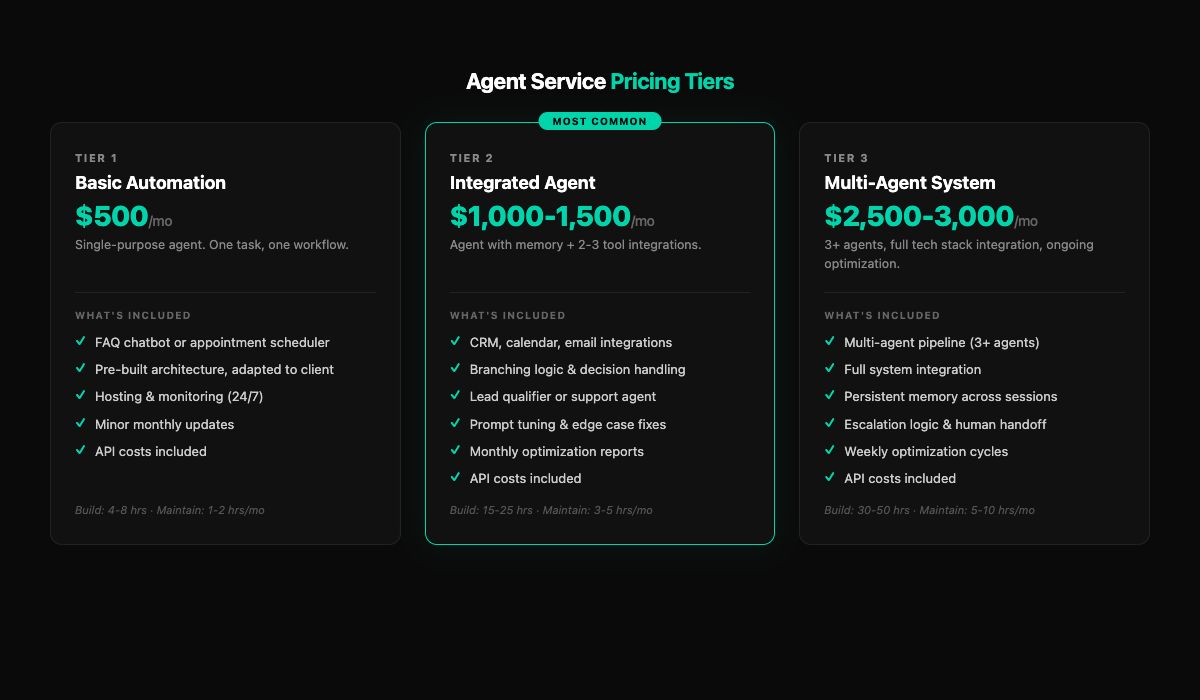
Tier 1: $500/month. Basic Automation Agent. Single-purpose agent handling one specific task. FAQ chatbot, appointment scheduler, lead capture form processor. Build it in 4-8 hours, maintain it in 1-2 hours per month. This tier works for sole proprietors and 1-3 employee companies, or as a starter package to get your foot in the door.
Tier 2: $1,000-1,500/month. Integrated Agent. Agent with memory and 2-3 tool integrations. Connects to CRM, calendar, email, database. Customer support agent with order lookup, lead qualifier with CRM integration, research agent with weekly reporting. Build time: 15-25 hours. Monthly maintenance: 3-5 hours. This is where most client relationships start.
Tier 3: $2,500-3,000/month. Multi-Agent System. Three or more agents, full integration with the client’s tech stack, persistent memory, ongoing optimization. Content pipelines producing weekly reports, customer support with escalation logic and human handoff, lead qualification and nurturing across the full sales funnel. Build time: 30-50 hours. Monthly maintenance: 5-10 hours.
Three rules that protect your margins:
- Include API costs in your retainer. Don’t bill the client separately for $150/month in OpenAI charges. It confuses the value proposition and creates awkward conversations. Absorb API costs into your margin.
- Don’t charge hourly. Hourly pricing punishes efficiency. If you build a client’s agent in 8 hours because you’ve done it before, you shouldn’t earn less than someone who takes 40 hours figuring it out.
- Frame price against current cost. Ask: “How many hours per week does your team spend on this task?” If the answer is 20 hours at $25/hour, that’s $2,000/month in labor. Your agent at $1,500/month is a $500/month savings plus 24/7 coverage.
For setup fees: skip them for your first client. Lower the barrier to entry. Once you have 3+ clients and referrals flowing, add $1,000-3,000 setup fees because you’ll have proof of value and a waitlist.
How do you find your first client?
Five channels, ranked by effectiveness for a new agent builder.
1. Your existing network (fastest to first client). You know people who run businesses. A text message that says “I’ve been building AI agents that automate customer support for small businesses. Know anyone who might be interested?” is the lowest-friction pitch possible. One builder’s first client came through a friend whose dentist complained about scheduling. A free demo led to a $1,500/month retainer.
2. Local business outreach (highest conversion rate). Walk into local businesses and ask about their biggest administrative headache. The dental practice on the corner. The real estate office down the street. These businesses are underserved by technology and over-served by vendors selling bloated software.
Cold email template that gets opened:
Subject: Cutting your appointment scheduling time by 80%

Hi [Name],

I build AI agents for local businesses. An agent I built
for a practice like yours handles 80% of appointment
scheduling automatically, freeing up front desk time for
patients who need personal attention.

Would it be worth a 15-minute call to see if this could help?
Short. Specific to their pain point. No jargon.
3. LinkedIn (best for B2B). Headline: “I build AI agents that automate business workflows | $500-$3K/month retainers.” Post what you’ve built. Comment on business owners’ operational pain posts.
4. Freelance platforms. Upwork and Fiverr have growing AI agent demand. Rates are lower but the projects build your portfolio. Three 5-star reviews become social proof for direct client conversations.
5. Referrals (best long-term). After the first month: “I’m looking to work with 2-3 more businesses like yours. Know anyone dealing with similar challenges?” One referral beats 100 cold emails.
What broke?
The deal-killing moment nobody posts on Twitter: a client says “can we try it?” and you have no URL to share. One builder spent a week perfecting a lead qualification agent on his laptop. Demo video went great. Client replied “this looks amazing, can we try it?” He froze. No deployment. No web interface. The client waited 48 hours while he figured out hosting. He almost lost the deal.
15 cold emails went nowhere before one hit. That one became a $1,800/month retainer for a property management company. But the lesson was clear: build the demo before the outreach, not after. A slide deck doesn’t close. A working agent with a testable URL does.
Three objections you’ll hear and how to handle them:
“Can’t I just use ChatGPT for this?” ChatGPT is a chatbot. It answers questions. What you build is an agent that connects to their specific systems, takes actions on their behalf, and runs 24/7 without someone typing into it. A calculator vs. a bookkeeper. Both deal with numbers. Only one does the work.
“This seems expensive.” Compare it to the alternative: “You’re spending $25/hour for someone to do this task 20 hours a week. That’s $2,000/month. My agent does the same work for $1,500/month and never takes a sick day.”
“What if it breaks?” The agent handles routine tasks autonomously. Unusual situations get flagged for a human. You monitor the system daily and fix issues before they notice. Month-to-month contract, cancel anytime.
Copy-paste service proposal template
This is the document you customize and send. Fill in every field with your specific offering. Pick a real business type as your target.
SERVICE PROPOSAL: [Agent Type] for [Business Type]

WHAT YOU GET:
[2-3 sentences describing the agent and what it does.
Be specific: "An AI agent that handles incoming
appointment requests via text, checks your calendar
for availability, books confirmed appointments, and
sends patients a confirmation message."]

WHAT IT REPLACES:
[Specific manual task it automates and estimated
hours saved per week. "Replaces approximately 15
hours/week of phone-based scheduling."]

HOW IT WORKS:
1. [Step 1 - e.g., "Patient texts your business number"]
2. [Step 2 - e.g., "Agent checks your calendar"]
3. [Step 3 - e.g., "Agent books the appointment"]
4. [Step 4 - e.g., "Patient and staff get confirmation"]

WHAT'S INCLUDED:
- Custom agent built for your specific workflow
- Integration with [specific tools: calendar, CRM, etc.]
- Hosting and monitoring (24/7 availability)
- Monthly optimization based on usage patterns
- [Hours] of support per month for questions and updates

INVESTMENT:
$[price]/month (month-to-month, cancel anytime)
Setup fee: $[one-time amount or "waived for first
3 clients"]

API costs (OpenAI, etc.) are included. No surprise
bills.

TIMELINE:
- Week 1: Discovery call + system access
- Week 2: Agent built and tested
- Week 3: Deployed and live with your team
- Ongoing: Monthly review and optimization

NEXT STEP:
Let's do a 15-minute call to see if this is a fit.
[Your calendar link or email]
What does the market actually pay?
Real numbers from builders posting invoices and retainer agreements:
| Client | Monthly Rate | Agent Type |
|---|---|---|
| Real estate agency (Austin) | $2,000/mo | Lead qualification |
| Dental practice (Portland) | $1,500/mo | Appointment scheduling |
| Shopify store (e-commerce) | $3,000/mo | Returns handling |
| Property management company | $1,800/mo | Maintenance request triage |
| VC firm | $2,500/mo | Research agent, 6 data sources |
Rates from builders posting real invoices and retainer agreements on Twitter/X.
First client will probably be $500-1,500. That’s fine. The market exists and is paying. Five clients at $2,000/month is $10,000/month. Maintenance is 3-5 hours per client after the initial build. Five clients at 5 hours each plus 10 hours for client acquisition = 35 hours. Less than a full-time job.
What should you actually do?
Decision tree:
If you’ve never built an agent: Build one first. You can’t sell what you can’t demo. Get a working research agent deployed with a live URL, then come back to this article.
If you have a working agent but zero clients: Send 10 messages this week. Five to people in your network, five cold emails to local businesses. Use the email template above. The first client is the hardest. Everything after gets easier.
If you have 1-2 clients: Ask for referrals. Raise your prices for new clients by 20-30%. Document your architecture so client #3 takes half the build time.
If you have 3+ clients: Add setup fees ($1,000-3,000). Decide whether to raise prices, hire help, or productize.
If every prospect says yes: Your prices are too low. Close rate above 80% means raise prices until it balances.
bottom_line
- The technical skill is table stakes. Knowing how to build agents is necessary but not sufficient. Knowing how to find clients, price the service, deliver reliably, and scale through referrals is what turns a skill into a business.
- Three clients at $2,000/month is $6,000/month running on weekends. The math works because maintenance is 3-5 hours per client after the initial build. This is a real side income on a part-time schedule.
- The window is open but closing. The AI agent market right now looks like the mobile app market in 2009. Give it twelve months and building a basic agent will be a commodity skill. The first movers get the clients, the referrals, and the recurring revenue. Everyone who comes later competes on price.
Frequently Asked Questions
How much should I charge for building an AI agent?+
$500/month for basic single-task agents, $1,000-1,500/month for agents with integrations, $2,500-3,000/month for multi-agent systems. Charge monthly, not per-project.
What businesses actually pay for AI agents?+
Dental practices, real estate agencies, e-commerce stores, marketing agencies, and law firms. The common thread: someone is doing manual, repetitive work that an agent could handle.
Should I charge a setup fee or just a monthly retainer?+
For your first client, skip the setup fee. Lower the barrier to entry. Once you have 3+ clients and referrals, add $1,000-3,000 setup fees.