How to Sell AI Agent Setups for $3K-$5K Each
Package your OpenClaw skills into a consulting business. Exact delivery process, pricing models, and the client acquisition playbook for agent services.
>This covers selling agent services. OpenClaw: The Money-Making Guide goes deeper on building all 7 projects that become your service offerings.
OpenClaw: The Money-Making Guide to AI Agents
Build 7 AI Agents That Earn $3K-$10K/Month
Summary:
- Package OpenClaw expertise into a service business charging $1,500-$5,000 per setup.
- Use a 6-step delivery process that takes 2-3 days of actual work.
- Build recurring revenue with $500-$2,000/month retainers.
- Includes the exact pricing math, client acquisition script, and proposal template.
Most people learning AI agents stop at “cool, it works.” They never ask the obvious next question: who would pay me to set this up for them?
The answer is almost everyone. Small business owners drowning in email. Content agencies that need to scale output. Freelancers who want automation but lack the time to build it. Real estate agents, lawyers, consultants: anyone whose day involves repetitive communication patterns.
How much can you actually charge for AI agent setups?
The market supports $1,500-$5,000 per one-time setup and $500-$2,000 per month for ongoing management. Those numbers come from what early OpenClaw service providers are charging right now.
For context, here is where AI automation consulting rates sit across the broader market in 2026:
| Service Tier | Hourly Rate | Typical Engagement |
|---|---|---|
| AI Workflow Automation | $75-$200/hr | Process builds, tool config |
| AI Strategy Consulting | $80-$300/hr | Roadmaps, vendor selection |
| Prompt Engineering | $200-$500/hr | System prompts, chain design |
| Monthly Retainer (implementation support) | $5,000-$15,000/mo | Ongoing optimization (enterprise tier) |
Source: AI Consultant Pricing Guide 2025 and Orient Software rate breakdown. Solo operators typically start at $500-$2,000/month retainers. The $5K-$15K range is enterprise with dedicated support.
At $3,000-$5,000 per setup taking 2-3 days, your effective rate lands at $1,000-$2,500/day. That sits at the low end of the consulting range above, which is exactly where you want to be when building a client base. You are cheaper than hiring a consultant at $200/hr for 20 hours, and you deliver a running system instead of a strategy deck.
Set expectations early. Week 1 is calibration, not magic. Tell clients: “The first week, the agent will make mistakes. We tune it together. By week 3, it runs without supervision.” Clients who expect instant perfection churn. Clients who expect a ramp-up period stay.
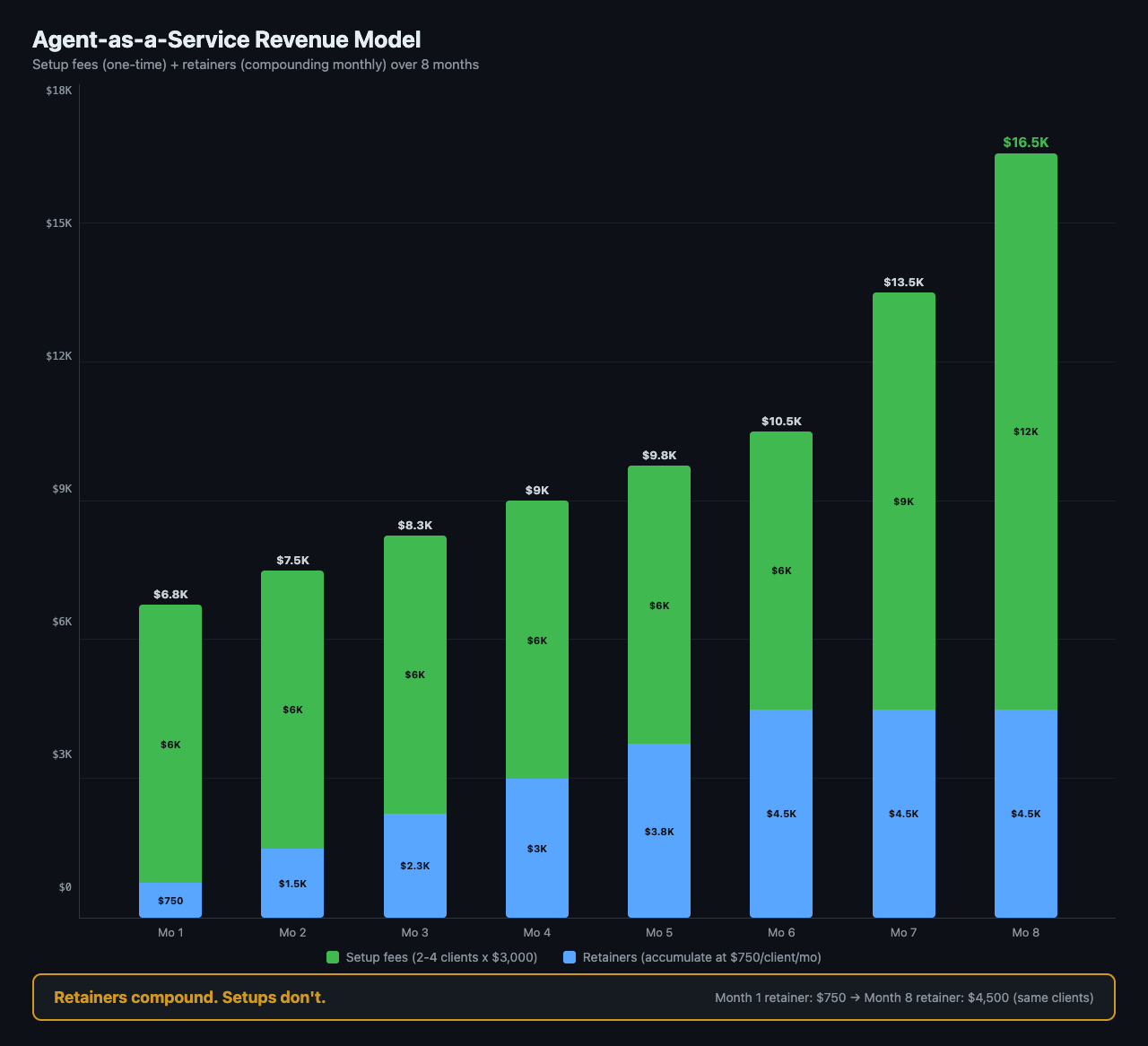
Here’s the math for a solo operator:
def monthly_revenue(setup_clients, setup_avg, retainer_clients, retainer_avg):
    """Calculate monthly revenue for an agent-as-a-service business."""
    setup_revenue = setup_clients * setup_avg
    retainer_revenue = retainer_clients * retainer_avg
    total = setup_revenue + retainer_revenue

    print(f"Setup revenue:    {setup_clients} clients x ${setup_avg:,} = ${setup_revenue:,}")
    print(f"Retainer revenue: {retainer_clients} clients x ${retainer_avg:,}/mo = ${retainer_revenue:,}")
    print(f"Monthly total:    ${total:,}")
    print(f"Annual run rate:  ${total * 12:,}")
    return total

# Conservative scenario
monthly_revenue(setup_clients=2, setup_avg=3000, retainer_clients=4, retainer_avg=750)
# Setup revenue:    2 clients x $3,000 = $6,000
# Retainer revenue: 4 clients x $750/mo = $3,000
# Monthly total:    $9,000
# Annual run rate:  $108,000

# Growth scenario (month 6+)
monthly_revenue(setup_clients=4, setup_avg=3000, retainer_clients=6, retainer_avg=750)
# Setup revenue:    4 clients x $3,000 = $12,000
# Retainer revenue: 6 clients x $750/mo = $4,500
# Monthly total:    $16,500
# Annual run rate:  $198,000
Those retainers compound. Every setup client who converts to a retainer adds $750/month permanently. By month 6, your retainer base does most of the heavy lifting.
What exactly are you delivering?
You are not building custom software. You are configuring, customizing, and maintaining OpenClaw installations. The distinction matters for pricing and for your own sanity.
The one-time setup ($1,500-$5,000) includes:
- OpenClaw installation on the client’s server or cloud instance
- 2-3 custom skills tailored to their workflow
- Multi-model routing configured (cheap model for simple tasks, premium for complex)
- Security hardening (the 10-point checklist from Chapter 3)
- 30 minutes of training
- Documentation
- 30 days of support
The monthly retainer ($500-$2,000) includes:
- Ongoing monitoring and optimization
- New skill development as workflows evolve
- Cost optimization (most clients overspend on API tokens by 3-4x)
- Priority support
- Monthly analytics report showing time saved and cost trends
What does the delivery process look like step by step?
Six steps. Total delivery time: 2-3 days of work. That puts your effective rate at $1,000-$2,500 per day.
Step 1: Discovery call (30 minutes)
Ask three questions:
- What takes up most of your time that you wish someone else handled?
- Walk me through a typical Monday morning. What do you do before 10am?
- What would you do with 2 extra hours per day?
The third question is the closer. When someone says “I’d finally write that course” or “I’d take on two more clients,” they just told you their ROI story.
Step 2: Proposal (1 hour)
Use a proposal generator to produce the document. Feed it the client name, their brief from the discovery call, and your relevant past setups.
# Proposal generator config: match portfolio to client needs
proposal_input = {
    "client": "Sarah Chen, Consulting LLC",
    "brief": "Email overwhelm, 200+ emails/day, scheduling back-and-forth, client status updates manual",
    "relevant_work": [
        "Inbox Zero setup for marketing agency, 14 hrs/week saved",
        "Client portal for freelance designer, 80% fewer 'status?' emails"
    ],
    "budget_range": "$3,000-5,000",
    "recommended_skills": ["email-triage", "calendar-bridge", "client-portal"]
}
The proposal writes itself because you have done this before. The “Why Me” section pulls real results from past clients.
Step 3: Setup (4-8 hours)
Install, configure, build custom skills. This is the technical work. For a typical email + scheduling setup:
# Standard setup sequence
git clone https://github.com/openclaw/openclaw.git
cd openclaw && npm install

# Configure multi-model routing
cat >> .env << 'EOF'
FAST_MODEL=moonshot/kimi-k2.5
STANDARD_MODEL=openai/gpt-4.1-mini
PREMIUM_MODEL=anthropic/claude-sonnet-4
MODEL_ROUTING=auto
EOF

# Security hardening
# Bind to localhost, set auth token, restrict file access
# (Full 10-point checklist. Never skip this for client installs)
Step 4: Testing (2-3 days)
Client uses the system with real workflows. You monitor the dashboard for errors, misclassifications, and cost spikes.
Step 5: Training (30 minutes)
Walk through the dashboard. Show them how to review drafts, approve agent actions, and check cost reports. Record the session so they can rewatch.
Step 6: Handoff
Documentation, support channel, first monthly check-in scheduled. If they bought a retainer, the ongoing relationship starts here.
Sample delivery folder:
client-delivery/
├── README.md              # Setup instructions
├── workflows/             # Agent YAML configs
│   ├── email-triage.yml
│   ├── lead-scorer.yml
│   └── report-generator.yml
├── credentials.env.example # Placeholder secrets
├── test-data/             # Sample inputs for testing
└── monitoring/            # Dashboard config + alert rules
What broke when I started selling this?
Three things failed early.
Problem 1: Clients expected magic. They thought the agent would handle everything perfectly from day one. Reality: it takes 3-5 days of tuning before email triage hits 90%+ accuracy. Now I set expectations in the proposal: “Week 1 is calibration. You review every draft. By week 2, you only review edge cases.”
Problem 2: API cost surprises. One client’s agent burned through $47 in the first week because I left it on Claude for every request. Multi-model routing dropped that to $6. I now configure routing before anything else, and I show the client the cost dashboard during training.
Problem 3: Scope creep. “Can it also manage my CRM? And track inventory? And write blog posts?” Scope the proposal tightly. Three skills per setup. Additional skills are quoted separately. This protects your time and gives you upsell opportunities.
How do you find your first 5 clients?
Warm outreach beats cold outreach 10 to 1 for this service. The product is invisible until you show it.
The Loom demo approach:
- Record a 2-minute screen capture of your own OpenClaw setup in action: morning briefing arriving on Telegram, email triage in real time, a draft response being generated
- Send it to 50 people in your network with a one-line message: “Built this for myself, saves me 2 hours/day. Want me to set one up for you? Free 30-min workflow audit.”
- The free audit identifies 3 processes you can automate. Quote the setup.
Conversion math:
def outreach_pipeline(contacts, reply_rate, audit_rate, close_rate, avg_deal):
    """Model the warm outreach funnel."""
    replies = int(contacts * reply_rate)
    audits = int(replies * audit_rate)
    clients = int(audits * close_rate)
    revenue = clients * avg_deal

    print(f"Contacts reached: {contacts}")
    print(f"Replied:          {replies} ({reply_rate:.0%})")
    print(f"Booked audit:     {audits} ({audit_rate:.0%})")
    print(f"Closed:           {clients} ({close_rate:.0%})")
    print(f"Revenue:          ${revenue:,}")
    return revenue

outreach_pipeline(
    contacts=50, reply_rate=0.30, audit_rate=0.60,
    close_rate=0.40, avg_deal=3000
)
# Contacts reached: 50
# Replied:          15 (30%)
# Booked audit:     9 (60%)
# Closed:           3 (40%)
# Revenue:          $9,000
Three clients from 50 messages. That is a realistic first month if your network includes anyone who complains about email, client management, or content creation.
What should you actually do?
- If you already have OpenClaw running with 2+ projects built: start with the Loom demo this week. Record your setup, send 10 messages.
- If you are comfortable with setup but have no client-facing experience: offer 2 free setups to friends or colleagues. Use them as case studies and testimonials for paid work.
- If you want recurring revenue more than project fees: lead with a $99/month “monitoring only” tier. Low commitment gets you in the door. Upsell to full retainer once they see the value.
Legal note: Your client’s data flows through the LLM API. Include a data processing clause in your service agreement. Specify which data is sent to which API, retention policies, and who is responsible for compliance. A one-paragraph clause prevents a six-figure lawsuit.
What does the full system look like?
This article covers the sales process. OpenClaw: The Money-Making Guide includes the complete service kit: proposal templates, discovery scripts, onboarding checklists, and deliverable packs for 7 business types.
Here’s one piece, the discovery call checklist:
## Discovery Call (15 minutes)
1. What 3 tasks eat most of your admin time?
2. How many hours/week do those tasks take?
3. What tools do you already use? (email, CRM, spreadsheets)
4. Have you tried automating before? What happened?
5. What would "working" look like in 30 days?
Five questions. Fifteen minutes. You walk out knowing whether to quote Tier 1 or Tier 2. The book includes 7 industry-specific versions (real estate, legal, consulting, agency, ecommerce, healthcare, finance).
bottom_line
- The AI agent services market is early. Most businesses have not heard of OpenClaw. Being one of the first people who can set it up professionally is a real competitive advantage.
- Your effective rate is $1,000-$2,500 per day of actual work. Each setup takes 2-3 days. Retainers compound monthly.
- Stop optimizing your own agent setup and start selling setups to other people. The skills you built are worth $3,000-$5,000 to every business owner who hates their inbox.
Frequently Asked Questions
How much can you charge for setting up AI agents?+
One-time setups run $1,500-$5,000 depending on complexity. Monthly retainers for ongoing management run $500-$2,000. A solo operator doing 4 setups and 6 retainers per month hits $16,500.
Do I need to be a developer to sell AI agent services?+
You need basic command line comfort and the ability to configure OpenClaw. You do not need to write production software. The delivery is configuration and customization, not software development.
How do I find clients who want AI agent automation?+
Start with warm outreach: record a 2-minute Loom showing your own agent triaging email or generating content. Send it to 50 people in your network. Offer a free 30-minute workflow audit. The demo sells itself.