How to Make the Claude Certification Worth It at Your Firm
Make the Claude Certified Associate worth its $99 by sending it to whoever staffs Claude work with one page of three measured work samples and a specific request. The badge on its own is the version people mock on Reddit, and the certification terms say plainly that it is not a guarantee of your abilities.
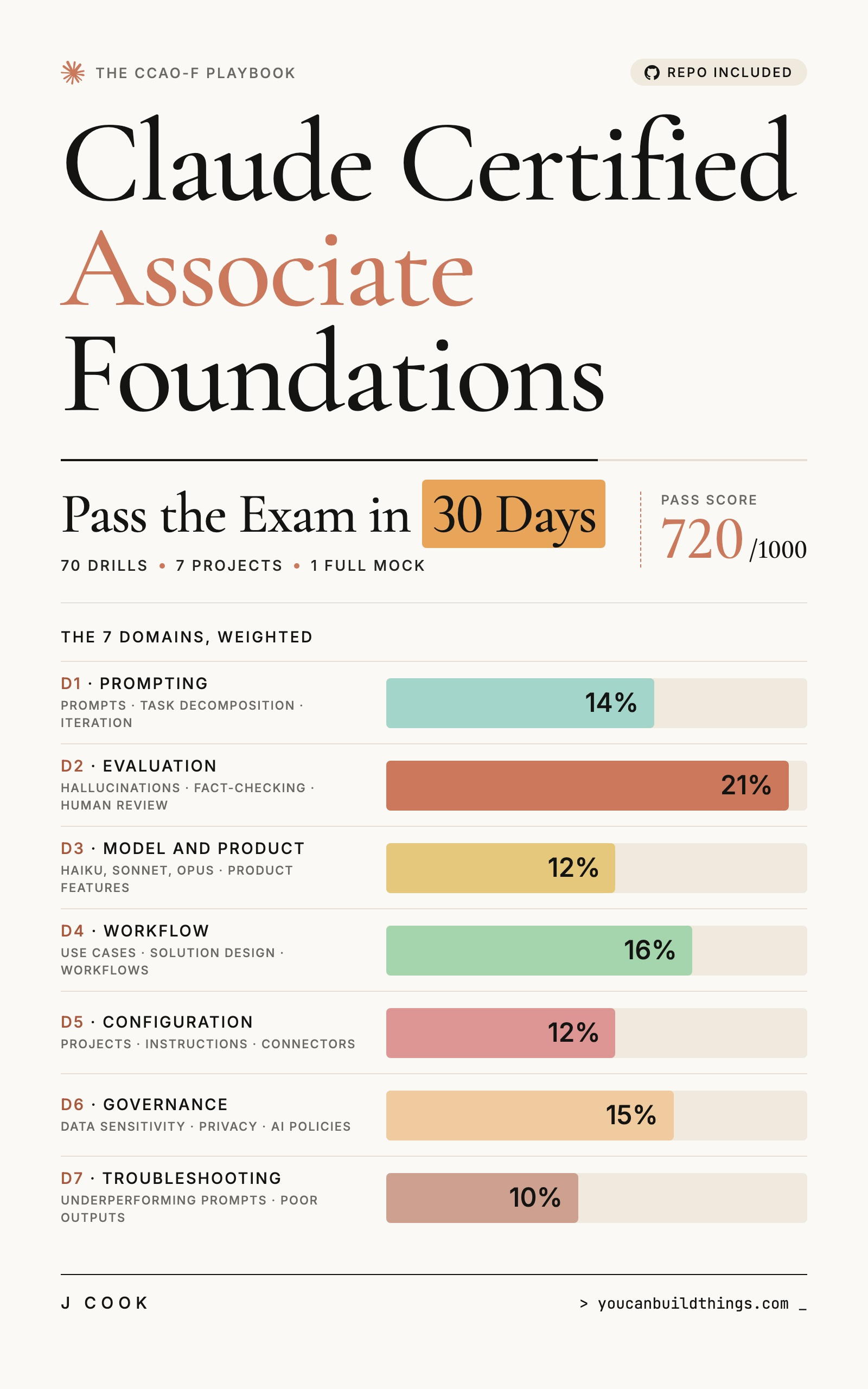
>This covers the one page. Claude Certified Associate Foundations Playbook walks you through the seven hands-on Claude projects that fill it, on your own work, plus the drills and the 60-question mock that get you the pass.
Claude Certified Associate Foundations Playbook
Pass the CCAO-F in 30 Days with 70 Scenario Drills and 7 Hands-On Claude Projects
Hello builders,
The Claude certification pays off at your firm when you send it to the person who staffs Claude work together with one page of work you measured yourself, because that page gives them something specific to say yes to. On its own, the badge gets a rougher reception, and one comment under a Reddit post congratulating a passer said it plainly: “Id be kinda ashamed to put that on my LinkedIn ngl.” So is Claude certification worth it? For the $99 fee and a month of prep, I think so, as long as the work travels with it.
Both sides of that argument turn up in the same threads. Under one passer’s tips post, someone asked whether employers are looking for it, and the answer came from a person whose employer had asked them to take it: “Yes they are. They asked me to do it.” Another passer, whose habit of scoping a use case first had killed three of their own proposals, put it the other way: “Nobody is hiring off it.” My read is that both are describing the badge alone. The credential opens the conversation. Your work wins it.
Here’s what the badge itself claims, from Credly, where Anthropic issues it as a Foundational-level certification:
“The Claude Certified Associate – Foundations credential is designed for client-facing and delivery practitioners. Earners can apply Claude to everyday business tasks, evaluate and refine its output, select the right products and models, and use Claude responsibly.”
The skills it lists are Claude Projects, Knowledge Management, Model Selection, Output evaluation, Prompt Engineering, Responsible AI, Troubleshooting and Workflow Integration. That tells a staffing lead you passed a proctored exam on everyday Claude judgment, and the terms you accept at registration are careful about how far it goes: “Certification is not a warranty or guarantee of an individual’s abilities.” The certification FAQ also lists the Associate as the one exam that doesn’t count toward a firm’s Claude Partner Network tier, so we pitch it as the everyday Claude work it covers.
Build the one page
I call the page a proof pack: three measured samples, your credential line and one specific ask. Who gets it? One person: whoever decides who works on Claude engagements at your firm. Any recurring task you already do with Claude can be a sample: a weekly client update, a meeting summary, a set of replies. My book builds seven of them on purpose (a study Project, a brief, a fix ladder, an acceptance sheet, a picker card, a workflow map and a sign-off sheet), and either way you pick the three with the clearest before-and-after in your own work.
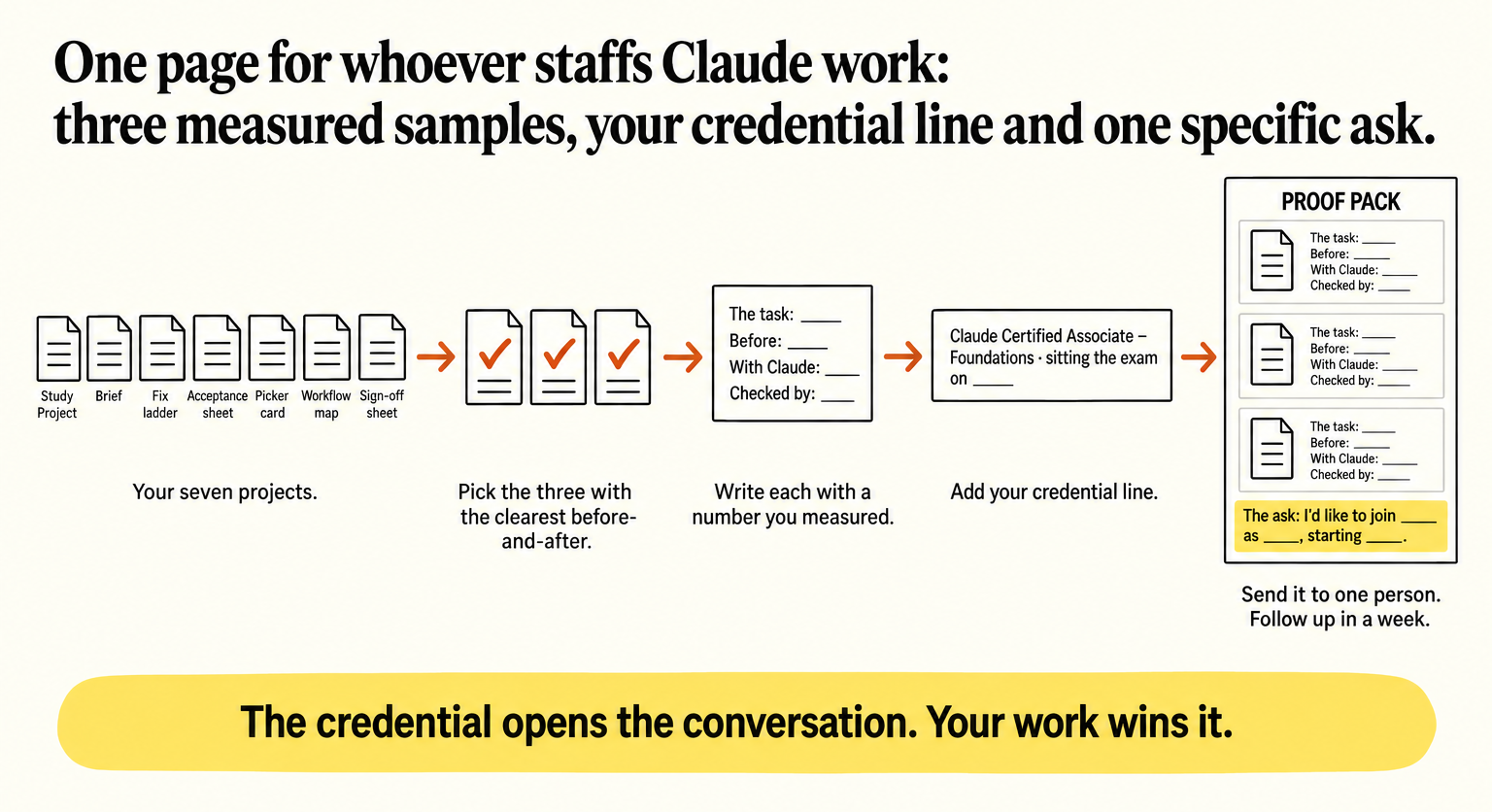
We write each sample in four lines, with a number we measured. The book prints no example numbers here on purpose, since the only numbers that belong on this page are yours.
The task: the recurring job, in one line Before: how it was done, and the number (minutes, edits, outputs passing out of 10) With Claude: what changed, and the new number Checked by: the acceptance check, the reviewer or the sign-off rule
Under the three samples goes your credential line. Before the exam, that’s “Claude Certified Associate – Foundations · sitting the exam on [date],” and after you pass it becomes the earned form with its period. Then the ask: “I’d like to join [engagement] as [role], starting [date].” Name the workstream and what you’d take on in the first two weeks, so the reader has something concrete to approve. Send it to that one person, and put a follow-up in your calendar for a week later.
Where do the numbers come from if you never timed anything? We can still get honest ones this week. Rerun one task twice on the same day, once as a one-line request and once with your saved brief, and time both. Open a document’s version history and count what changed between the Claude draft and the version you sent. Or regrade the same 10 inputs against the same checklist after you tighten your brief, which gives you two pass rates anyone can check. Leave estimates off the page, because “probably saves an hour a week” invites the first question the reader will ask: how do you know?
Keep it from lapsing
Every place you list the credential, list its period with it, because the terms bar you from presenting yourself as certified after it expires. The rest is renewal, and the policies page is clear about it:
“Certifications are valid for 12 months from the date you earn them. Before yours expires, you can renew it for free by passing an open-book online assessment on Anthropic Partner Academy, which extends your certification for another 12 months from your current expiration date. You can retake that assessment as many times as you need. If your certification lapses, you’ll need to pass the full exam again to regain it.”
The same page says the certification “belongs to you, not to your employer,” so add a personal email to your Credly profile the day you pass. Then we set a reminder 11 months from the award date to take the free renewal. Miss it, and the exam policy puts you back to sitting the full exam at the full fee.
If you post it to LinkedIn, list the period and put one line of measured work under the badge, with your own numbers in it.
Now go build something this weekend!
John Cook