How to Pass the Tricky Questions on the Claude Certified Associate Exam
Pass the Claude Certified Associate by getting its dozen or so tricky questions right, the ones where two options both look correct. Anthropic's three official sample questions are all keyed to B, so here is the method they never train, shown on one question whose answer flips when one clause changes.
>This covers the tie-break on one question. Claude Certified Associate Foundations Playbook drills it across 166 scenarios in all seven domains, each key naming the word that decides it, plus a 60-question mock scored by domain.
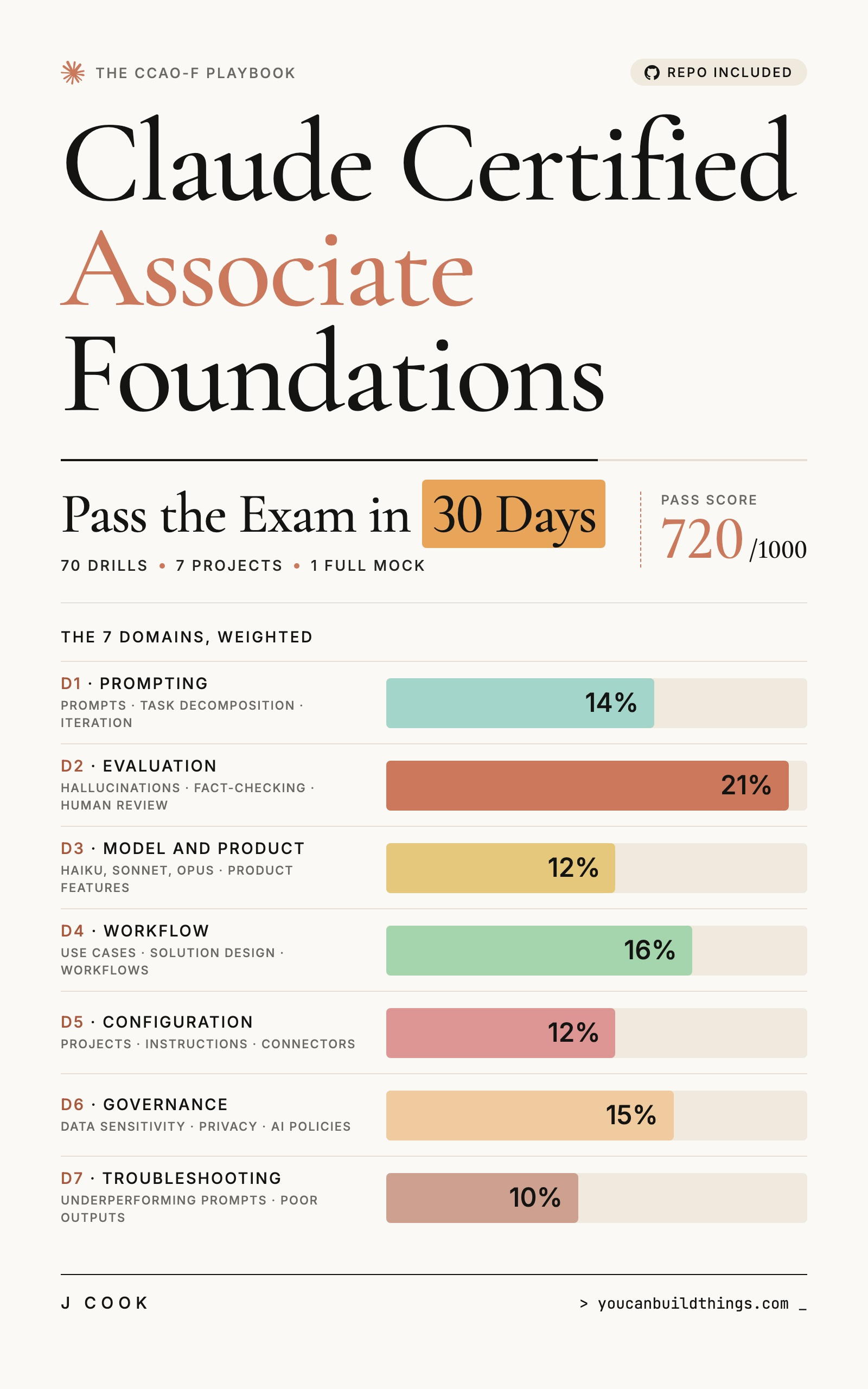
Claude Certified Associate Foundations Playbook
Pass the CCAO-F in 30 Days with 70 Scenario Drills and 7 Hands-On Claude Projects
Hello builders,
You pass the Claude Certified Associate exam by getting its dozen or so tricky questions right, the ones where two answers both look correct, and that’s a skill you can train on purpose. The free material won’t train it for you: I measured the three official sample questions and every one is keyed to B. Candidates report the same pattern in the Claude Certified Associate practice questions they find, so here’s the method I’d drill, shown on one question whose right answer moves when a single clause changes.
Here’s what the three samples in the official exam guide look like once we strip the wording and keep the shape.
- Sample 1, Output Evaluation: keyed B, options run 54 / 80 / 72 / 54 characters
- Sample 2, Model Selection: keyed B, options run 77 / 76 / 44 / 34 characters
- Sample 3, Responsible Use: keyed B, options run 54 / 86 / 53 / 27 characters
Three for three on B, and B is also the longest option in two of them. Those three were written to show the format (“Multiple-choice and multiple-response items; each item states how many responses to select,” in the guide’s words). Practice on questions like them and what do you learn? You learn to reach for the fullest, most careful-sounding option, which is no help once two options are both full and careful.
That part of the exam decides your score. One passer who scored 934 out of 1,000 put the split plainly: “80% of the question will have one obvious correct answer while 20% has subtle close wrongs.” On the 60-item exam, that’s about 12. Another passer, who got through close to the line, said the samples are “too easy, you can pick the right answer just from the choices alone. The real exam narrows it down to two, and that’s where it gets hard.” A candidate who failed summed it up in eight words: “Its super hard and 2hrs is not enough.”
Read the last sentence first
The method takes about 10 seconds per item once it becomes a habit, and we will run it on a real-shape question in a minute.
- Read the last sentence of the question first. It holds the word that decides the item (first, only, before, without, next, most appropriate) and tells you whether to pick one answer or two.
- Strike the options that answer a different question. Ask whether each option fixes the problem this scenario describes, and cross out the ones that fix some other problem.
- Let that one word choose between the two that survive, then commit and move on.
Now watch it work. A project manager typed a two-line description of her project and asked Claude for a status update for the steering committee. Two milestone dates are wrong, and the draft lists a risk that appears nowhere in her notes. What should she try first? A: switch to Opus and send the same request again, word for word. B: ask Claude to be more careful and to double-check each date. C: split it into three prompts, milestones, then risks, then summary. D: attach the project plan and risk log, and say to use only those.
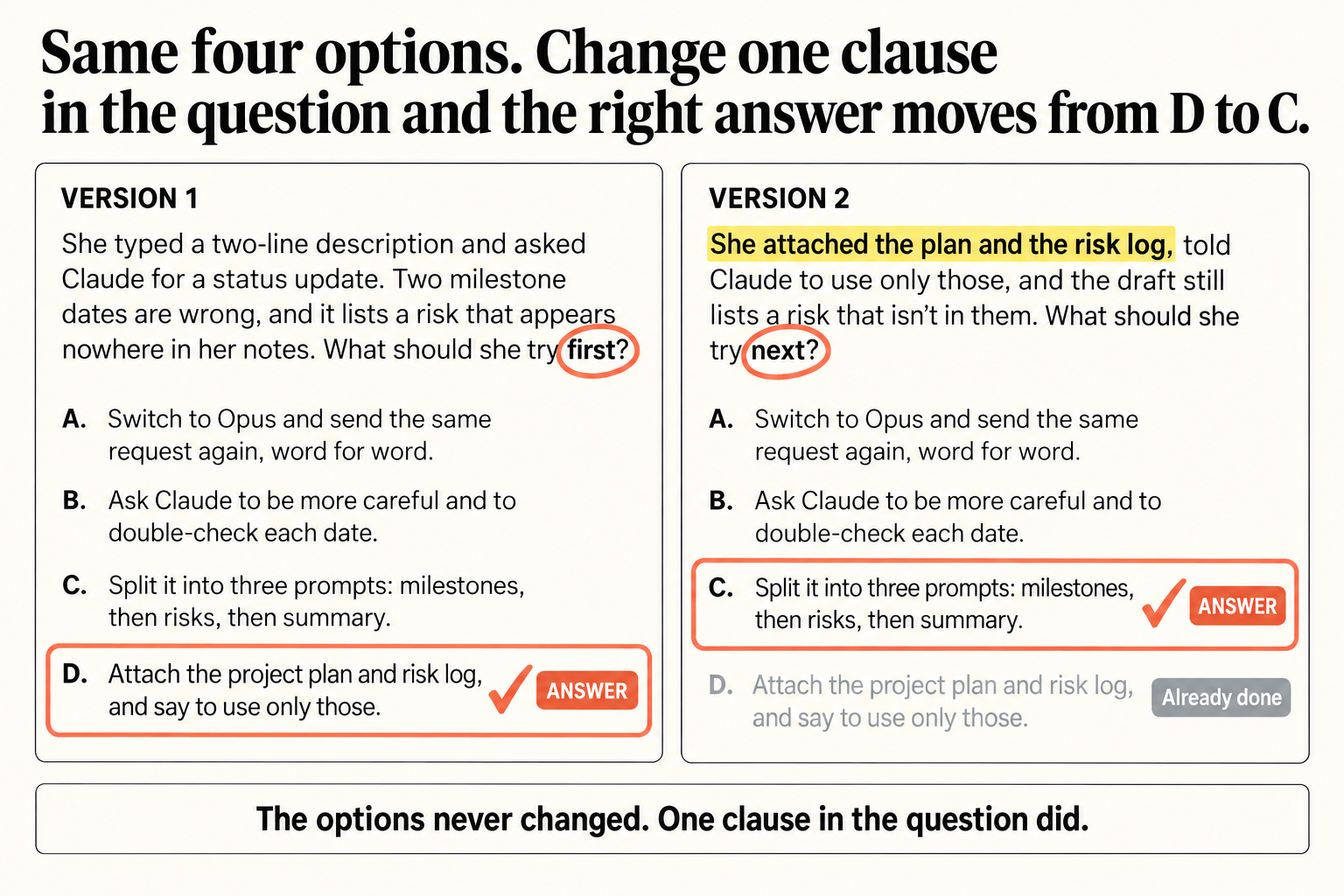
The last sentence says first, so we are looking for the cause, and the stem hands it to us: she gave Claude two lines. Claude got the dates wrong because it had no dates to get right, so it produced plausible ones. A bigger model (A) can’t know dates nobody gave it, and “be more careful” (B) asks for something the tool cannot supply without the inputs. That leaves C and D, and I could defend either one in a meeting. Splitting a big ask into smaller steps is a real technique, and it comes second here. D.
Now we change one clause. She attached the plan and the risk log, told Claude to use only those, and the draft still lists a risk that is not in them. What should she try next? Same four options, and D is already done, so it answers a question nobody is asking anymore. And B? Asking Claude to be more careful changes nothing about the request it just got wrong, and A, a bigger model, is the move to save until the smaller fixes have been tried. C wins. The options never changed. One clause in the question did.
Try one yourself
This one comes from a different domain. Read the last sentence first, pick, then check the key below it.
An events manager wants Claude to draft seating plans from a guest list that includes dietary requirements and medical notes for two guests. What should he do before using Claude? (Choose one.)
- A. Replace names with guest numbers and remove the medical notes first.
- B. Upload the full list and ask Claude to ignore the medical notes column.
- C. Upload the full list in an incognito chat so nothing is stored afterwards.
- D. Skip Claude and draw the seating plan by hand, since health data is involved.
The answer is A, and the deciding words are “before using Claude.” B is the runner-up and the one careful people pick, because it sounds like a compromise. It is the same trap as the third official sample, whose rationale reads: “instructing the model not to retain data … does not satisfy the policy control.” The medical notes still go into Claude, whatever the instruction says. C still uploads everything, and D throws the job away when removing two notes makes it safe.
So what should your practice look like? After every item, we write one sentence on why the right answer beats the runner-up, in our own words, naming the word we should have spotted. If you ask Claude to write practice items, tell it to make two options defensible, keep all four close in length and vary which letter is correct, because one candidate who asked Claude and ChatGPT for practice questions reported that “out of 4 options, three options are easy to eliminate.” Keep your sentences together on one page, and read them once more on the morning of the exam.
Now go build something this weekend!
John Cook