How to Pass the Claude Certified Associate in 30 Days
Pass the Claude Certified Associate in 30 days at about an hour a day, or in 7 when your manager already picked the date, with every hour pointed at the domains that cost you the most points. A half-missed Output Evaluation domain costs more than a fully missed Troubleshooting one, and one multiplication shows you why.
>This covers how to rank your domains and lay out the month. Claude Certified Associate Foundations Playbook prints the 14-question diagnostic with its key, 70 domain drills, a 15-question timed sprint and a 60-question mock scored by domain.
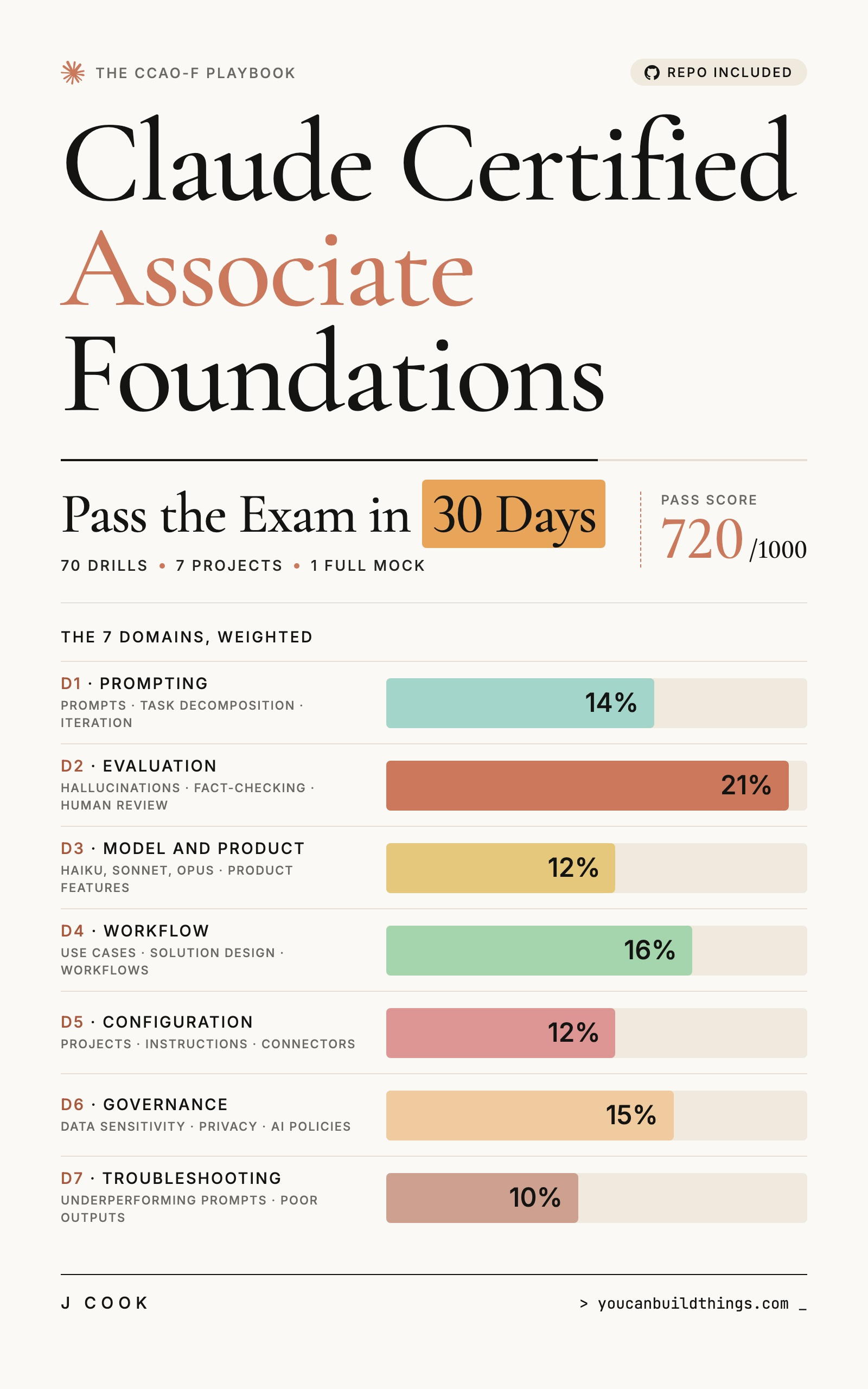
Claude Certified Associate Foundations Playbook
Pass the CCAO-F in 30 Days with 70 Scenario Drills and 7 Hands-On Claude Projects
Hello builders,
You can pass the Claude Certified Associate in 30 days at about an hour a day, or in seven when your manager has already picked the date, as long as every hour goes where the exam pays points. Most people guess wrong about where those points sit: a half-missed Output Evaluation domain costs you more than a fully missed Troubleshooting domain, 1,050 points against 1,000 on the scale we use below. Here’s the Claude Certified Associate study plan I’d build, and it starts with a cold 14-question test before you study anything.
The question behind this plan sat unanswered under a Reddit tips thread from a passer: “Does it require a lot of prep?? My manager is forcing to give it before monday.” People who have posted about sitting it on Reddit and X report everything from two weeks of study to none at all, and neither the exam guide nor the certification page gives a recommended study time. Its certification page and exam guide say only this:
“Prerequisites: There are no mandatory prerequisites or required courses, and no software-development or API experience is needed. The experience above is recommended, not required. The credential is awarded based on exam performance alone.”
So how long do you need? That depends on where you are weak, and on day one you don’t know where you’re weak, which is what the next step is for.
Sit a cold diagnostic
We start with 14 questions, two per domain, in 28 minutes, which is the exam’s own pace of two minutes per item. No notes, no Claude, and nothing studied beforehand, so the score measures what you bring in cold. My book prints a 14-item diagnostic with its key. Without it, pick two practice questions per domain whose options include two believable answers, for example from the free official prep course on Partner Academy, which has one module per domain. Score a two-answer item right only if both picks are right, since the exam does not publish whether it gives partial credit. Each domain comes out at 0%, 50% or 100%.
Every domain gets exactly two items, so every domain gets a reading. We bring the weights in when we score it, and these are the seven the exam guide publishes.
- D1 Prompting and Task Execution: 14%
- D2 Output Evaluation and Validation: 21%
- D3 Product and Model Selection: 12%
- D4 Workflow Integration and Solution Design: 16%
- D5 Configuration and Knowledge Management: 12%
- D6 Governance, Risk, and Responsible Use: 15%
- D7 Troubleshooting and Optimization: 10%
Weight every gap
For each domain, the weighted gap is (100 minus your score) times the weight of that domain. Circle the two biggest. Those are your priority domains, and they get extra time every day from the second week on.
Here is the result for one reader, as an illustration: 100% on Prompting, Model Selection, Workflow and Configuration, 50% on Output Evaluation, and 0% on both Governance and Troubleshooting.
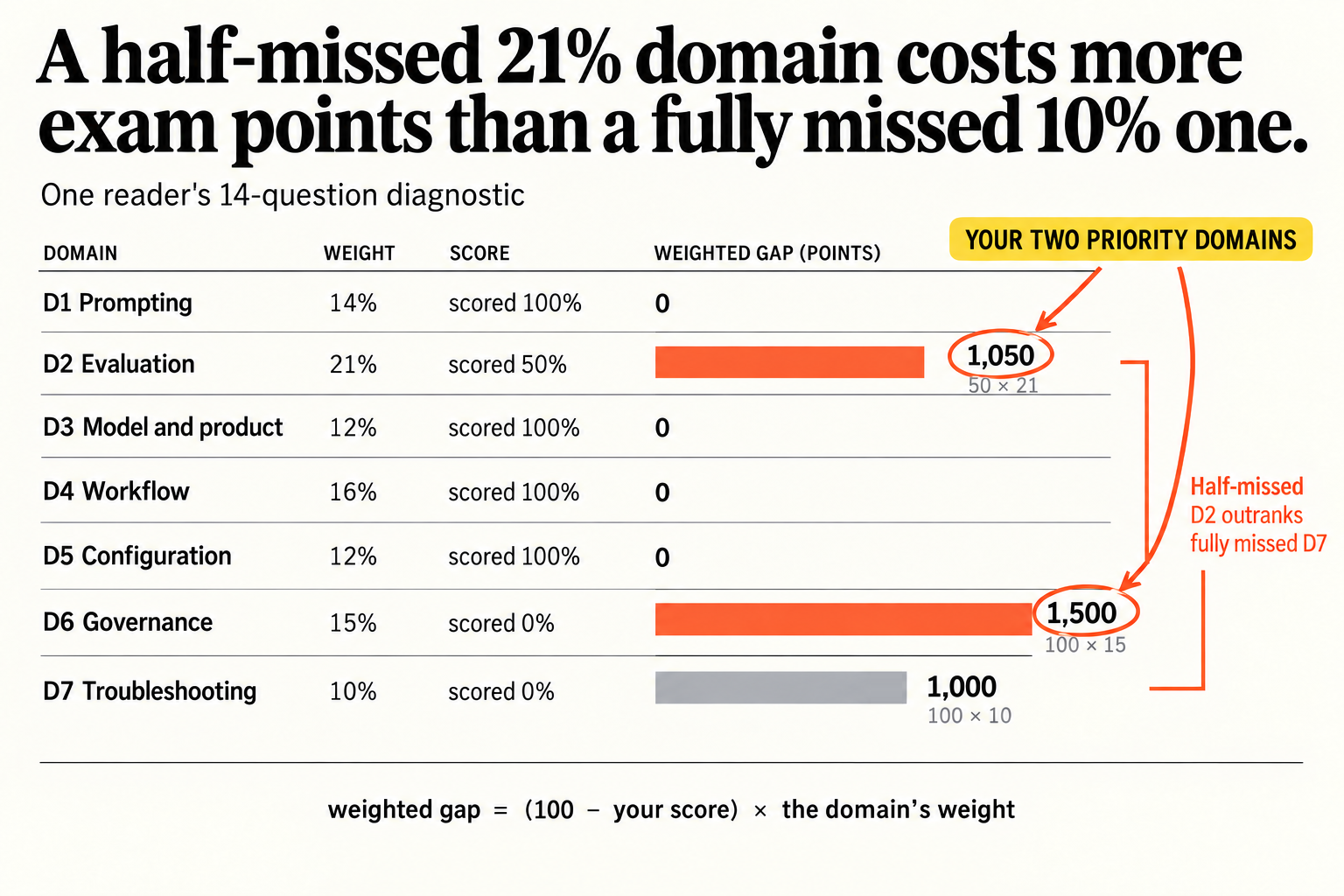
Governance comes out at 100 × 15 = 1,500. Output Evaluation comes out at 50 × 21 = 1,050, and Troubleshooting lands third at 100 × 10 = 1,000, even though both of its items went wrong. How does a half-right domain outrank a zero? The exam asks about twice as many Output Evaluation questions as Troubleshooting ones, 21% against 10%. So the priorities for this reader are Governance and Output Evaluation.
Two items per domain is a coarse reading, and one lucky guess moves a domain from 0% to 50%. The map can’t predict your score either, because Anthropic doesn’t publish how raw answers convert to the 100 to 1,000 scale, so I only use it to choose where the next hour goes.
Lay out the 30 days
At about an hour a day, we lay the month out in four blocks that follow the exam’s own split. The Week 1 Project works on any plan, including Free: upload the exam guide as knowledge, and give it instructions to ask you one workplace scenario question at a time, with four options and two believable ones, then wait for your answer before explaining.
- Week 1: book the date and sit the diagnostic; set up a Claude Project that quizzes you; study Configuration (12%)
- Week 2: Prompting, Troubleshooting and Output Evaluation (45% together)
- Week 3: Model Selection, Workflow and Governance (43% together)
- Week 4: a full 60-question mock, scored by domain, then the exam
From Day 8, spend 15 minutes a day on your two priority domains, whichever week teaches them. Governance comes up in Week 3, and by then our reader has already had four short sessions on it, one every other day of Week 2. Sit the full mock at least three days before the exam, because the certification FAQ lets you move a booking only up to 48 hours before it, and a “wait” verdict has to arrive while we can still act on it. And leave the last day for rest, since the exam is 120 minutes of long workplace scenarios and you want to read them rested.
When the mock comes back, my line is 70% in every domain. Anything under it means we move the booking 7 to 14 days and drill that domain again.
When your manager says Monday
With a week, the biggest domain goes first and the order follows weight.
- Day 1: the diagnostic and a skim of the guide’s objectives
- Day 2: Output Evaluation (21%)
- Day 3: Prompting and Troubleshooting (24% together)
- Day 4: Workflow and Governance (31% together)
- Day 5: Model Selection and Configuration (12% each)
- Day 6: 15 questions in 30 minutes under exam conditions, then half a mock
- Day 7: the exam
Before you book Monday, run the numbers once: what does a failed first attempt cost? Under the exam’s retake rules, the full fee again and 14 days before you can resit, so “Monday, unprepared” often ends up later than “three weeks from now, ready.” I’d show the manager this plan and ask for the month.
Now go build something this weekend!
John Cook