How to Make Money with Claude Code: 4 Real Paths
How to make money with Claude Code: four income paths with real rate ranges, the deliverable each buyer pays for, and the first move to make this week.
>This covers the four income paths. Master Claude Code goes deeper on the .claude/ config you hand clients, the security docs that close the sale, and the demo script that justifies the rate.
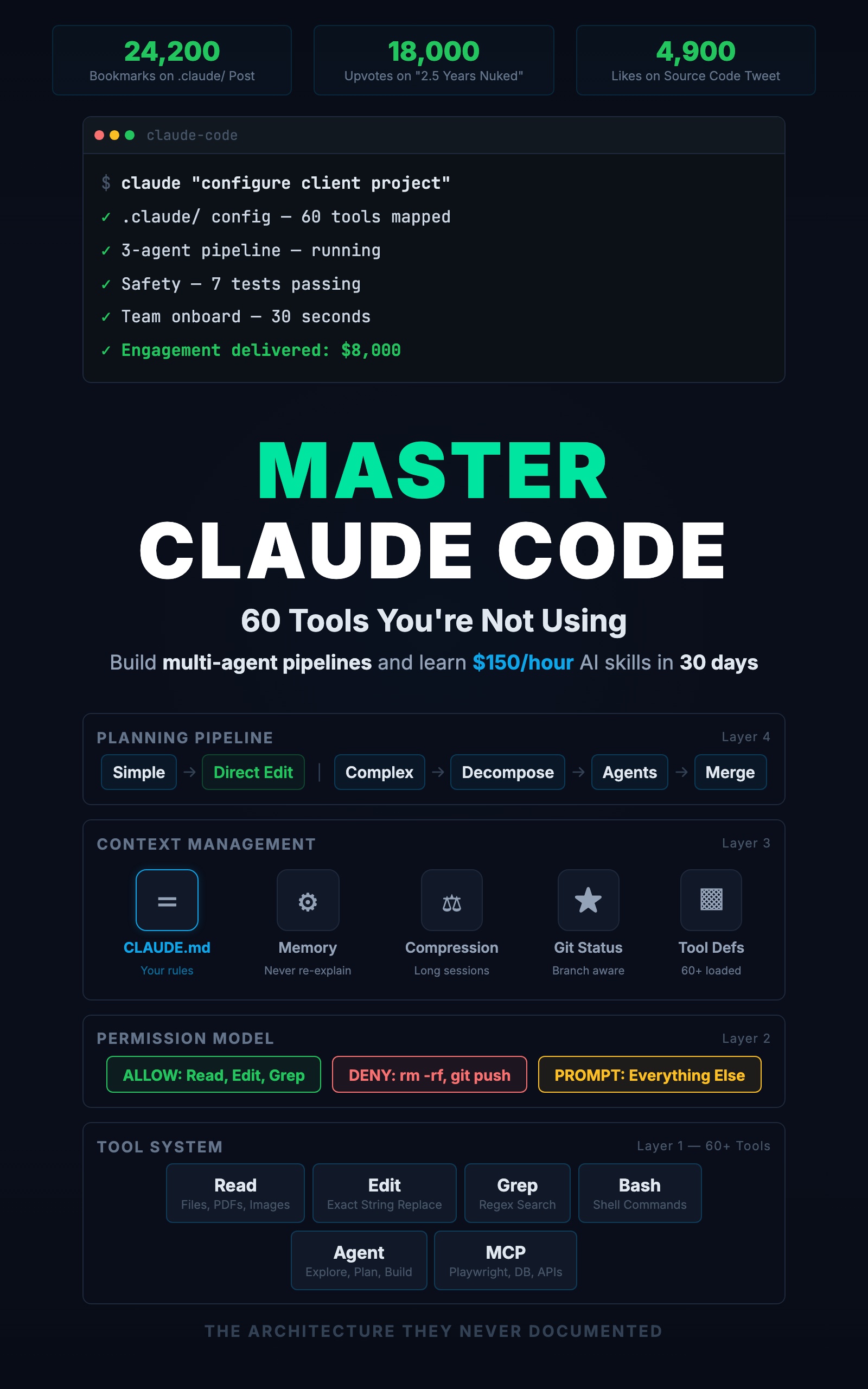
Master Claude Code: 60 Tools You're Not Using
Build Multi-Agent Pipelines and Learn $150/Hour AI Skills in 30 Days
Summary:
- Four income paths from Claude Code mastery: freelance, micro-SaaS, consulting, workshops.
- Real rate ranges from market data, plus the exact deliverable each buyer pays for.
- You sell infrastructure the client keeps, not “I use AI.”
- A copy-paste demo script, a weekend SaaS plan, and a consulting deliverable tree.
If you want to know how to make money with Claude Code, the honest answer is that nobody pays you for the tool. A $20 subscription is not a business. What clients pay for is what the tool lets you ship: a project that takes one week instead of three, a configured setup their team keeps, a product that runs on a weekend’s work. There are four paths that work, and they share one rule: sell the deliverable, never the AI.
How do you actually make money with Claude Code?
You make money with Claude Code by packaging your skills into one of four offerings: premium freelance development, a micro-SaaS product, a fixed-scope consulting engagement, or a paid workshop. Each is a real thing a buyer can see and keep. The premium comes from demonstrable infrastructure, not from telling someone you use an AI tool. Every developer says that now. It moves no rates.
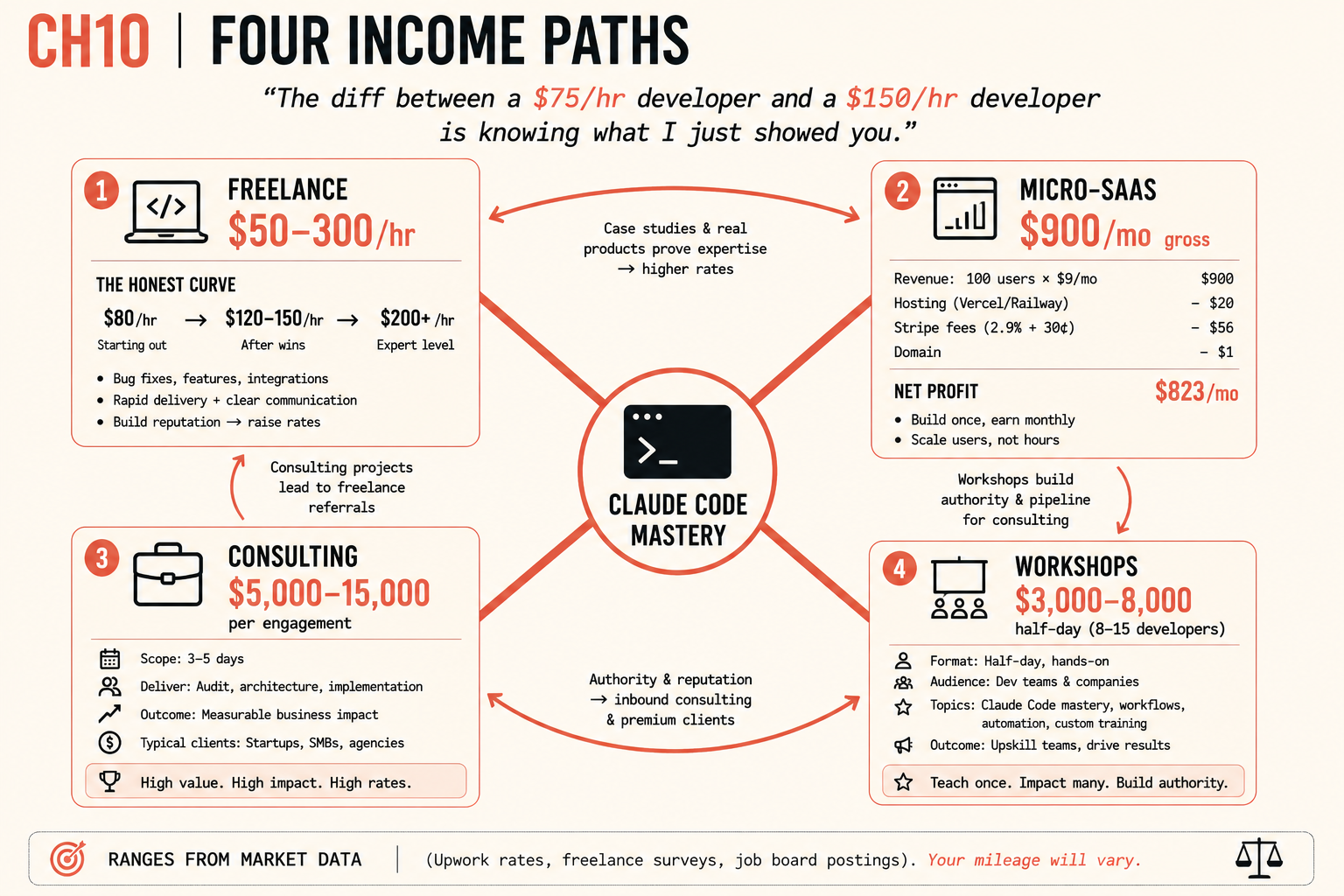
Here is the map, with rates pulled from market data (Upwork rates, freelance surveys, job board postings):
| Path | Entry effort | Revenue range | What the buyer keeps |
|---|---|---|---|
| Freelance | Low | $50–300/hr | Code + your .claude/ config |
| Micro-SaaS | Medium | ~$900/mo gross at 100 users | A product + recurring revenue |
| Consulting | Medium | $5,000–15,000 per engagement | Config package + training |
| Workshops | Higher | $3,000–8,000 per half-day | Curriculum + hands-on session |
What does the $20 subscription turn into?
The cheapest tier that includes Claude Code is Pro, at about $20 a month. That is the entire input cost. Here is the current pricing, pulled live:
| Plan | Price | Note |
|---|---|---|
| Free | $0 | Does not include Claude Code |
| Pro | $20/mo (or $17/mo billed annually) | Lowest tier with Claude Code |
| Max | From $100/mo | Higher usage limits |
Source: claude.com/pricing.
So the math is a $20 input. The output is billed at developer rates. That gap is the whole business, and it is the difference between a $75/hr developer and a $150/hr developer. The skills in the book are what move you across it.
Path 1: Freelance at premium rates
Freelance development is the most direct path: you code faster and hand over better infrastructure, so you charge more per hour. The trick is the demo. Don’t tell a client you use AI. Show them a live build. This is the 10-minute script that does the selling for you:
1. Show SPEC.md: "Every project starts with a 30-line spec."
2. Show the .claude/ directory: "This config travels with the
   project. Your team inherits my rules after I leave."
3. Run /feature "add user avatars with image upload" and let
   the client watch Claude Code scan, plan, and build it.
4. Run /review: the automated quality check.
5. Run the tests: everything green.
6. Show SECURITY.md: "Here is exactly what the tool can and
   can't do on your codebase."
That demo beats any rate justification. The client sees speed, consistency, and safety infrastructure, and the number stops being a debate. On the rates: an $80/hr developer can justify $120 to $150/hr with the config deliverable and the speed demo. A $150/hr developer can justify $200+/hr with team setup and security hardening. Don’t discount the first project to win it. Charge your rate and treat the first client as the case study that lands the next three.
Path 2: Micro-SaaS
The app you build in the book (a task API with auth, a database, and a deployed URL) is one frontend and a Stripe checkout away from being a product. The build is a weekend, not a quarter:
Weekend 1 — build
- API already exists
- Add a React frontend (one afternoon)
- Add Stripe Checkout for subscriptions (one evening)
- Write a landing page (one sitting)

Weekend 2 — launch
- Deploy frontend + landing page
- Post on Product Hunt
- Write 2-3 SEO posts targeting "task tracker for [niche]"
- Post in 3-5 relevant communities
Be honest about the economics. At $9/month with 100 users, you gross $900/month. Subtract roughly $20 hosting, about $56 in Stripe fees, and $1 for the domain, and you net around $823/month. Getting to 100 users is the hard part, not the build. The advantage is that if it flops, you lost 20 hours, not three months. Build three of these and see which one gets traction.
Path 3: Consulting engagements
Companies want Claude Code configured for their team. Most have no idea how. You package that as a fixed-scope deliverable, and here is exactly what lands in the client’s repo:
.claude/
├── CLAUDE.md            (50-80 lines, project-specific)
├── settings.json        (permissions, hooks)
├── commands/
│   ├── review.md        (team code review)
│   ├── feature.md       (research-plan-build pipeline)
│   ├── onboard.md       (codebase tour)
│   └── pr-prep.md       (PR description generator)
└── memory/
.mcp.json                (shared MCP servers, if any)
SECURITY.md              (boundaries + 7-point test results)
.github/PULL_REQUEST_TEMPLATE.md  (AI review checklist)
That package runs $5,000 to $15,000 depending on team size and codebase complexity. The work takes three to five days. Price the engagement, not the hour: “$8,000 to $12,000 for your team’s Claude Code setup” is far easier for a budget owner to approve than “30 to 50 hours at $250.” And if you finish in three days instead of five, you deliver early and earn more per day. Don’t lower the price.
Path 4: Training and workshops
If you can configure it, you can teach it. A half-day workshop runs four hours: architecture, building the .claude/ config, safety and team standards, then a live multi-agent pipeline. Pricing lands at $3,000 to $8,000 for a half-day with a team of 8 to 15 developers. The low end is meetup-style; the high end is corporate training customized for their stack.
Build demand with free content first. One blog post covering a single chapter, one lightning talk, one short video of a live build. Free content builds authority, authority generates inbound, and one workshop refers the next. Record it once and the same material sells as a self-paced course for $49 to $99 on Gumroad or Teachable.
What should you actually do?
- If you already freelance and want a raise: pick Path 1. Record the 10-minute demo this week and update your rate on the next proposal.
- If you have a product itch and a free weekend: pick Path 2. Write the SPEC.md this weekend, ship the MVP next weekend.
- If you have a network of companies adopting AI tools: pick Path 3. Write the one-page service description with the deliverable tree above and send it to three companies you already know use Claude Code.
- If you like teaching and have an audience: pick Path 4. Outline the four-hour workshop and offer it free to one local meetup as a test run.
Pick one. Two or three will reinforce each other later (a consulting gig hands you a SaaS idea, a SaaS launch becomes a freelance case study), but you start with one.
The bottom line
- The premium is the deliverable, never the AI. A configured
.claude/, aSECURITY.mda compliance team can read, a set of team commands. Those are what companies pay for. - Price on value, not time. A setup that saves a 20-person team two hours each per week is worth six figures a year to them. Charging five grand for it is a bargain you should take.
- Stop waiting to feel ready. Your first client needs someone who knows more than they do, not the world’s top expert. After the book, that is you. The only thing separating the developers who earn from this and the ones who don’t is that the first group started.
Frequently Asked Questions
Can you actually make money with Claude Code?+
Yes, through four paths: premium freelance development, micro-SaaS products, fixed-scope consulting engagements, and paid workshops. You sell the deliverable (a configured setup, a shipped product, a training session), not the fact that you use an AI tool.
How much can a Claude Code freelancer charge?+
Developer rates on Upwork and Toptal run $50 to $300 an hour. The skills push you toward the top of your own range: an $80/hr developer can justify $120 to $150/hr with a configured setup and a live build demo.
What does a Claude Code consulting engagement deliver?+
A configuration package: a project-specific CLAUDE.md, settings.json with permission boundaries, custom commands, a SECURITY.md, and a team training session. That package runs $5,000 to $15,000 for three to five days of work.