How to Pass the Safety Questions on the Claude Certified Associate Exam
Turn the safety section of the Claude Certified Associate exam into some of your surest points, about 9 of every 60 questions, with one sorting habit and one rule. One candidate failed after treating this section as secondary; here are the three lanes, the two halves of Anthropic's rule, and the four half-measures the exam keeps offering as answers.
>This covers the governance rule and one worked question. Claude Certified Associate Foundations Practice Questions drills it across 32 governance questions and 34 workflow questions, every option explained, plus six full mocks scored by domain.
Claude Certified Associate Foundations Practice Questions
600 Questions and 6 Practice Tests to Pass the CCAO-F Exam
Hello builders,
You can turn the safety section of the Claude Certified Associate exam into some of your surest points, because most questions in it come down to one rule you can learn in an afternoon. The section is Governance, Risk, and Responsible Use, 15% of the exam or about 9 of every 60 questions, and we answer the Claude Certified Associate responsible use questions in it the same way every time: sort the task into a lane, then check both halves of the rule.
One candidate who failed wrote that their score report showed they “underperformed in the safety and responsible use sections specifically.” Their own diagnosis was one line: “i had focused preparation time on the practical usage sections and treated the safety content as secondary which was clearly a mistake.” How many of those nine can you afford to give away on an exam with a scaled pass mark of 720?
Sort the task into a lane
Every task in these questions belongs in one of three lanes. The three lanes are my frame from the book, and the rule for the third one comes from Anthropic’s Usage Policy.
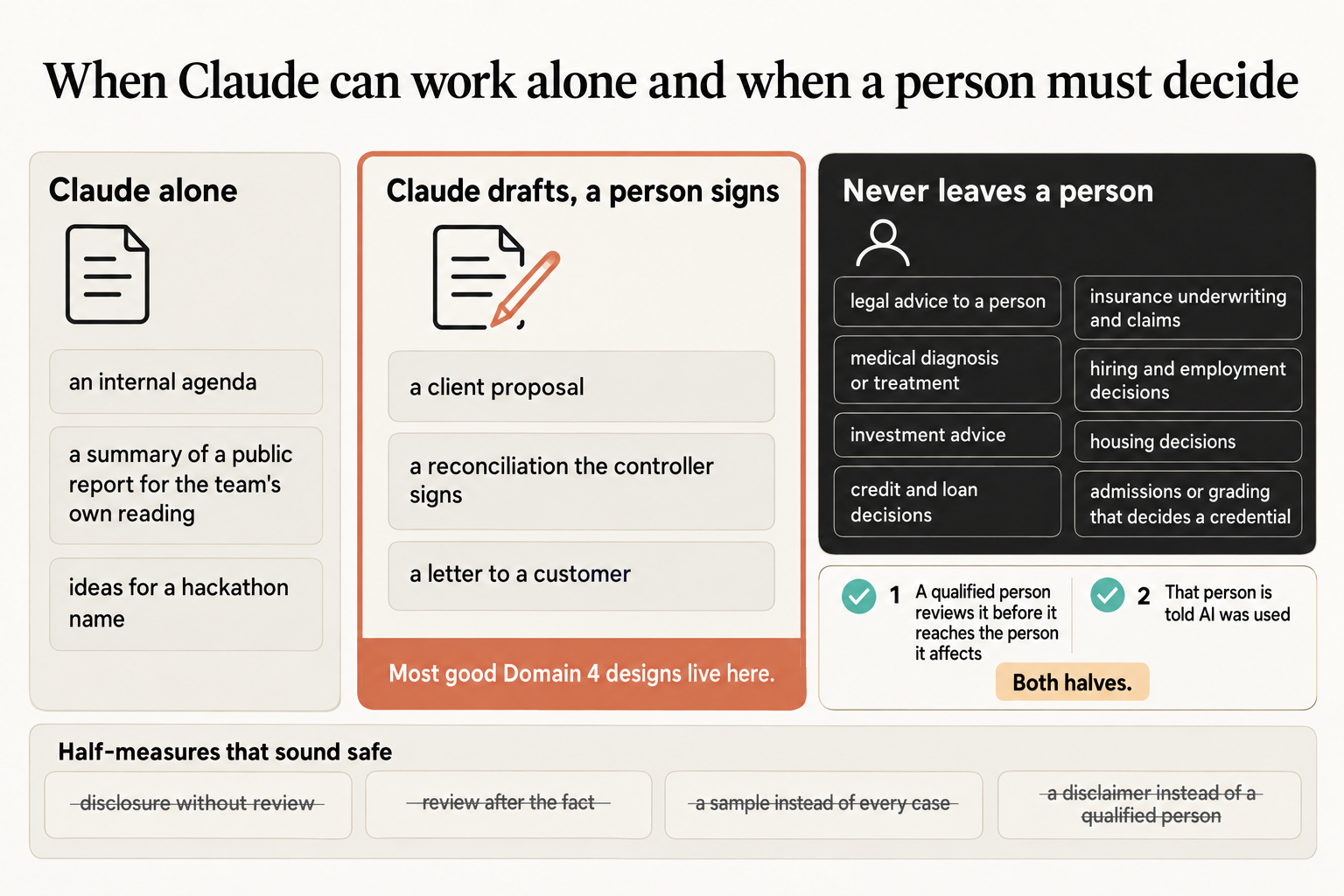
Claude alone. The output touches nobody’s rights, money, health, home or job, so a quick check by the person using it is enough: an internal agenda, a summary of a public report for the team’s own reading, ideas for a hackathon name.
Claude drafts, a person signs. The output matters, so a qualified person reviews it before it goes anywhere: a client proposal, a reconciliation the controller signs, a letter to a customer. Most good workflow designs on the exam live in this lane.
Never leaves a person. These are high-stakes decisions about one individual, and the picture names eight of them: legal advice to a person, medical diagnosis or treatment, investment advice, credit and loan decisions, insurance underwriting and claims, hiring and employment decisions, housing decisions, and admissions or grading that decides a credential. Claude can still do the reading and the first draft in this lane, as long as a person makes the call.
Check both halves of the rule
The third lane runs on a rule from Anthropic’s Usage Policy. The page now shows a newer version, marked with the date it takes effect, and here is its wording under “High-risk Use Case Requirements”:
Qualified human-in-the-loop for advice and decisions — A qualified person must meaningfully review a High-risk AI Recommendation, with the authority to change or modify it, before it is delivered as advice to an individual who might rely on it or before it is used to implement a decision.
Disclosure for advice and decisions — An individual who receives advice or who is the subject of a decision based on a High-risk AI Recommendation must be clearly told that AI was used to produce it.
So for a high-stakes decision about one person, we check two things: a qualified person reviews it before it reaches them, and they’re told AI was used. The same page defines qualified as “someone with the training or experience to evaluate the output in that field, and who holds a license where applicable law requires one.” The version it replaces asks for the same two halves, a qualified professional’s review before the decision is final and disclosure of AI use, across 7 high-risk use cases. The newer page lists 11 areas and names some the older list doesn’t, such as healthcare access, public benefits and services, and legal status and adjudication. The eight on the picture are high-risk under both versions, since the older list groups employment and housing as one case and puts investment advice and credit under finance, which is why I wrote every drill in the book around those eight, so the answers hold either way.
What moves a task from the middle lane into the third? We ask one question: is this advice or a decision about one person, in one of those eight areas, that the person will rely on or be bound by? A client proposal goes to a client who can say no, so it stays in the middle. A rental decline decides where someone can live, so it moves to the third lane and picks up the disclosure half. The newer version also puts “Internal drafting, research, summarization, or analysis that is not the ultimate High-risk AI Recommendation delivered” outside the rule, which is the middle lane.
Spot the half-measure
When I wrote the wrong answers for the book’s 32 drills on this domain, I built most runner-ups (the option that looks right) the same way: keep one half of the rule and drop the other. Four versions come up again and again:
- Disclosure without review
- Review after the fact
- A sample instead of every case
- A disclaimer instead of a qualified person
Here’s a warm-up from the book. Pick before you read the key. A letting agency gets about 90 rental applications a month, and its operations lead wants Claude to read each applicant’s file and “send the approval or decline email itself,” to cut the wait from five days to one. What’s the most appropriate design? (Choose one.)
- A. Claude sends the emails, and a qualified staff member reviews a random tenth of the decisions every week.
- B. The agency keeps Claude away from the whole process, since rental decisions can never involve AI tools.
- C. Claude sends the emails, and each one tells the applicant that an AI system helped reach the decision.
- D. Claude summarizes each file against the criteria, and a qualified staff member decides every reply.
The answer is D, and the words that decide it are “send the approval or decline email itself.” A housing decision is in the third lane, so a qualified person has to decide before the applicant hears anything. A is the runner-up, a sample checked after applicants already have their answers, which is two half-measures at once. C is disclosure without review. B throws away the faster replies that a reviewed draft would keep.
One more rule for data
A smaller share of these questions turn on data, and we answer them with a second rule: share only what the task needs, follow your organization’s policy on what may be uploaded, and if it restricts identifiable data, remove the identifiers before upload. Telling Claude not to keep something doesn’t satisfy a rule about uploading it. Watch for a true product fact, like a plan that isn’t used for training by default, sitting inside an option that uploads more than the task needs.
When we mark our practice sets, we log every governance miss by which part decided it: review before it reaches the person, disclosure, or the data policy. Which column fills up fastest in yours? That one goes on the card you read on exam morning.
Now go build something this weekend!
John Cook