How to Pass the CCAO-F on Your First Try With Mock Exams
Pass the Claude Certified Associate exam on your first $99 attempt by sitting mock exams the way the real one runs: 60 questions, 120 minutes, scored by domain. Here's the pacing strip, the three rules for the block, and the scoring routine that turns one mock into a list of what to drill.
>This covers how to sit and score one mock. Claude Certified Associate Foundations Practice Questions prints six full 60-question CCAO-F mocks, 210 domain drills and a 35-question diagnostic, with every option explained.
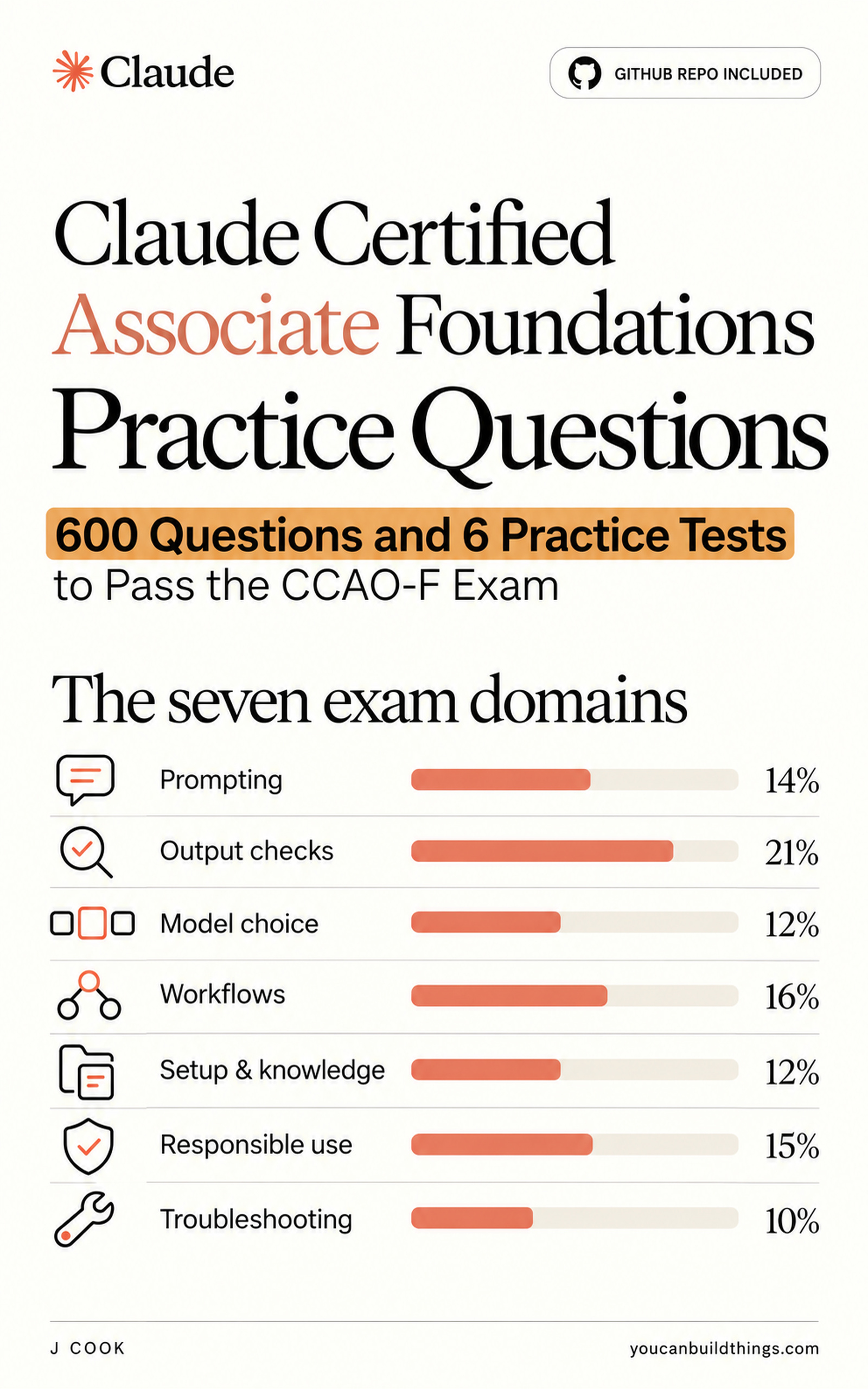
Claude Certified Associate Foundations Practice Questions
600 Questions and 6 Practice Tests to Pass the CCAO-F Exam
Hello builders,
You can walk into the Claude Certified Associate exam already knowing your pace and your weakest domain, and those two numbers are what a first-try pass is built on. A CCAO-F mock exam gives you both when you sit it on the real clock and score it domain by domain, so here’s how I’d run one.
The biggest post about this exam I found was one line on X: “Did anyone clear Claude Certified Associate - Foundations exam ? If so, any dumps or question sets available ?” More than 1,000 people bookmarked it. This is what I’d tell every one of them to do once they have a set.
Sit it like the real one
Anthropic’s official exam guide puts the whole format in one box near the front. Here’s what version 1.0 prints, word for word:
- Number of items: 60
- Item format: “Multiple-choice and multiple-response items; each item states how many responses to select”
- Time limit: 120 minutes
- Passing score: “Scaled score of 720 on a scale of 100–1,000”
- Result reporting: “Pass/fail with scaled score (100–1,000), plus percent-correct by domain on the score report”
Sixty items in 120 minutes is two minutes a question. One passer wrote that “120 minutes for 60 questions goes by faster than you’d expect,” and a candidate who failed wrote “Its super hard and 2hrs is not enough.” How do you learn a pace like that? You sit the full block, start to finish, at least once before exam day.
Any full 60-question mock works for this. If its key doesn’t tag each question with a domain, tag them yourself as you mark, using the one-line description of each domain in the list further down. Check a free one for a single pattern before you trust its score. The owner of one free bank on GitHub audited their own set and found the right answer was the strictly longest option in 474 of 487 Associate single-answer questions, and that “always picking the longest option scored about 95%.” They rebalanced it, and the same count works on any set you find.
We set a timer for 120 minutes, close the book, close Claude, and put the phone in another room. The real exam is closed book and runs about 135 minutes in the seat with check-in, so we block out the whole afternoon and pace against four checkpoints.
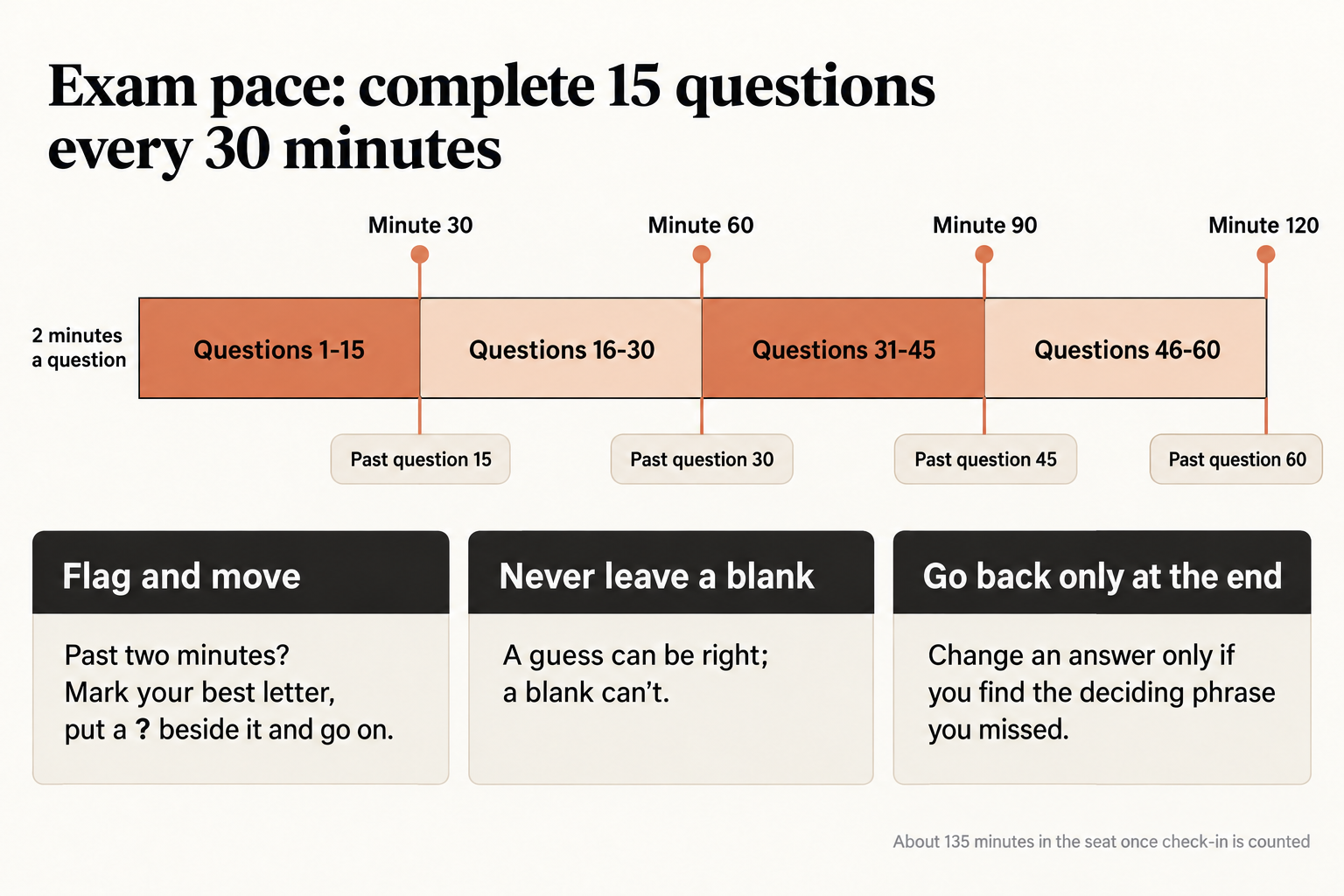
- Minute 30: past question 15
- Minute 60: past question 30
- Minute 90: past question 45
- Minute 120: past question 60
Three rules hold the block together. Flag and move: once you’re past two minutes on a question, mark your best letter, put a ”?” beside it and go on. Never leave a blank, because a guess can be right and a blank can’t. Go back only at the end, and change an answer only if you find the deciding phrase you missed, meaning the few words in the question that settle it.
Score it by domain
The guide weights seven domains, and your real score report gives a percent for each one, so we score the mock the same way. The percentages are the guide’s, the question counts are those weights rounded to 60, and the 75% lines (rounded up) are my rule from the book:
- Prompting and Task Execution (how the work is asked for): 14%, 8 questions, line 6
- Output Evaluation and Validation (checking what came back): 21%, 13 questions, line 10
- Product and Model Selection (which model, which part of Claude): 12%, 7 questions, line 6
- Workflow Integration and Solution Design (which work goes to Claude): 16%, 10 questions, line 8
- Configuration and Knowledge Management (what lives in a Project): 12%, 7 questions, line 6
- Governance, Risk, and Responsible Use (data, policy, who signs): 15%, 9 questions, line 7
- Troubleshooting and Optimization (the smallest fix for a weak result): 10%, 6 questions, line 5
When the timer stops, we write down the finish time and the number of ”?” marks, then mark every question and read every explanation, including the ones we got right. A choose-two question counts only if both picks are right, since there’s no half credit in my book and you should assume none on the exam. Every miss gets a row in a miss log, and so does every right answer with a ”?” beside it, since a lucky guess won’t repeat on a different exam form. Each row has six columns: the question, the letter you chose, the key, whether you picked the runner-up (the second option that looked right), the deciding phrase you missed, and the trap. For the trap, pick the closest of seven: under-briefed request, trusted the output, bigger model, wrong lane or missing license, rule in the wrong place, half-measure that sounds safe, or over-correction.
Then we place the total on a band. Anthropic publishes no table that turns a raw count into a scaled score, so this band is my readiness signal: 48 or more of 60 is comfortably above, 44 to 47 is borderline, and 43 or fewer is not yet. The seven domain lines add up to 48, which is where the top zone starts.
Here’s how one reads, as an illustration and not a real result. Say a first mock comes back at 45 of 60, with output evaluation at 9 of 13 and governance at 6 of 9. The total is borderline and two domains sit under their lines. Both get re-drilled from the miss log, output evaluation first because it carries more questions.
Sit a second one
A second mock on fresh questions at the same weights shows which domains moved. For each domain we mark the change as up, held or down, and any domain that stayed under its line, or fell by two or more questions, gets a re-drill before the next sitting: only the logged misses, with every explanation read again. Does a small domain that slips by one question need a re-drill? Not on its own, since one question on a 6-question domain is noise. Two mocks in a row under the line puts it at the top of the list.
Passers mention one or two mocks, and one who scored 901 summed up their prep as “Skipped the official courses and did 2 mock exams.” Two is the fewest that shows a trend. If you have the days, sit one a day, since the certifications FAQ puts a first fail at the full fee again and a 14-day wait before the retake.
Now go build something this weekend!
John Cook