The Mock Score You Need to Pass the Claude Certified Associate Exam
Know the mock score you need before you sit the Claude Certified Associate exam: 44 of 60 on each of your last two mocks, with every domain at 75%. The passing score is 720 on a 100 to 1,000 scale, Anthropic publishes no way to turn that into a count of right answers, and this go-date rule is what to use instead.
>This covers the go-date rule. Claude Certified Associate Foundations Practice Questions gives you the six scored mocks it reads, plus 210 domain drills and a scorecard that ends in a dated verdict.
Claude Certified Associate Foundations Practice Questions
600 Questions and 6 Practice Tests to Pass the CCAO-F Exam
Hello builders,
The mock score you need before you sit the Claude Certified Associate exam, by the rule in my book, is 44 of 60 on each of your last two mocks, with every one of the seven domains at 75% across the two. One commenter asked a candidate who had failed the question every candidate is really asking: “Did it say you were ready?” The Claude Certified Associate passing score is 720, and since that number can’t be turned into a count of right answers, here is the rule we use to decide when a candidate is ready.
What 720 actually means
A candidate asked online, “How many minimum we need to answer correct to pass the exam?” It is the right question, and the official pages explain why nobody can answer it with a number. From the certifications FAQ:
Results are reported as a scaled score of 100 to 1,000. The minimum passing score is 720 for all four certifications. Scaled scoring equates scores across exam forms that may have slightly different difficulty.
The exam guide adds that the exam is criterion-referenced, so you are measured against a fixed standard set by a panel of experts. It also says the percent-correct figures for each domain on your score report “are not used to determine your pass or fail result, which is based on your total scaled score.”
Two people with 44 right on two different forms can walk out with two different scaled scores. Anthropic publishes no chart that converts correct answers to 720, so any chart you find online is somebody’s guess. We measure readiness on practice material built to the exam’s shape, and we set the bar high enough that a slightly harder form does not catch us.
The go-date rule
Anthropic publishes no readiness standard, so this one is my rule from the book. It reads your last two full 60-question mocks, sat timed on fresh questions after you’ve drilled your weak domains. Each mock should follow the guide’s domain weights, which on 60 questions come to 8, 13, 7, 10, 7, 9 and 6, with each question tagged by domain. The six mocks in my book were written to that mix; any other set needs the same tags or the domain half of the rule can’t be read. You go on your booked date if both of these are true:
- Each of the two mock totals is 44 or more out of 60
- Every domain is at 75% or more across the two mocks combined
Why two separate tests? You can reach 44 with one domain sitting at 50%, and that domain is where the real exam finds you. And why combine the domains across two mocks? One 6-question domain on a single mock moves 17 points with one answer, which is far too jumpy to decide anything. Two mocks give each domain enough questions to mean something. Across two mocks, the 75% lines are:
- Prompting and Task Execution: 12 of 16
- Output Evaluation and Validation: 20 of 26
- Product and Model Selection: 11 of 14
- Workflow Integration and Solution Design: 15 of 20
- Configuration and Knowledge Management: 11 of 14
- Governance, Risk, and Responsible Use: 14 of 18
- Troubleshooting and Optimization: 9 of 12
Here’s what a go looks like. This scorecard is an illustration from the book, not a real candidate’s result.
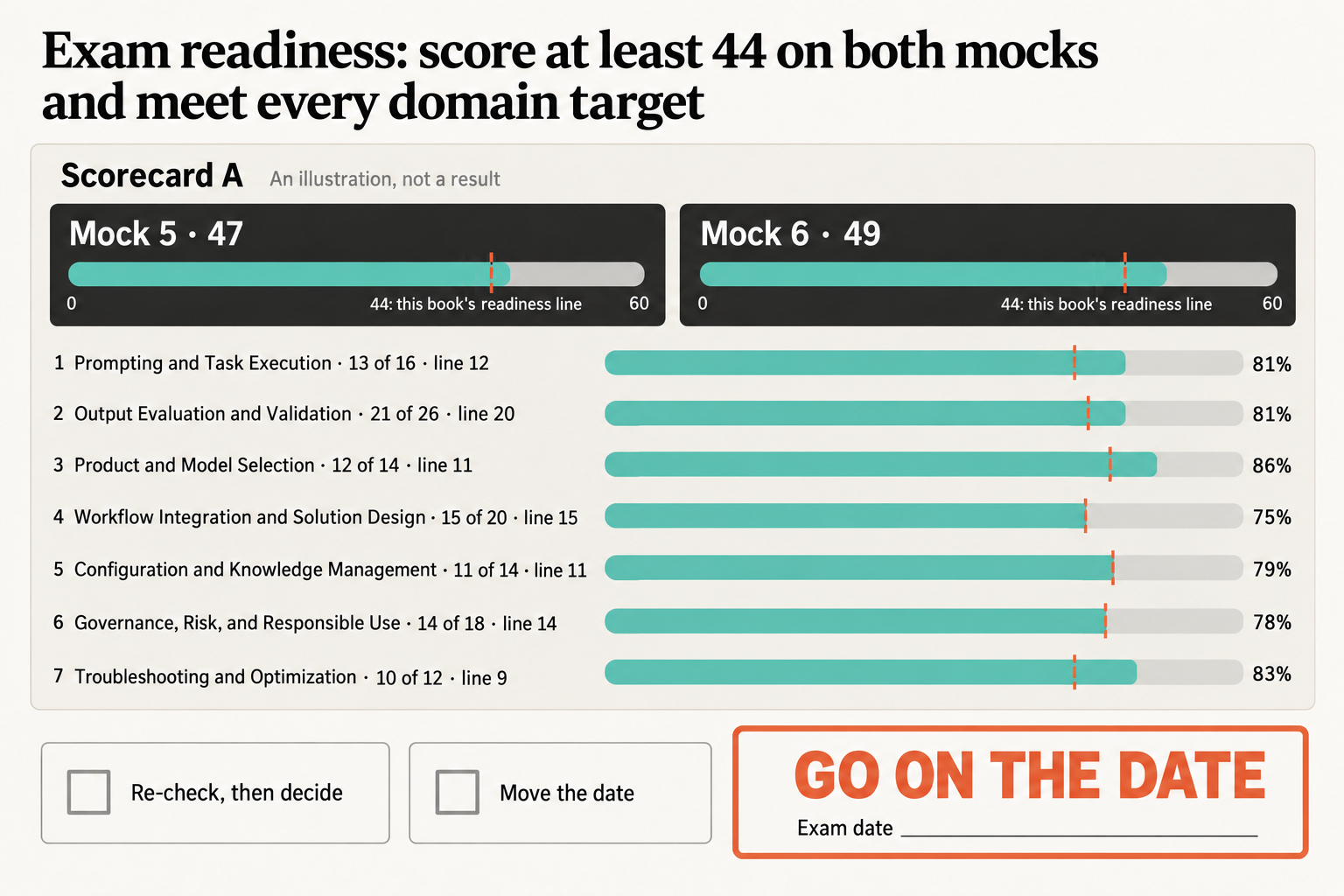
Scorecard A has mocks of 47 and 49, both over 44. Across the two, the domains read 13 of 16, 21 of 26, 12 of 14, 15 of 20, 11 of 14, 14 of 18 and 10 of 12, which adds up to the 96 the two totals make. Every domain meets its line, so the verdict is go. Workflow design, configuration and governance meet theirs with nothing to spare, so I’d spend the days left re-reading your logged misses in those three.
When the totals lie
Now look at Scorecard B. Its mocks come in at 46 and 45, so both totals clear 44. Governance reads 11 of 18 across the two mocks, three short of its line of 14. That total is being carried by strong domains, with one weak one the real exam can find. A form with two more governance questions and a harder output evaluation set is all it takes, and that’s the whole reason the rule checks domains separately from totals. The verdict is move the date.
Count the domains every time, because the total will lie to you.
There’s a middle verdict for a near miss. If one total is 42 or 43, or one domain is a single question short, and your exam is at least three days away, re-drill that domain’s logged misses and re-sit the two earlier mocks it scored lowest on, then read the rule off those two re-sits. A re-sit scores higher because you remember the questions, so we hold it to a higher bar: go only if both re-sits reach 48 and the domain line is met. Anything else means you move the date.
Moving the date is cheap
The FAQ says you can cancel or reschedule “at least a minimum of 48 hours prior to your appointment,” and later than that, or a no-show, forfeits the fee. (The exam guide says 24 hours, so plan on the FAQ’s 48.) If you sit and fail, you pay the full fee again, wait 14 days before a retake, and use one of your four attempts in a rolling 12 months. I put the verdict day at least three days before the exam, which leaves room for a re-check and still beats the 48-hour line. Under three days left? Then the re-check is off the table, a near miss means move the date, and you decide before the 48-hour mark, which is your appointment time two days earlier.
What if your manager booked the date and wants it kept? We take the scorecard into that conversation. Show the two mock totals, the domain under its line, and what a fail costs. Then offer the plan: the new date, the two domains you’ll re-drill and the two re-sits that will confirm it. Which would your manager rather approve: one week with a plan, or a second attempt at the full fee?
Now go build something this weekend!
John Cook