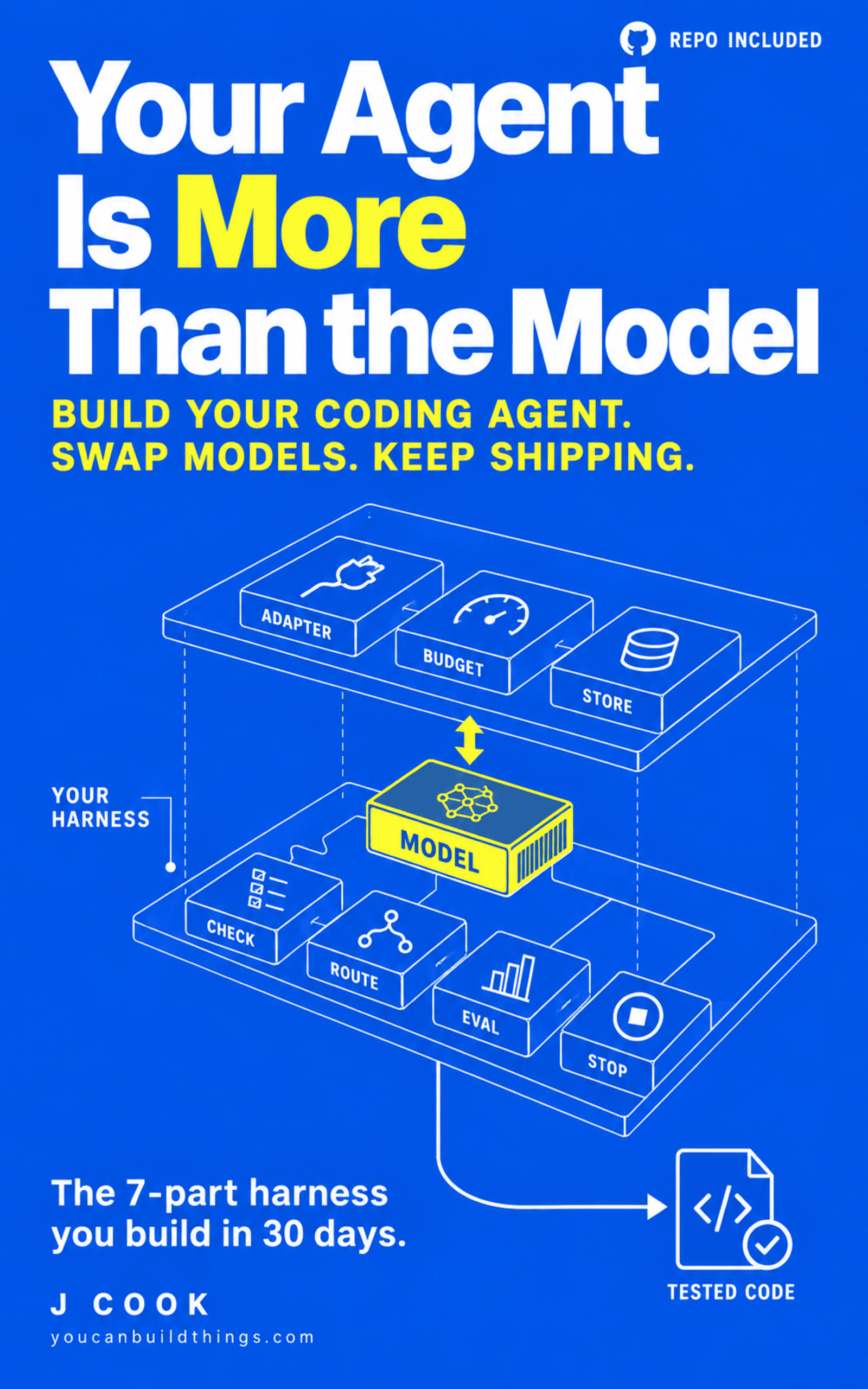
Your Agent Is More Than the Model
The 7-Part Agent Harness for Swapping Models, Stretching Your Token Budget, and Shipping Working Code
Fifteen minutes into the session the weekly quota is gone and the job never finished. Build the seven parts around the model that decide whether a job finishes: an adapter that swaps providers in one line, a token budget that holds, a claim checker, and an eval set that tests the next model the day it ships.
You open Codex. Fifteen minutes later the weekly quota is gone and the job never finished. Meanwhile someone on the same model, with the same limits, in the same week, is shipping. The difference is owning the loop the agent runs in instead of renting it.
This book does not teach you to build an agent. It teaches you to keep the one you already run when the model under it changes: a model adapter, a token budget, a state store, a claim checker, a routing table priced per finished job, an eval set built from your own work, and a stop that fires at the tool boundary instead of asking the model to please stop.
Every part ships in a free companion repository at the paths the book uses, with an offline test suite and an installer that wires the hooks for you.
What You'll Build
Same model, different adapter, 54 points apart: the measured case for owning everything around the model.
Inventory the six layers of your current setup and mark each one yours, the vendor's, or nobody's.
Price leaving your current setup in hours, row by row, with a named input behind every hour.
Run one real job on two models and get your first measured figure for what the layer around the model is worth.
Build a model adapter that changes providers in one line, then prove the same job passes on both.
Put a token budget with an eviction rule on one job and count the tokens before and after.
Move run history into a state store so a long job stops paying for its own memory and resumes where it stopped.
Wire a claim checker on every completion that tests the contract, the exit code, and the bytes instead of the summary.
Price every finished job with the failed reruns counted in, then write a routing rule your setup reads.
Turn your own past commits into an eval set you run in one command the day a new model ships.
Build a stop that fires at the tool boundary in both vendors, plus a failure-mode checklist with a drill for each row.
A swap runbook and a thirty-day plan, so a new model launch costs one morning instead of a rebuild.
Free Articles from this Book
How to Get Claude Code to Finish the Job on the Cheaper Model
Get haiku finishing jobs you were paying sonnet to attempt, and quote what one finished job costs with the failures counted in. My first five runs finished nothing on either model; eleven words of job text later both went six for six.
from: Your Agent Is More Than the Model
How to Build a Kill Switch for Claude Code and Codex
Let Claude Code or Codex run unattended on real work, because one empty file from any terminal stops it at the next tool call. A founder typed STOP eleven times in capitals and lost 1,200+ executive records; this stop doesn't ask the model.
from: Your Agent Is More Than the Model
How to Know If Sonnet Is Worth 3x Haiku on Your Code
Pick the Claude model you pay for on a real job from your own repo, and have an answer the same afternoon a new model ships. Both models passed my test job and one cost three times as much, and the same model re-run moved 15% with nothing changed.
from: Your Agent Is More Than the Model
How to Resume a Long Claude Code Job Without Starting Over
Hand Claude Code or Codex a long job and let it crash, because a fresh session picks up at the next unfinished step on a 122-byte brief. One Codex run spent 7.13 million tokens asking its workers the same question 47 times, because nothing wrote the answer down.
from: Your Agent Is More Than the Model
How Long Does It Take to Switch From Claude Code to Codex?
Try Codex, a cheaper model or a local one whenever you like, because you already know what the move costs you in hours, layer by layer. My whole setup came to 3 hours to move, and the expensive row was the run state I had never saved.
from: Your Agent Is More Than the Model