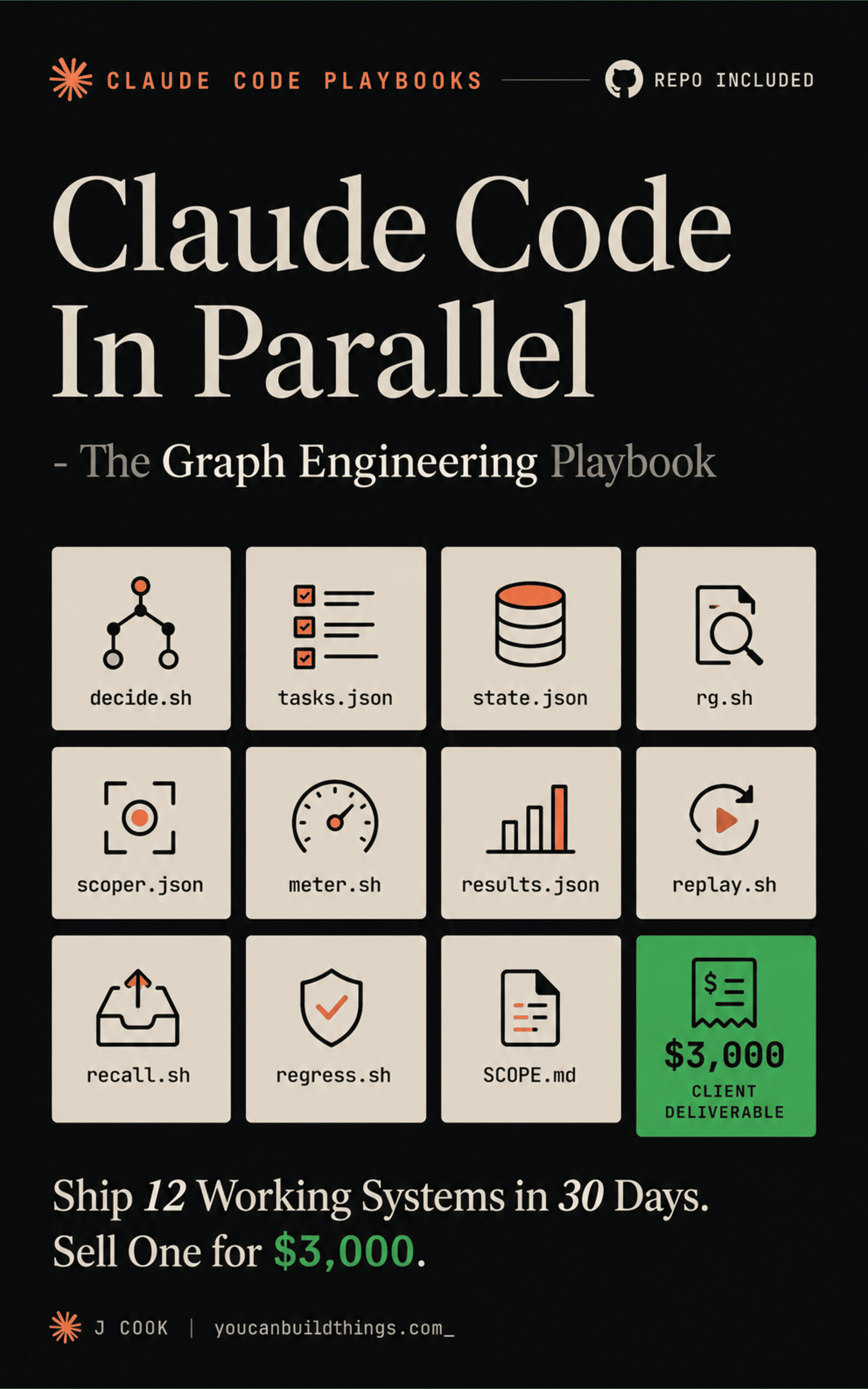
Claude Code In Parallel
The Graph Engineering Playbook
Stop running one Claude Code agent at a time. In 30 days you ship twelve working graph systems on your own repo, learn when parallel agents are worth it, and turn one measured system into a client deliverable.
Graph engineering is not another agent diagram. It is execution control: which node runs next, who verified it, what it cost, why a branch fired, and how you recover when the run breaks.
The companion repo ships all twelve graphs, one folder per chapter, plus one command that installs the nodes and gates into a repo the reader already owns.
What You'll Build
Run the first three-node graph and see two agents start inside the same second.
Decide whether a task needs one agent, a loop, or a graph before you add branches.
Move graph state onto disk so a run can be inspected, resumed, and trusted.
Fan out across your own repository, dedupe the results, and merge one verified answer.
Measure the run from Claude Code's real cost fields instead of guessing from token counts.
Add a verifier that catches what a self-grading agent waved straight through.
Write routing decisions to JSON Lines so any branch can be replayed without a model call.
Build a file-based memory layer with entities, edges, raw facts, and tried reasoning.
Use wall clock, branch width, and cost to know when parallel work is worth the bill.
Turn a recurring manual workflow into a scoped package priced from your own measured numbers.
Snapshot, rollback, dry-run, and debug the ordinary failures that break agent graphs.
Install the graph scaffold into a repo you already own and run the full system.
Free Articles from this Book
Give Your Claude Code Subagents Memory Without a Database
Full graph indexing costs about a thousand times what plain vector indexing costs, and frequently loses. Here is the three-layer file store that replaces it, with a pointer that walks any claim back to the sentence it came from.
from: Claude Code In Parallel
How to Stop a Claude Code Subagent From Faking a Test Pass
A verifier subagent will report a clean pass on tests it never executed unless you make the verdict a file it had to run something to produce. Mine did exactly that on 8 test cases, 0 of which ran, and the code being fine is the part that should worry you.
from: Claude Code In Parallel
How Do Claude Code Subagents Communicate? They Don't
There is no channel between subagents. If two of them have to agree on anything, the agreement lives in a file with exactly one owner per field, or it does not exist. Here is the file, and the race that eats it.
from: Claude Code In Parallel
Why You Shouldn't Use a Model to Merge Claude Code Subagent Results
A model asked to combine parallel agent findings is slow, gives different answers on different days, and can return a file path no searcher ever found. Four lines of shell do it deterministically and print a duplicate count that tells you how well you scoped the run.
from: Claude Code In Parallel
Claude Code Subagents in Parallel: Are They Actually Faster?
I timed the same job with one Claude Code agent and with three subagents in parallel, same repo, same afternoon. The graph lost twice. Here is how to measure your own floor and get a verdict on your own work.
from: Claude Code In Parallel