Don't Get Flagged: CCA-F Exam Proctoring Survival
Claude Certified Architect exam proctoring can void your one $99 attempt over an innocent habit. The clean-room setup and the two moves that flag you.
>This is the survival page. Claude Certified Architect Foundations: Crash Course boils the five domains to a weekend, decodes the trick questions, and ships one realistic mock plus the full exam-day plan.
Claude Certified Architect Foundations: Crash Course
Pass the CCA-F Exam in a Weekend. The 5 Domains Boiled Down, the Judgment Patterns Decoded, and One Realistic Mock.
Summary:
- You can lose your one $99 CCA-F attempt to a proctoring flag, not a wrong answer.
- A one-business-day result on a multi-day window is the community’s tell for an automated flag.
- Two innocent habits trip it: glancing off-screen to read, and muttering while you reason.
- You get the clean-room setup, the morning-of ritual card, and the appeal path from a real notice.
Claude Certified Architect exam proctoring is the part of prep nobody writes about, and it can cost you your one $99 attempt to an automated flag instead of a wrong answer. You can study every domain, clear a mock, walk in ready, and still lose the attempt to a system that decided you broke a rule you never knew you were near. One honest frame before anything else: almost none of this comes from Anthropic. There is no published proctoring-violation policy or official flag list. What follows is what takers reported, labeled as that, because on a certification an audience checks, and a forum rumor dressed as policy is how a prep resource loses its credibility.
What broke: a clean setup, a disqualification
One taker followed every rule and still got disqualified. Instead of the usual multi-day wait, the result came back in a single business day, and it was not a pass or a fail. It was a noncompliance notice, quoted here from the r/ClaudeAI thread (219 comments) with the session date trimmed out:
Anthropic has completed a review of your proctored Claude Certified Architect – Foundations exam session … and has determined noncompliance with the Certification Terms and Conditions and the Anthropic Certification Exam Policy.
As a result, no score will be released for this attempt and no certification will be issued.
You may appeal this decision … by emailing academy-support@anthropic.com with “appeal” in the subject line within 14 calendar days of this notice.
The taker’s own account: “I cleared my desk, showed my whole test taking area, followed all the provided guidelines and did nothing but stare at the screen for an hour and a half.” They never learned a single answer. The attempt was simply gone. Two useful facts fall out of that notice: the outcome is real, and there is an appeal path, an email to academy-support with “appeal” in the subject inside 14 days. Most prep resources mention neither.
How does the flag actually trip?
The flag trips on ordinary online-proctoring signals, and the fast turnaround is the giveaway. The top comment on that thread read it plainly:
one business day on a 7-10 day window is the tell. that’s not a human review, that’s an automated proctoring flag tripping (eyes off screen, second face/voice detected, background noise, tab switch). reply and ask for the SPECIFIC clause and the session evidence, don’t accept the boilerplate.
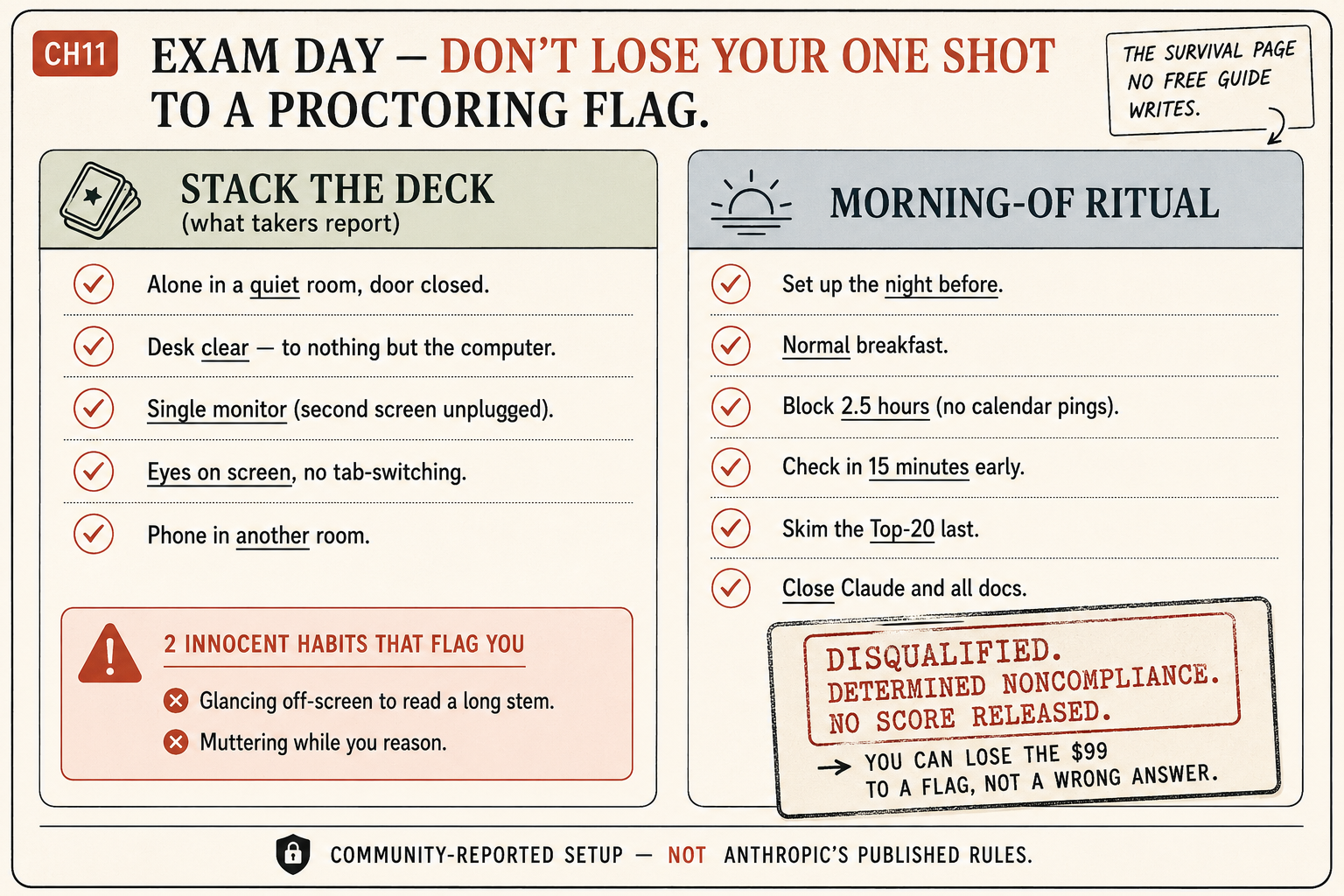
Hold that as an inference, not a published rule. Nobody outside Anthropic knows the exact triggers, so do not treat it as “here is what Anthropic flags.” Treat it as: give an automated proctor nothing to misread. The image on this page carries the same caveat in its footer, community-reported setup, not Anthropic’s published rules, because that line is the whole discipline.
How do you stack the deck?
You strip the room of anything a machine could mistake for cheating. Set this up the night before, then run it again right before check-in. Five moves, in order:
- Be alone in a quiet room with the door closed. No one walking through, no music, no TV bleeding in.
- Clear your desk to nothing but the computer. No phone, no notes, no second device, no mug with a printed sheet taped to it.
- Use one monitor. Unplug the second screen, because looking off at a dark second monitor reads exactly like looking at notes.
- Keep your eyes on the screen and your face in frame. Do not glance down and to the side to think.
- Do not switch tabs or windows, not even to a calculator. Whatever you need lives inside the exam or nowhere.
Two habits are worth singling out, because they are the innocent ones that get people, and they are the two the card flags:
- Reading by looking away. When a scenario runs three paragraphs, your instinct is to glance down while you think. To a proctor watching your gaze, repeated glances off-screen look like consulting something. Train yourself to read at the screen.
- Muttering while you reason. A detected second voice, even your own, can read as another person in the room. Work silently.
Neither breaks a rule you would recognize. That is exactly what makes them dangerous.
What does the morning-of ritual look like?
Treat exam day like a small operation, because the failures here are logistical, not intellectual. Block two and a half hours even though the exam runs two, because the proctoring check-in can run long and you do not want your real time ticking while you verify your ID. Start the check-in fifteen minutes early. The last thing you touch before you begin is your Top-20 card, to load your highest-yield facts, and then it goes out of sight.
Generate the card instead of hand-copying it, so it matches the plan exactly. Save this as ritual_card.py and run it once:
# ritual_card.py — emit the one card you hold on exam day. Print it on paper.
card = """\
==== EXAM-DAY RITUAL CARD ====
SETUP (night before, and again before check-in):
  [ ] alone, quiet room, door closed
  [ ] desk clear to nothing but the computer
  [ ] single monitor, second screen unplugged
  [ ] phone in another room; Claude and docs closed
MORNING:
  [ ] normal breakfast; block 2.5 hours
  [ ] check in 15 minutes early
  [ ] skim the Top-20 last, then put it away
AFTER:
  results ~2 business days (community reports longer)
  appeal: email academy-support@anthropic.com, "appeal" in subject, within 14 days
"""
open("ritual_card.txt", "w").write(card)
print(card)
You get a printable card you run without thinking:
==== EXAM-DAY RITUAL CARD ====
SETUP (night before, and again before check-in):
  [ ] alone, quiet room, door closed
  [ ] desk clear to nothing but the computer
  [ ] single monitor, second screen unplugged
  [ ] phone in another room; Claude and docs closed
MORNING:
  [ ] normal breakfast; block 2.5 hours
  [ ] check in 15 minutes early
  [ ] skim the Top-20 last, then put it away
Close Claude and every doc before check-in, both because you do not need them and because an open AI assistant on a Claude certification exam is the last thing you want a proctor to glimpse during the room scan.
What about the clock?
You have 120 minutes for 60 questions, two minutes each on average, and the discipline is to never leave a blank, because a blank scores the same as a wrong answer. Rehearse the pace the night before so the decision is a reflex, not a calculation you run under pressure:
# pace.py — rehearse the clock the NIGHT BEFORE. Run nothing during the exam.
TOTAL, QS, CAP = 120, 60, 3   # minutes, questions, hard cap per question

def check(mins_in, done):
    left = max(1, QS - done)
    budget = min(CAP, (TOTAL / 2 - mins_in) / left)
    tag = "BEHIND" if done < mins_in else "ON PACE"
    print(f"{mins_in}m in, {done} done -> {tag}; commit within {budget:.1f} min, then move")

check(30, 32)
check(30, 24)
30m in, 32 done -> ON PACE; commit within 1.1 min, then move
30m in, 24 done -> BEHIND; commit within 0.8 min, then moveWhen the number says commit, you stop rereading and move. Indecision, not the hard question, is what runs you out of time.
What should you actually do?
- If you have a second monitor → unplug it entirely before check-in, not just turn it off.
- If you catch yourself reading by glancing down → retrain to read at the screen; that habit is the top innocent flag.
- If a result comes back in one business day as noncompliant → reply asking for the specific clause and session evidence, and appeal within 14 days.
- If the submit screen looks weird → check the platform dashboard for a completed status, do not re-take, and contact support.
The bottom line
- The flag can cost you the $99, not a wrong answer. Study protects your score; a clean room protects your attempt. You need both.
- Stack the deck, do not memorize a rule list. Alone, clear desk, single monitor, eyes on screen, phone gone. Give an automated proctor nothing to misread.
- The two innocent habits are the real risk. Glancing off-screen and muttering both look guilty to a machine, and neither feels like cheating.
- Keep the provenance honest. This is community-reported, not Anthropic’s published policy, and the one documented fact is the appeal path in the notice itself.
Frequently Asked Questions
Can you fail the Claude Certified Architect exam for a proctoring flag?+
Yes. Takers have reported a 'determined noncompliance' result where no score is released and no certification is issued, separate from getting answers wrong. The community reads a one-business-day turnaround on a multi-day window as an automated flag.
What triggers a proctoring flag on the CCA-F exam?+
The community's read, not a published Anthropic list, points to the ordinary online-proctoring suspects: eyes leaving the screen, a second face or voice detected, background noise, and tab or window switching.
Can you appeal a noncompliance result on the CCA-F exam?+
The disqualification notice one taker received named an appeal path: email academy-support@anthropic.com with 'appeal' in the subject line within 14 calendar days of the notice.