The Claude Certified Architect Exam Format, Explained
The Claude Certified Architect exam format: 60 scenario questions, 120 minutes, one $99 attempt, scaled 100-1000, and the domain weights that set your prep.
>This is the exam on one page. Claude Certified Architect Foundations: Crash Course boils all five domains to a weekend, decodes the trick questions, and ships one realistic mock with a go-or-no-go verdict.
Claude Certified Architect Foundations: Crash Course
Pass the CCA-F Exam in a Weekend. The 5 Domains Boiled Down, the Judgment Patterns Decoded, and One Realistic Mock.
Summary:
- The CCA-F is 60 scenario questions in 120 minutes, one $99 attempt, scaled 100 to 1000.
- Domain weights are 27 / 20 / 20 / 18 / 15, so prep is not evenly split.
- The one scoring rule that changes every answer: a blank scores the same as a wrong answer.
- You get both fact tables, the provenance on the pass line, and a script to turn it into a plan.
The Claude Certified Architect exam format is simple to state and easy to get wrong in ways that cost real points. It is a scenario-judgment exam, not a recall test, and the mechanics decide how you should spend a weekend of prep. One discipline runs through everything below: this separates what Anthropic publishes from what the community reports, because on a certification that distinction is the difference between a fact and a rumor you bet $99 on.
What is the Claude Certified Architect exam format?
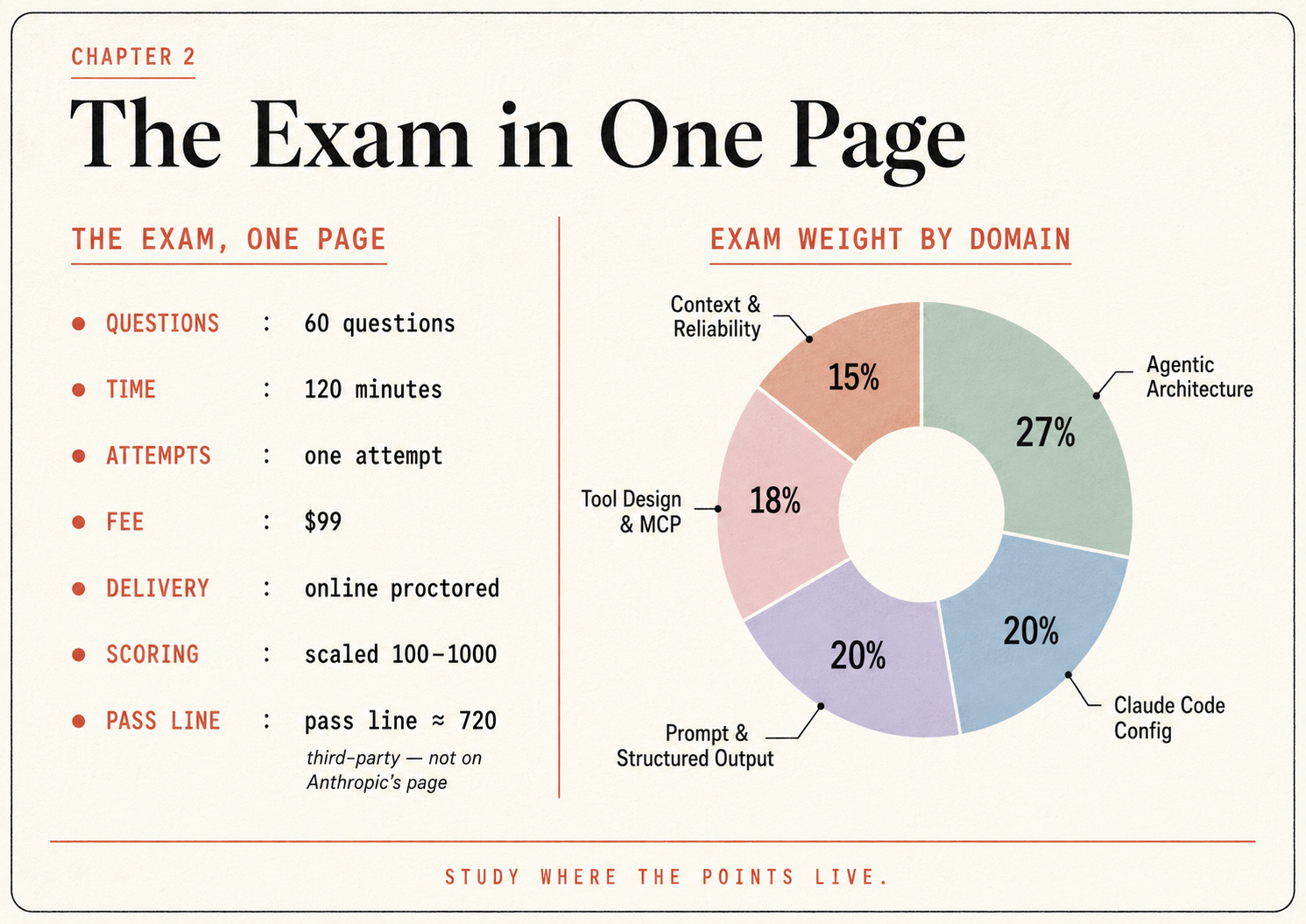
It is sixty scenario-based multiple-choice questions in 120 minutes, one online-proctored attempt, for $99, scored on a scaled range from 100 to 1000. Anthropic publishes the format, the cost, and the domain weights on its exam page, so those are facts you can state plainly:
| Field | Value | Source |
|---|---|---|
| Questions | 60, scenario-based | Anthropic exam page |
| Time | 120 minutes | Anthropic exam page |
| Attempts | one per registration | Anthropic exam page |
| Fee | $99 | Anthropic exam page |
| Delivery | online proctored | Anthropic exam page |
| Scoring | scaled 100 to 1000 | Anthropic exam page |
| Pass line | ~720 | third-party, not on Anthropic’s page |
Two minutes a question is the average, and it is a trap if you treat it as a per-question budget, because the scenarios are uneven. Some you answer in thirty seconds; some are three-paragraph production incidents you have to actually read.
What score do you need, really?
You need 720 out of 1000, and you should hold that number loosely. It comes from the independent prep blueprints, which agree on it, not from anything on Anthropic’s official page. So plan for 720, and know it is third-party. Do not tell anyone “Anthropic says 720,” because Anthropic does not say it anywhere you can point to.
Ignore “you need 75% to pass.” A scaled score from 100 to 1000 is not a raw percentage, and there is no published table that converts “48 of 60 right” into a scaled number. Anyone quoting a percentage pass mark does not understand the scoring. And validity? Nobody prints it, because Anthropic has not published a recertification policy and the third-party claims conflict. Leave that field blank rather than guess.
Where do the points actually live?
Five domains, not weighted evenly, so your prep should not be either:
| Domain | Weight |
|---|---|
| Agentic Architecture and Orchestration | 27% |
| Claude Code Configuration and Workflows | 20% |
| Prompt Engineering and Structured Output | 20% |
| Tool Design and MCP Integration | 18% |
| Context Management and Reliability | 15% |
Write them by name, not by number, because the independent blueprints order the domains differently and there is no canonical numbering. Agentic Architecture is more than a quarter of the exam, so it earns the most study time. The two middle domains, Claude Code configuration and tool design, are the ones experienced builders underprepare, precisely because they use them daily and assume familiarity is readiness.
The one scoring rule that changes every answer
A blank scores the same as a wrong answer. That is the rule that should change your behavior on every question, and it is just arithmetic, not a published policy. There is no penalty for guessing, because a blank is already counted against you, so a guess can only help. You never leave a question unanswered. If the clock is dying and you have ten untouched, you answer all ten, even as coin-flips, because a coin-flip beats a guaranteed zero. The math is not subtle:
# never leave a blank: guessing the rest beats leaving them, every time
UNANSWERED, OPTIONS = 10, 4
guess_ev = UNANSWERED / OPTIONS   # ~2.5 right, on average, from blind guesses
blank_ev = 0                      # a blank scores the same as a wrong answer
print(f"guess all {UNANSWERED}: ~{guess_ev:.1f} right")
print(f"leave blank:   {blank_ev} right")
guess all 10: ~2.5 right
leave blank: 0 rightTurn the facts into a plan
Run the mechanics through a script so the pace and the point-map fall out of the machine instead of your nerves at minute ninety. Save examclock.py:
# examclock.py: turn the exam's raw facts into a plan.
QUESTIONS, MINUTES, OPTIONS = 60, 120, 4
DOMAINS = {"Agentic Architecture": 27, "Claude Code Config": 20,
           "Prompt & Structured Out": 20, "Tool Design & MCP": 18,
           "Context & Reliability": 15}
assert sum(DOMAINS.values()) == 100, "domain weights must total 100"
print(f"pace: {MINUTES/QUESTIONS:.1f} min/question")
print(f"guess 10 blind: ~{10/OPTIONS:.1f} right vs 0 for blanks\n")
for name, w in sorted(DOMAINS.items(), key=lambda kv: -kv[1]):
    print(f"{name:26}{w:>4}%{w/100*MINUTES:>7.1f} min")
Run it and the point-map prints in one shot:
pace: 2.0 min/question
guess 10 blind: ~2.5 right vs 0 for blanks

Agentic Architecture        27%   32.4 min
Claude Code Config          20%   24.0 min
Prompt & Structured Out     20%   24.0 min
Tool Design & MCP           18%   21.6 min
Context & Reliability       15%   18.0 min
The minutes column is your study calendar in miniature: Agentic’s 32 minutes of exam time is 32 minutes of prep priority. The guess line is the blank-equals-wrong rule in arithmetic, ten blind guesses worth about two and a half questions, ten blanks worth nothing.
What should you actually do?
- If you are budgeting study time → weight it by domain, most on Agentic (27%), extra on the underprepared middle (config and MCP).
- If the clock is running out → answer every remaining question, even blind; never leave a blank.
- If someone tells you “75% passes” → ignore it; the score is scaled 100 to 1000, not a raw percentage.
- If you are asked how long the cert lasts → say Anthropic has not published it and the sources conflict; do not bank on a number.
The bottom line
- The format is fixed and public. 60 scenarios, 120 minutes, one $99 attempt, scaled 100 to 1000. Know it cold so nothing on screen surprises you.
- The pass line is a plan, not a published fact. Aim well past a bare 720, and never call it Anthropic’s number.
- Weights are marching orders. Agentic is a quarter-plus of the exam; the middle domains are where confident builders quietly lose points.
- Never leave a blank. It is the cheapest points on the test, and the one rule most crammers forget under the clock.
Frequently Asked Questions
What is the format of the Claude Certified Architect exam?+
Sixty scenario-based multiple-choice questions in 120 minutes, one online-proctored attempt, $99, scored on a scaled range from 100 to 1000. Questions are decisions about a broken system, not definitions.
What score do you need to pass the CCA-F exam?+
The pass line is widely reported as 720 out of 1000, but that number is third-party, not on Anthropic's official page, so plan around it without treating it as published. A scaled score is not a raw percentage, so 'you need 75%' is wrong.
How are the CCA-F domains weighted?+
Agentic Architecture 27%, Claude Code Configuration 20%, Prompt Engineering and Structured Output 20%, Tool Design and MCP 18%, Context and Reliability 15%. Study by name and weight, since Agentic is more than a quarter of the exam.