Best Claude Skills Marketplaces in 2026: The Buyer's Shortlist
We ran the open-standard validator on 973 skills from 6 sources and checked licences, listing cost and upkeep. Here is where to get Claude Skills.
>This ranks where skills come from. Claude Skills: The Paid Work Playbook gives you the six-row screen to run on any candidate.
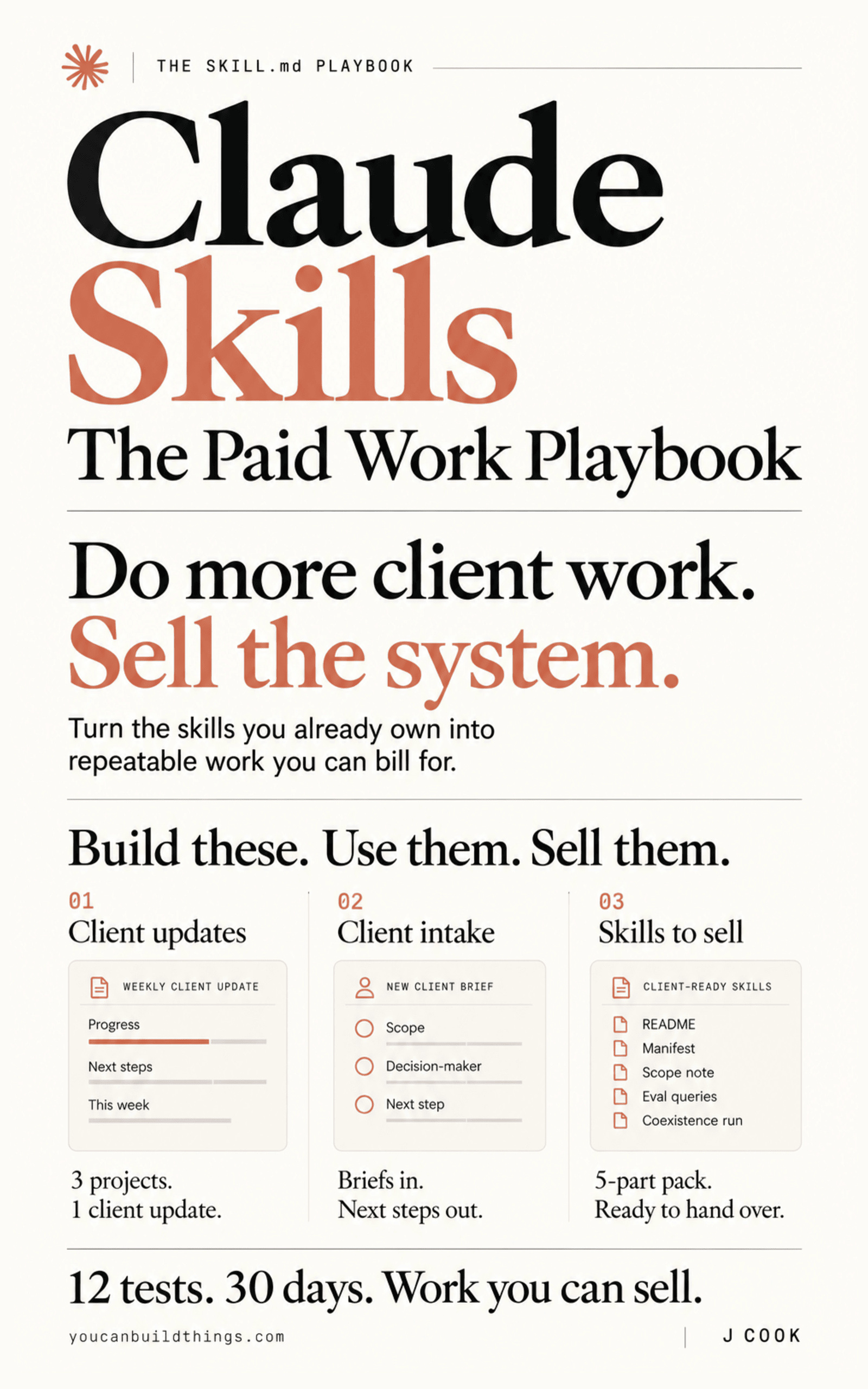
Claude Skills: The Paid Work Playbook
Build a Client-Ready Claude Skills System in 30 Days
We cloned 6 of the biggest Claude Skills sources, ran the open-standard validator on all 973 skill folders inside them, and checked licences, listing cost and upkeep. Anthropic's official plugin marketplace is our top pick, because it is the one place that shows a skill's context cost before you install it. Below are the best Claude Skills marketplaces in 2026, ranked on six checks, four of them rows from our book's screening sheet, with who each one fits.
Key Takeaways
- 59 of the 109 skills from the five curated sources pass the open-standard validator. At least 44 of the 50 failures come only from fields outside the standard, such as
disable-model-invocation, which Claude Code accepts. A claude.ai upload accepts only the six standard fields, so those skills need stripping first. - 4 of Anthropic's own skills are not open source. The docx, pdf, pptx and xlsx skills are "source-available, not open source" and marked all rights reserved. The other 14 in that repo are Apache 2.0, and one has no licence file at all.
- Anthropic's official marketplace shows 2 token estimates before you install. "Every turn" is what a plugin adds to each message, and "When invoked" is what its skills add once loaded. No other source we checked prices a skill up front.
- 6 of the top 10 skills on skills.sh come from one author, Matt Pocock. The leaderboard counts installs made through its own command-line tool. A skill you cloned or installed as a plugin counts as zero there.
- 0 of 973 skill folders bundle test files. That matters because a test file copied into your project is the hiding place Gecko Security reported scanners missing. None of the 973 exceeds the 1,536-character listing cap either.
Free: The screening and intake scripts from the book, free, for your own skills folder. Get the companion repo on GitHub.
What a Claude Skills Marketplace Actually Is (and What It Is Not)
In Claude Code, a marketplace has a precise meaning. The docs put it in one line: "A marketplace is a catalog of plugins, and Claude Code has to know about a marketplace before you can install from it." You add one with /plugin marketplace add owner/repo, and its plugins, which can carry skills, agents, hooks and MCP servers, appear on the Discover tab of /plugin.
In everyday use the word stretches further. People call any place they get skills a marketplace: GitHub collections you clone, leaderboard sites with a command-line installer, and "awesome" lists that link out to other repositories. This guide covers all three, because that is where the skills in your folder came from.
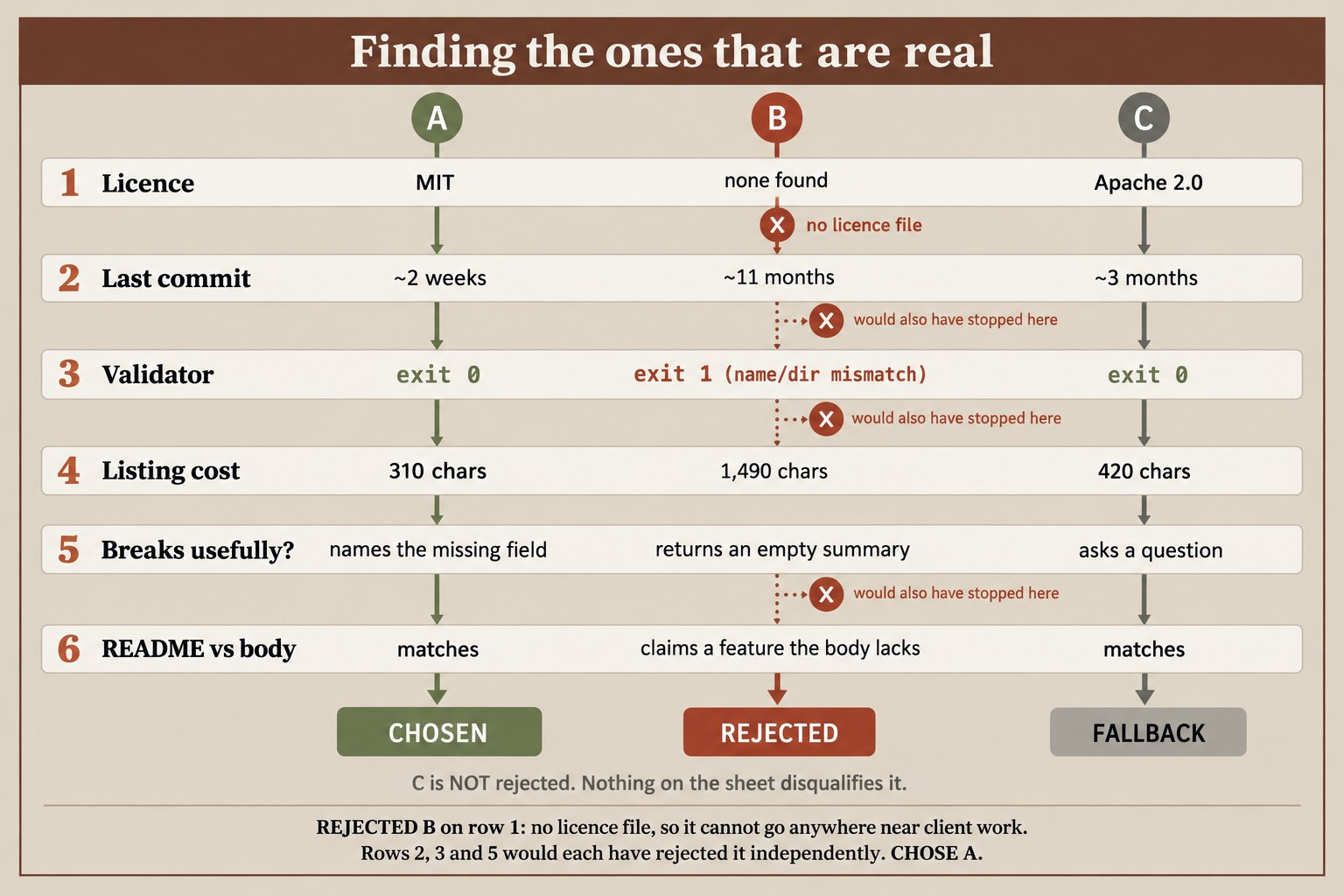
A marketplace is not a review. Anthropic's docs say plainly that "Anthropic doesn't review third-party marketplaces," and even its official marketplace lists mostly plugins from partners and other authors. A big number on a listing is not a review either. An install count measures one installer. A star count measures attention on GitHub. A spot on an awesome list proves a link exists. None of them tells you whether a skill has a licence you can ship to a client, whether its name will survive an upload, or what it costs you in every session. Those are the checks below, and Chapter 7's version of them takes about 90 seconds a candidate.
How We Ranked These Marketplaces
Four criteria are rows from the screening sheet in Chapter 7 of our book, the test-file check comes from Chapter 8, and the last is what a source shows you before install. We did not run Chapter 7's other two rows, breaking a skill on purpose and checking its README against its body, because they need a person reading each skill. Every row ends in something you can check: an exit code, a character count, a file, a date.
- Licence you can ship. Repository licence plus any licence file inside each skill folder. No licence means not open source, whatever the README implies.
- Passes the open-standard validator.
agentskills validate(packageskills-ref0.1.1) on every skill folder, exit 0 or exit 1. We report why skills failed, because a Claude Code-only field fails it too. - Listing cost. Characters in each skill's
descriptionpluswhen_to_use, median and maximum, against Claude Code's 1,536-character cap per skill. - Upkeep. Days between the source's last push and the day we checked, 2026-10-14.
- Bundled test files. Any
*.test.*,*.spec.*ortests/inside a skill folder, the files an installer copies into your project. - Shows cost or security before you install. Whether the source tells you what a skill costs or what a scanner found, before it reaches your folder.
The Best Claude Skills Marketplaces in 2026
Six sources made the list. The order puts first what a source tells you before you install, because that is the one check you cannot run on a skill you have not downloaded yet. On the validator alone, obra/superpowers is the cleanest source here and the official marketplace is one of the weakest. Quick picks: to price a plugin before installing, the official marketplace; to learn, anthropics/skills; for skills that pass the open standard, superpowers; for engineering habits across agents, Matt Pocock's; to see what is popular, skills.sh. All six cost nothing to browse. A seventh, VoltAgent's awesome-agent-skills, is a list of links with no skill files to test, so it appears only in the table notes.
1. Anthropic's official plugin marketplace, best for pricing a skill before you install it
At a glance: context cost before install · added on first run · 315 plugins listed · Apache-2.0 repo · auto-updates on
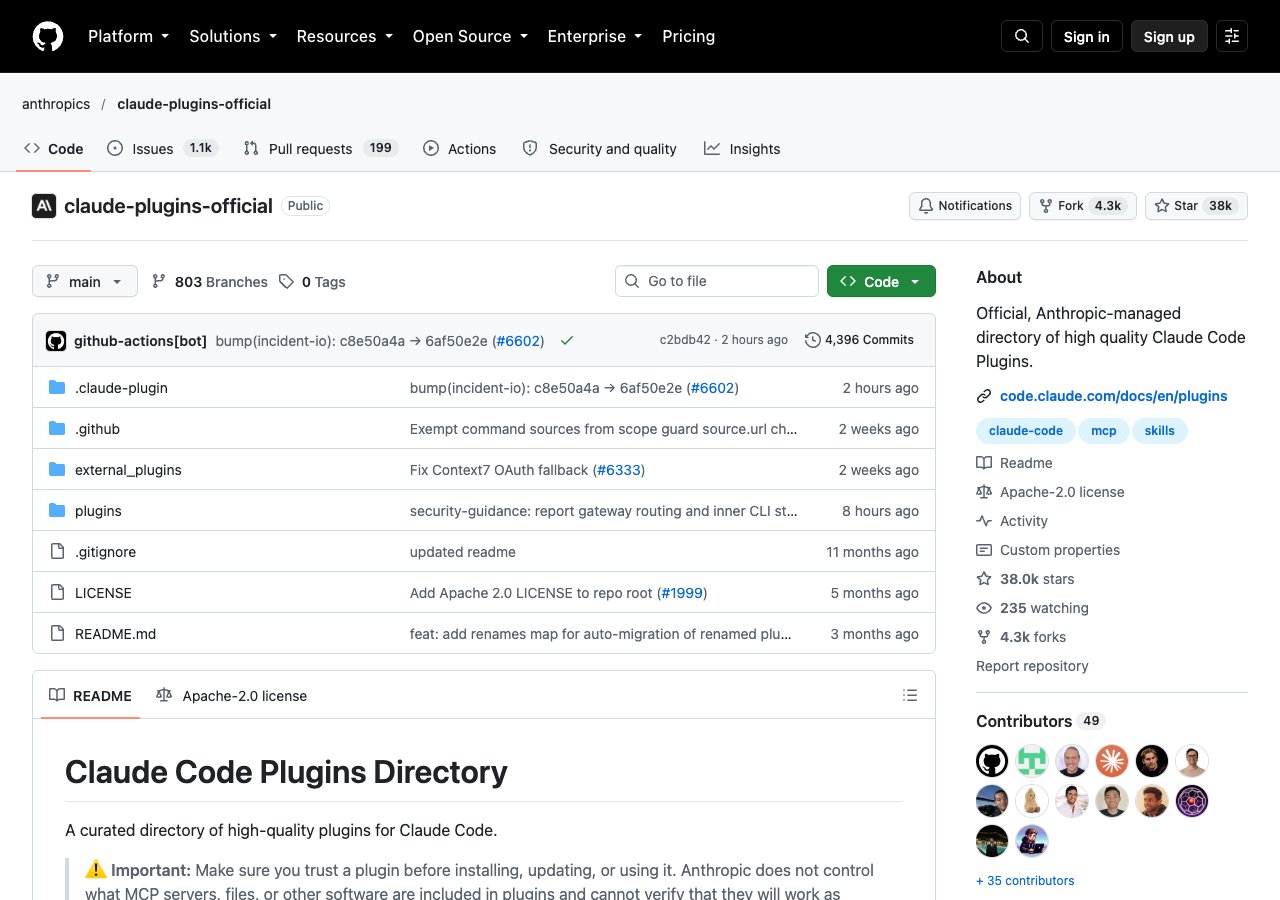
claude-plugins-official.This is the marketplace Claude Code registers for you the first time you start an interactive session, so you already have it. Its catalog file lists 315 plugins, and most of them live in other people's repositories. In the docs' words, "Most of what it lists comes from partners and other authors rather than from Anthropic." Anthropic maintains a smaller set of its own, such as commit-commands, code-review and feature-dev.
Its best feature is the one our book spends a whole chapter building by hand. Open a plugin with /plugin install name@claude-plugins-official, or from the Marketplaces tab, and the details pane shows "Context cost": an "Every turn" token estimate and a "When invoked" estimate, plus a "Last updated" line. The Discover list does not show them, so open the plugin by name. After installing, claude plugin details name prints the "Always-on" token figure, and the Installed tab groups plugins you have not used recently.
The validator tells a second story. Of the 33 skill files physically in the repo, 8 pass agentskills validate. At least 21 of the 25 failures are only fields outside the standard's six, mostly version (12) and user-invocable (7); one has YAML the parser refuses and one has a name that does not match its folder. Those fields work in Claude Code, but an upload accepts only the six, so they would need stripping first. None bundles a test file.
Best suited for: Claude Code users who want the price of a skill before it touches their listing. If the skills are going to claude.ai or another tool, plan to strip extra fields first.
2. Anthropic's skills repo, best for reading well-built examples
At a glance: 14 Apache 2.0 skills · 4 source-available · 18 of 20 validate · 181,128 GitHub stars
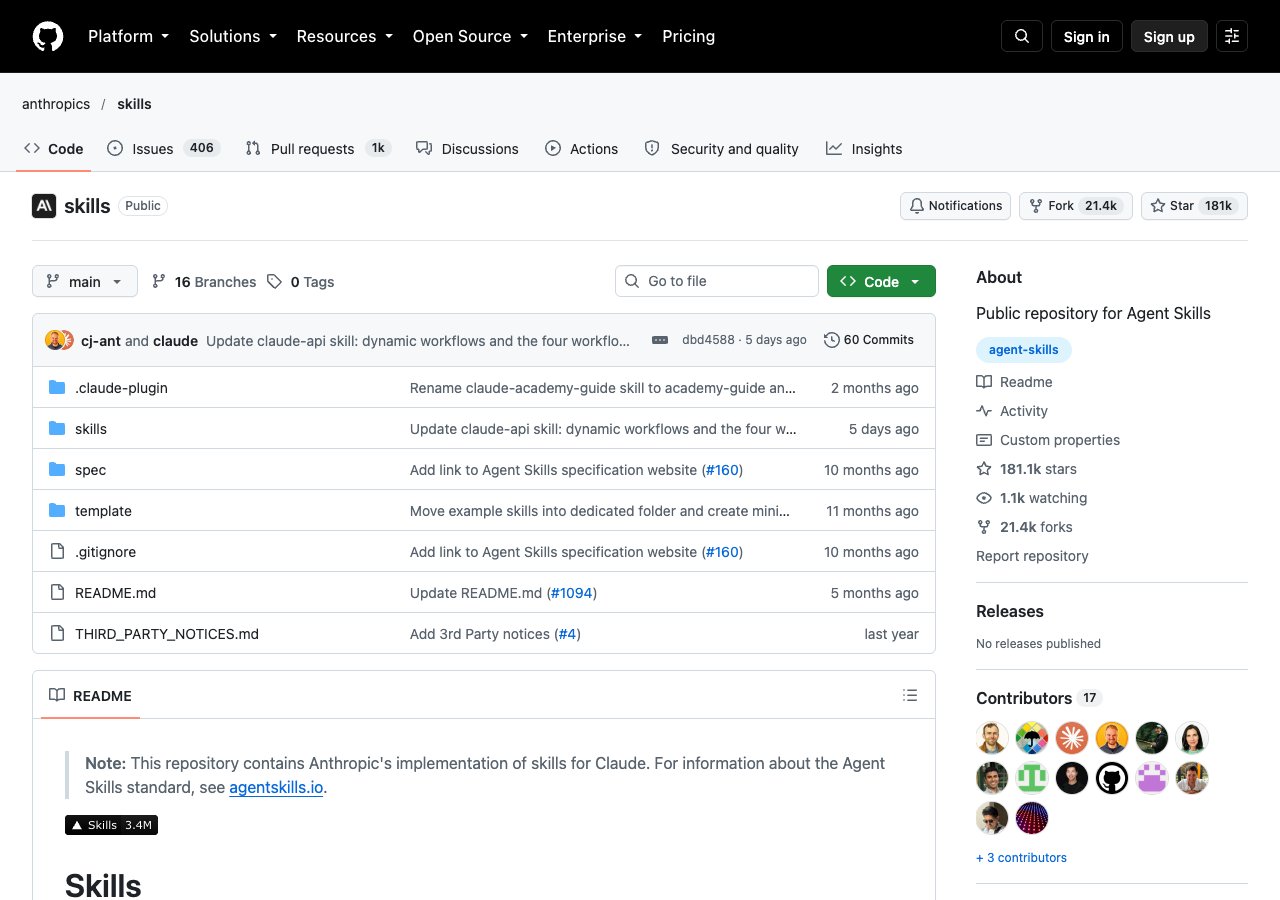
The repo you add with /plugin marketplace add anthropics/skills is the vendor's own code, and it says so honestly. The README opens with: "These skills are provided for demonstration and educational purposes only." They are examples, very good ones, and not a supported product.
The licences need reading before you copy anything. Of the 19 skills, 14 carry Apache 2.0. Four, the docx, pdf, pptx and xlsx skills, are described by the README as "source-available, not open source," and their licence files say all rights reserved. One, doc-coauthoring, has no licence file in its folder, and the repository itself declares none. You can read all of them. You can only reuse the 14.
On the validator, 18 of 20 folders pass. The two failures: the claude-api skill has a 1,068-character description, over the standard's 1,024 limit, and the template folder's name does not match its own name field. Descriptions here are among the longest we measured, a median of 321 characters. The repo also holds skill-creator, Anthropic's tool for testing skills.
Best suited for: learning what a strong skill looks like and adapting the Apache-licensed ones. Keep the four document skills out of anything you hand a client.
3. obra/superpowers, best for a set that passes the open standard
At a glance: 15 of 15 validate · 299,123 GitHub stars · MIT · median 107 chars
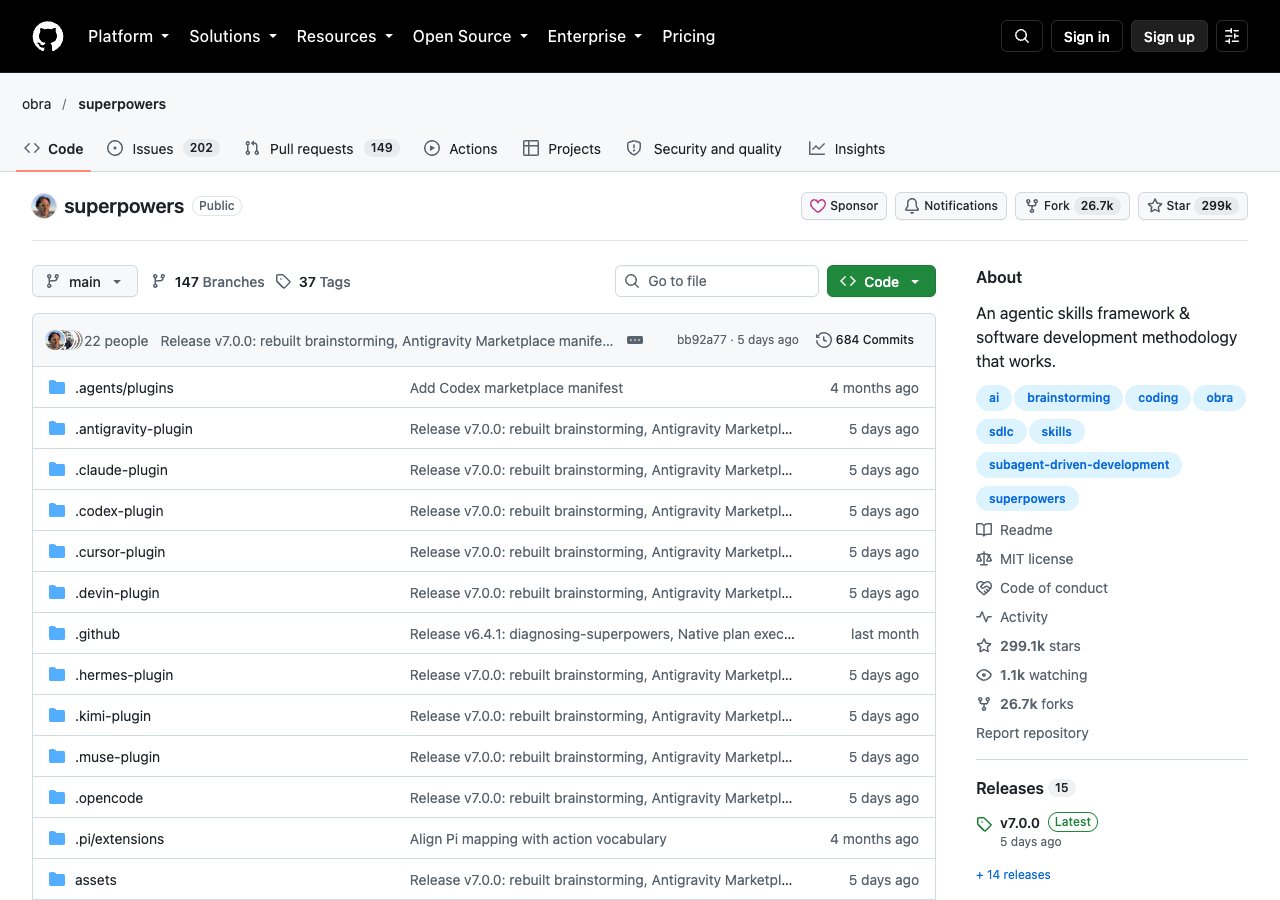
Superpowers describes itself as "a complete software development methodology for your coding agents, built on top of a set of composable skills." The 15 skills follow one working method: brainstorming, writing-plans, executing-plans, test-driven-development, systematic-debugging, requesting-code-review, verification-before-completion and so on. Most names describe the job in verb form, the way Anthropic's naming guidance asks.
It was the only large collection where every skill passed agentskills validate: 15 of 15. Descriptions are short, a median of 107 characters and a maximum of 375, so the whole set costs little in your listing. The repo holds 10 test files, all outside the skill folders, so installing a skill does not drop a test file into your project. It is MIT-licensed, was last pushed 4 days before we checked, and has more GitHub stars than any other skills repo here.
The README lists install steps for 16 agents, including Claude Code, Codex, Cursor, Gemini CLI, GitHub Copilot CLI and OpenCode. It also has a section on telemetry for its visual companion, which is worth reading before you install. The README presents the skills as one method plus "some initial instructions that make sure your agent uses them," so picking out one or two is not how it is designed to be used.
Best suited for: developers who want a coherent working method and skills that already meet the open standard. Less useful if you only want one or two skills to drop into an existing folder.
4. Matt Pocock's skills, best for engineering workflows across agents
At a glance: 6 of the skills.sh top 10 · 291,055 GitHub stars · MIT · 38 skills
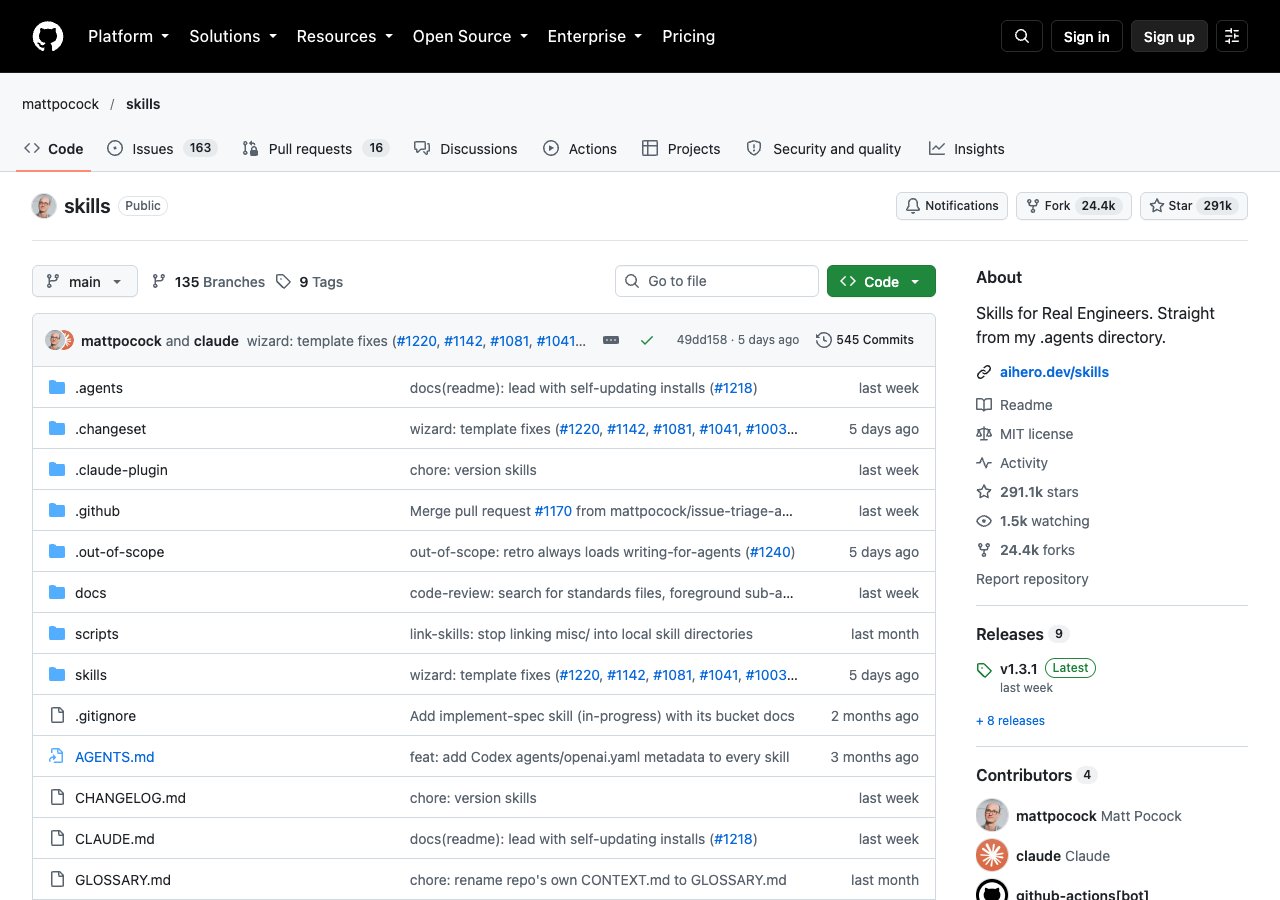
Matt Pocock's collection has 6 of the top 10 skills of all time on skills.sh, led by grill-me at 1.4M and grill-with-docs at 1.2M. His README says why it exists: "I built these skills as a way to fix common failure modes I see with Claude Code, Codex, and other coding agents." The 38 skills sit in skills/ under engineering, productivity, misc, in-progress and deprecated.
It installs several ways: as a plugin through Anthropic's official marketplace (mattpocock-skills@claude-plugins-official), through the Codex and Copilot plugin marketplaces, with Gemini's skills installer, or with npx skills add. The README spells out the trade: "A plugin updates itself. skills.sh copies editable files into your project, and you update them by hand."
On the validator, 15 of 38 pass. All 23 failures are Claude Code fields: every one carries disable-model-invocation, and 4 also carry argument-hint, so they behave as intended in Claude Code and need those lines removed for an upload. Descriptions are compact, a median of 130 characters. The licence is MIT and the last push was 1 day before we checked.
Best suited for: developers who want the most-installed engineering skills available in several agents. Read anything in the in-progress folder before installing it.
5. skills.sh, best for seeing what other people install
At a glance: audits from 3 scanners · counts its own CLI only · MIT CLI, 34,920 stars · 79 agents named
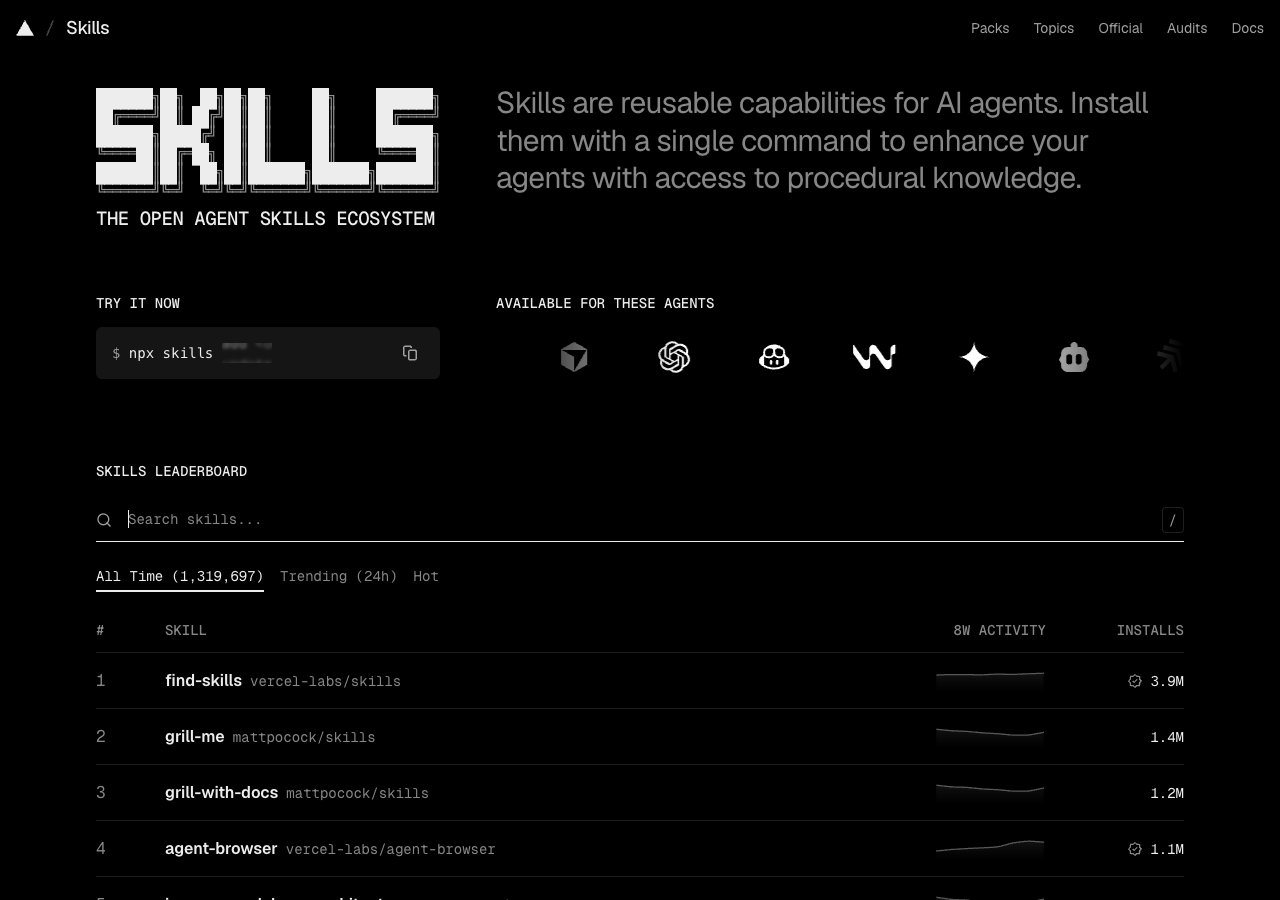
skills.sh is the leaderboard for Vercel's open-source installer, npx skills add owner/repo, which says it "Supports OpenCode, Claude Code, Codex, Cursor, and 75 more." Its own skill, find-skills, tops the board at 3.9M installs.
The FAQ says the leaderboard "is powered by anonymous telemetry data from the skills CLI." So it counts one installer and nothing else: a skill you cloned, copied or installed as a plugin shows zero. The header reads "All Time (1,319,697)" without saying what that figure counts, and since the top skill alone shows 3.9M installs, it is not a total of installs. Rank tells you what is visible to that tool's users. It says nothing about quality.
The audits page is the more useful half: "Combined security audit results from Gen Agent Trust Hub, Socket, and Snyk," with a verdict from each scanner per skill. It covers the top of the board, a few dozen skills on the day we looked, with some still pending. One more trade from Matt Pocock's README applies here: files installed this way are copies you update by hand.
Best suited for: spotting which skills people actually reach for and reading three before writing your own. Not a quality ranking, and its audits cover only the most-installed skills.
6. ComposioHQ awesome-claude-skills, best for app-automation coverage
At a glance: 864 skill folders · no licence · 31 of 864 validate · 77,111 GitHub stars
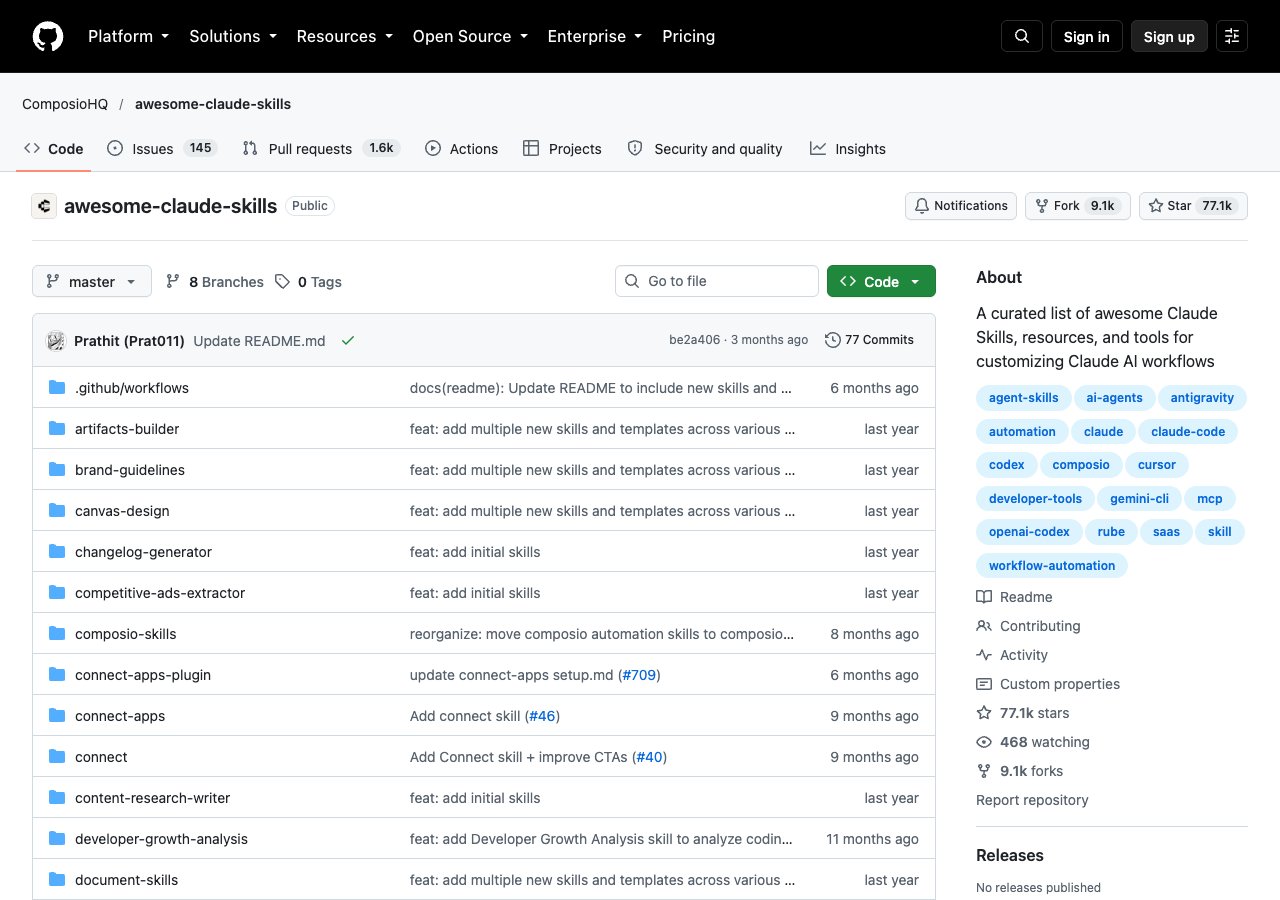
If you want a skill for a specific app, this is the biggest pile: 864 skill folders, almost all generated as composio-skills/<tool>-automation, one per service. Nothing else we checked comes close on count.
It fails most of the screen. The repository has no licence and only 13 of its 864 folders carry their own, which under the first row of our screen means most of it cannot go into anything you hand a client. On the validator, 31 pass and 833 fail, 96% of the folder. In 778 of those, the frontmatter line mcp: [rube] is YAML the standard's strict parser refuses. Others have names like Ahrefs Automation, with capitals and a space, which the standard does not allow.
That does not make the skills useless. Descriptions are short, a median of 96 characters, and none bundles a test file. But the frontmatter of most of them names an MCP server called rube, so read the body to see what each one calls before you install it. The last push was 26 days before we checked. Several other repositories share the same name, so check the owner too.
Best suited for: finding out which apps already have a skill, then writing your own version. Not for installing as-is into client work, with no licence and 96% failing the validator.
Side-by-Side Comparison
The six checks from the methodology, one row per source, all measured on the same day. "Skills checked" counts folders containing a SKILL.md.
| Source | Best for | Licence | Skills checked | Pass validator | Listing chars, median / max | Days since push | Cost or security shown |
|---|---|---|---|---|---|---|---|
| Official plugin marketplace | Pricing a skill before install | Apache-2.0 | 33 (315 plugins listed) | 8 of 33 | 338 / 906 | 0 | Context cost per plugin |
| anthropics/skills | Reading well-built examples | 14 Apache, 4 source-available, 1 none | 20 | 18 of 20 | 321 / 1,068 | 5 | No |
| obra/superpowers | A set that passes the standard | MIT | 15 | 15 of 15 | 107 / 375 | 4 | No |
| mattpocock/skills | Engineering workflows across agents | MIT | 38 | 15 of 38 | 130 / 417 | 1 | No |
| skills.sh | Seeing what people install | MIT (CLI) | 3 (its own) | 3 of 3 | 100 / 303 | 5 | Audits from 3 scanners |
| Composio awesome-claude-skills | App-automation coverage | None at repo level (13 folders have one) | 864 | 31 of 864 | 96 / 445 | 26 | No |
Checked 2026-10-14. Bundled test files inside skill folders: 0 in every source. Not ranked here: Anthropic's community marketplace (anthropics/claude-plugins-community, third-party plugins submitted to Anthropic) and the web Claude Marketplace at claude.com, which shows install counts and marks some plugins Anthropic verified. VoltAgent/awesome-agent-skills (35,718 stars, MIT) is a link list with no skill files, so it has nothing to validate. Validator: skills-ref 0.1.1. Sources and check dates are listed under this article.
Which Claude Skills Marketplace Fits Your Use Case
Match the source to what the skill is for, not to the size of the number on it.
| If you | Pick | Why |
|---|---|---|
| Want to know what a skill costs before installing it | Official plugin marketplace | Every turn and When invoked token estimates |
| Are learning to write skills | anthropics/skills | Vendor-written examples, 14 reusable under Apache 2.0 |
| Want skills you can upload anywhere without edits | obra/superpowers | 15 of 15 pass the open standard |
| Work in several coding agents | mattpocock/skills | Install routes for Claude Code, Codex, Copilot and Gemini |
| Want to see what is popular first | skills.sh | Install ranking plus a 3-scanner audit page |
| Need a skill for a specific app | Composio list, then write your own | 864 skill folders, mostly one per app, but no licence |
What Results Look Like When We Screened 973 Skills
We cloned each source, ran the validator on every skill folder, and measured each description. Nothing inside the clones was executed. The results:
- 973 skill folders checked across 6 sources.
- 59 of 109 from the five curated sources pass
agentskills validate; 31 of 864 from the generated Composio list do. - 1 skill over the standard's 1,024-character description limit (Anthropic's
claude-api, 1,068) and 0 over Claude Code's 1,536-character listing cap. - 0 skill folders with bundled test files.
- 4 sources with a repository licence, 1 with per-skill licences only (anthropics/skills), and 1 with no repository licence (Composio).
The validator is the open standard's own, installed with pip install skills-ref from PyPI. Before you trust what any of these sources hands you, read our guide to the best Claude skill security scanners, which covers what the validator cannot see.
Get the Six-Row Screen in Claude Skills: The Paid Work Playbook
Every number on this page came from checks you can run yourself. Chapter 7 of the book turns them into a screening sheet you fill in for three candidates doing the same job, and it rejects at least one on evidence in about 90 seconds. Chapter 8 then reads the whole folder of the survivor, the files no screen opens. You also run the screen backwards on the skills you already own, which is where most of the surprises turn up. Get Claude Skills: The Paid Work Playbook and screen your next install before it reaches your folder.
Frequently Asked Questions
What is the best Claude Skills marketplace?+
For Claude Code users, Anthropic's official plugin marketplace, because it shows a plugin's context cost before you install it and is registered automatically. For learning, Anthropic's skills repo has the best examples, and obra/superpowers is the cleanest set against the open standard.
How do I add a Claude Skills marketplace in Claude Code?+
Run /plugin marketplace add owner/repo in a session, or claude plugin marketplace add from your shell. Anthropic's official marketplace is added for you the first time you start an interactive session. Install from any marketplace with /plugin install name@marketplace.
How do I check what a skill costs before installing it?+
For a plugin in the official marketplace, open it with /plugin install name@claude-plugins-official and read the Context cost line. For a loose skill, count the characters in its description and when_to_use together and compare them with the 1,536-character cap. After installing, /context shows what your whole skill list costs.
What does the skills.sh install count measure?+
Installs made through its own command-line tool, reported by anonymous telemetry. A skill installed any other way counts as zero there. Treat the rank as a measure of visibility, not quality.
Can I use Anthropic's skills in client work?+
The 14 Apache 2.0 skills, yes, within that licence. The docx, pdf, pptx and xlsx skills are "source-available, not open source," so read them but do not copy them into a client deliverable. One skill, doc-coauthoring, has no licence file at all.
What does agentskills validate check?+
It checks a skill against the open standard: name rules, that the folder name matches the name field, a required description, and only the six standard frontmatter fields. It exits 0 or 1 with named errors. It does not check security, triggering or output quality.
How do I know a skill from a marketplace is safe?+
Read the whole folder, not just SKILL.md: scripts, references, assets and any test files. Scanners help, and Cisco's free scanner flagged a test-file payload in our run, but disguised payloads still get past them. Our guide to Claude skill security scanners covers what each one checks.
Are Claude Code plugins and skills the same thing?+
No. A skill is a folder with a SKILL.md file. A plugin is a package that can add skills, agents, hooks and MCP servers at once, which is why installing one can cost more than its skills alone.