Build an AI Board of Advisors That Argues Back
Stop making pricing and hiring calls with a yes-man AI. Build an AI board of advisors: four roles that pressure-test the decision and return one honest verdict.
>This board is one room. The LLM Council adds the idea council, the code-review board, and the fact-gate, plus the chairman and audit trail behind all four.
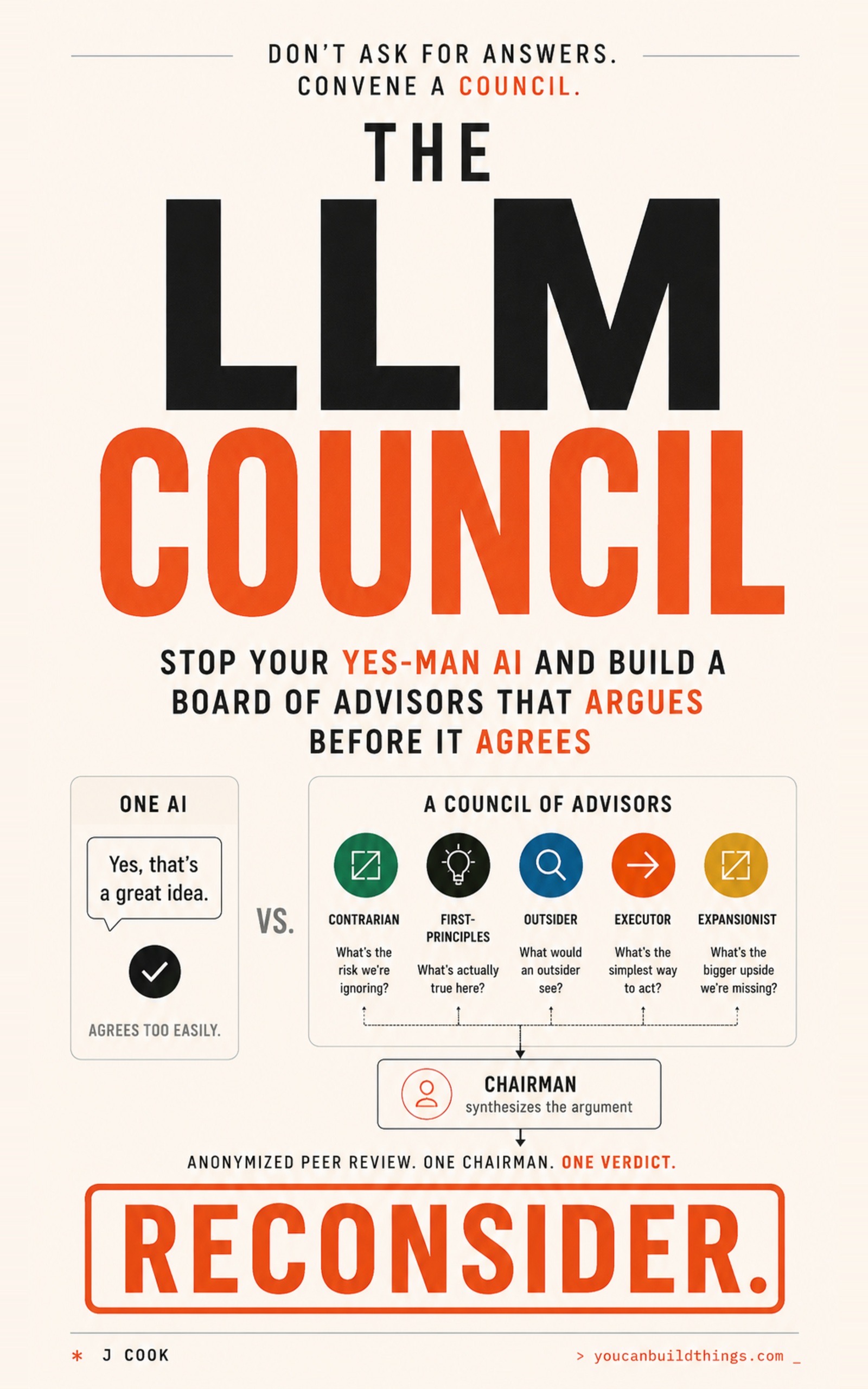
The LLM Council
Stop Your Yes-Man AI and Build a Board of Advisors That Argues Before It Agrees
Summary:
- Build a
/boardof four business advisors you convene before pricing, hiring, and go/no-go calls.- CFO lens, skeptical customer, ops realist, growth bull. Three skeptics and one voice for the upside.
- The chairman returns a verdict with the biggest tradeoff named and the dissent shown, not buried.
- Bonus: the full
/boardskill, a worked pricing decision, and the decision log that scores your judgment over time.
An AI board of advisors is the fix for the loneliest part of running something: the high-stakes call you make with only a yes-man AI to check you. A council run costs pennies. A wrong pricing call costs months. A bad hire costs a year. Those are exactly the decisions founders make alone, talking it through with the one advisor on tap that tells them what they want to hear. This seats you a board for those calls.
What is an AI board of advisors?
An AI board of advisors is a small panel of AI roles that each judge your decision from a different business angle, then hand back one verdict. It is not one model wearing five hats; it is several independent calls, each tuned to a way the decision could be wrong. You are not the only person who has wanted this. One operator on Reddit put it exactly right:
I don’t need an AI cheerleader. I need an AI that challenges my thinking like a sharp co-founder would!
That is from a post titled “Turning ChatGPT from yes-man to board advisor” (100 upvotes, r/ChatGPTPromptGenius). The instinct is everywhere. This article turns it into a standing skill instead of a prompt you retype.
Who sits on the board?
A business board needs different seats than an idea council, because business decisions fail in business-specific ways. Four seats cover most of it.
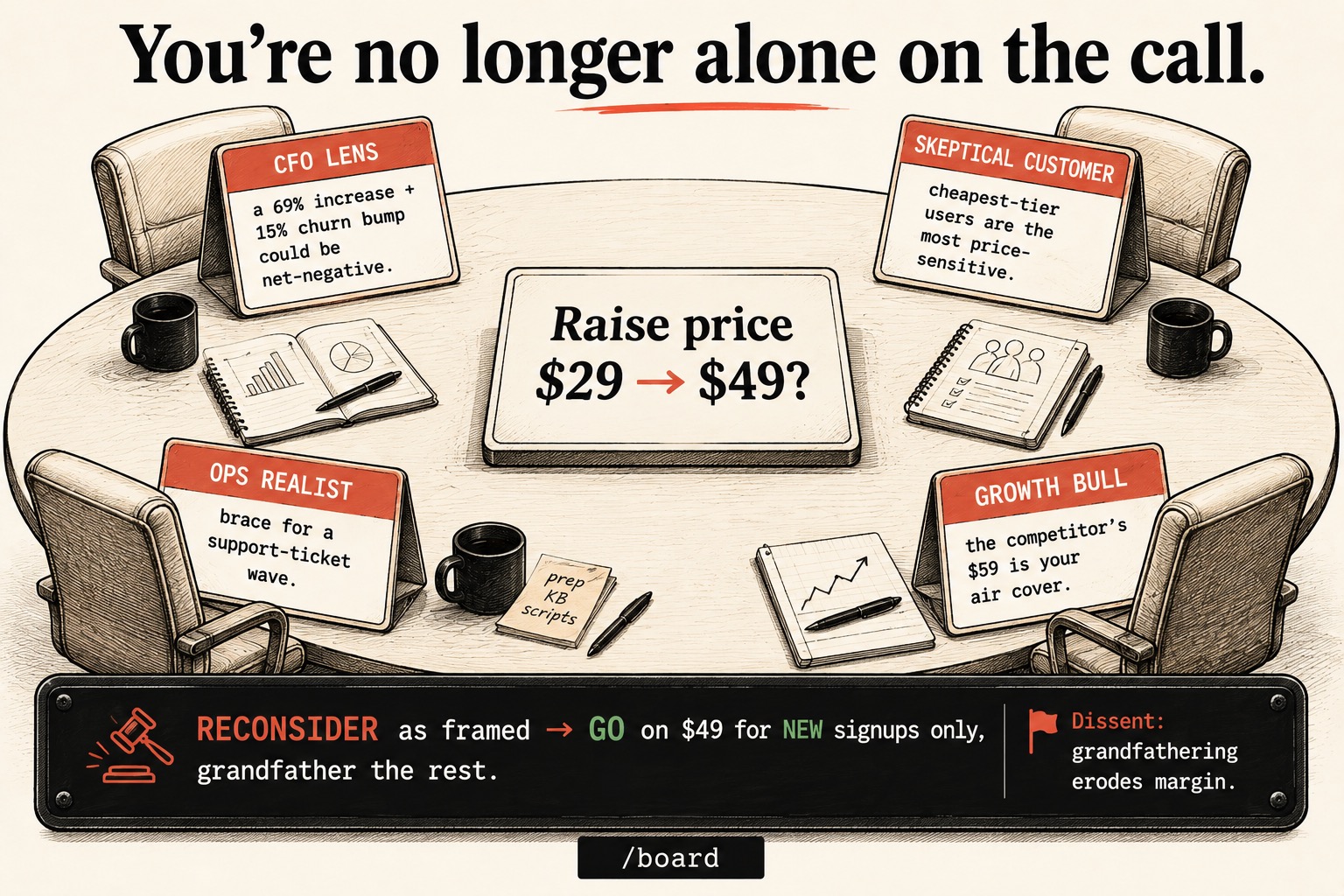
- The CFO lens judges the money, including the money you are not counting: fully-loaded cost, margin, cash-flow timing, the optimistic number you left off the spreadsheet.
- The skeptical customer is the person who has to pay or actually use the thing and does not care about your internal reasoning. The cheapest-tier users are the most price-sensitive by definition.
- The ops realist asks who delivers this and what breaks at scale. A price change, for instance, means bracing for a support-ticket wave.
- The growth bull argues the upside, the counterweight to the other three. A competitor pricing higher is your air cover. You need this seat, or a board of three skeptics talks you out of every bold move.
Build the /board skill
You already have the engine if you built the idea council. The board is the same machine with a business roster. Create .claude/skills/board/SKILL.md:
---
description: Convene a business board on a high-stakes decision (pricing, hiring,
  go/no-go). Four roles answer independently, then a chairman returns a verdict.
---

# Board

Treat the user's message as the DECISION and any numbers as CONTEXT. Run these
four advisors independently with the Bash tool, each a separate call:

  claude -p "You are the CFO LENS. Judge this on the money, including costs left
  out: fully-loaded cost, margin, cash-flow timing, any optimistic number. Name
  the financial risk most likely underestimated. CONTEXT: CONTEXT DECISION: DECISION"

  claude -p "You are the SKEPTICAL CUSTOMER. You pay for or use this and do not
  care about internal reasoning. Would a real customer notice, pay for, or resent
  this? CONTEXT: CONTEXT DECISION: DECISION"

  claude -p "You are the OPS REALIST. Ask who delivers this and what breaks at
  scale: staffing, the 10x case, what falls over first. CONTEXT: CONTEXT DECISION: DECISION"

  claude -p "You are the GROWTH BULL. Make the strongest case for the upside: if
  this works, what does it set up? Is the cautious version leaving money on the
  table? CONTEXT: CONTEXT DECISION: DECISION"

Then run the anonymized peer review and the chairman. The chairman opens with
GO / NO-GO / RECONSIDER, gives the leading case, names the biggest tradeoff, and
ends with a Dissent line. Append to a decision log. Print the verdict, then the four answers.
You convene it with the real decision and the real numbers:
/board
DECISION: Raise our entry price from $29 to $49 a month?
CONTEXT: The $29 tier is most of our signups. Churn is already a bit high.
A competitor just raised to $59. We need the revenue but fear a churn spike.
Run a real decision past the board
Feed the board that $29 to $49 question and watch the seats earn their keep. The CFO lens does the math you have been avoiding. The skeptical customer speaks for the people on your cheapest tier. The ops realist asks if you are staffed for the cancellation wave. The growth bull points at the competitor’s $59 as air cover. Then the chairman refuses to average it into “raise prices a little”:
RECONSIDER as framed; lean GO on a modified version.

A flat 69% increase risks net-negative revenue if it drives even a 15% churn
bump on your most price-sensitive segment. The board's strongest convergent idea:
raise to $49 for NEW signups only, grandfather existing $29 users, and you
capture the competitor's $59 air cover without the churn spike.

Dissent: grandfathering forever erodes margin as costs rise, so make it
time-limited. The one number to get first: your actual churn elasticity.
That is a board meeting, run in two minutes, for pennies, and it just talked you out of the version that would have cost you.
Log every verdict so you can score your own judgment
Business outcomes take months to land, and your memory of why you decided something will be gone by the time the result arrives. So have the skill append every run to a decision log:
DECISION LOG (append every /board run; keep dates out of the entry text and let
the filesystem track timestamps):
  - The decision as you posed it
  - The four advisors' core positions
  - The chairman's verdict and the dissent
  - One line you add yourself: what you actually chose, and why
That last line is the gold. Three months on, when the pricing change either worked or did not, you open the log and see exactly what the board told you, which dissent you honored or ignored, and whether your gut override was wise or expensive. A founder who keeps this for a year has something most never get: an honest record of their own judgment, scored against reality.
What broke: the call I got wrong
Here is why this one is personal. The decision that cost real money was a pricing call. I set a number, asked a single model to pressure-test it, and it came back with a confident, well-structured defense of the exact number I had already picked. It cost me before I caught it. Not because the model lied, but because it agreed, and agreement from something that sounds that smart feels like confirmation. A board would have had a seat whose only job was to attack that number, and the CFO lens would have found the margin error I missed. The first business board I built later caught exactly that class of mistake on its second run: one advisor flagged a double-counted discount that a single model had blessed twice. I built this skill so I would never make that particular mistake again.
What should you actually do?
- If the decision is cheap and reversible (which font, which send time) → one model is fine. Save the board for the calls that keep you up.
- If you walk in already wanting a yes → that is exactly when to convene, and seat a Contrarian whose only job is to argue the other side.
- If the verdict comes back generic → your context was too vague. Feed the board the actual numbers and constraints, not a summary.
- If you start rubber-stamping the verdict → stop. The board advises, you decide. Keep a decision log with your actual choice, and score it against the outcome months later.
The bottom line
- The board is for high-stakes, hard-to-reverse, emotional calls: pricing, hiring, go/no-go. That is where a yes-man is most expensive.
- Three skeptics and one growth bull. The upside seat keeps the board from becoming a wall of no.
- The board advises, you decide. A board that replaces your judgment has just rebuilt the yes-man with extra steps.
Frequently Asked Questions
What is an AI board of advisors?+
An AI board of advisors is a set of AI roles (a CFO lens, a skeptical customer, an ops realist, a growth bull) that each judge a high-stakes decision independently, then a chairman returns one verdict with the tradeoff named and the dissent shown.
Do I need to be a developer to build an AI advisory board?+
No. It is a Claude Code skill that runs a few model calls and prints a verdict. If you can create a file and type a command, you can build it. There is no server and no framework to learn.
Should I let the AI board make the decision for me?+
No. The board advises, you decide. It exists to pressure-test your thinking and surface the tradeoff you missed, not to replace your judgment. You own the call and the accountability, so use the dissent line to disagree on an informed basis.