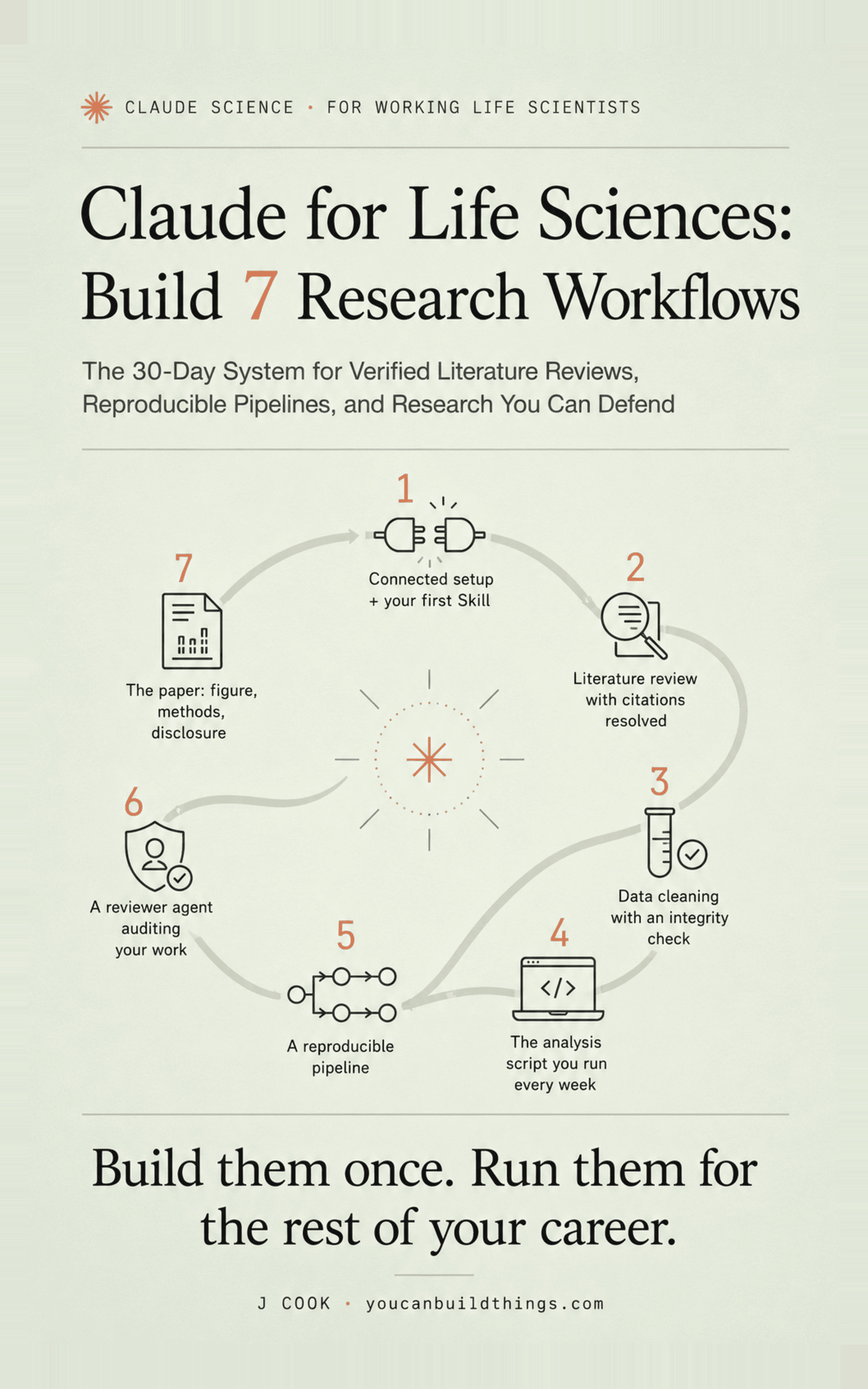
Claude for Life Sciences
Build 7 Research Workflows
You asked Claude for the literature and it handed you three papers that do not exist. You ran the pipeline it wrote and today it breaks. This book hands you seven research workflows you build once and run for the rest of your career, each one with a verification layer that resolves outside the model. Your connectors are wired the first afternoon and your first verified literature review runs in under an hour, every citation resolved to a real paper or thrown out. By Week 2 your analysis script is a pipeline that returns the same answer on any machine, and a reviewer agent audits your work for the errors that slip past peer review. Written for a bench scientist, not a computer scientist.
The one book actually named for this field is 225 pages of survey with no build steps. The closest hands-on competitor is 89 pages and never once shows you how to check whether the AI lied.
You cannot ask Claude to grade its own citations. You cannot ask it whether it quietly dropped your positive control. You cannot ask it to prove your pipeline will reproduce. This book does all three, and the rule holds across every chapter: every check has to resolve against something outside the model. A count is a count. A dtype is a dtype. Nothing here is an opinion.
Every workflow ships with a free companion repo: the Skills, the connector table, and the checklists at the exact paths the book uses, plus two sample runs so you can watch the verification fail on a real error before you point it at your own work.
What You'll Build
See what one scientist replaced for free, and where the line actually sits between a rentable suite and a workflow you own.
Write trust-boundary.md: five rows each side, and every unsupervised row must carry a detection method that resolves outside the model.
Install the life-sciences marketplace and ship your first Skill: a confounded-design check that fires on real work within a week.
Build the citation-check Skill that resolves every reference to a real paper or kills it, plus an audit table for the review in front of you.
Snapshot the before-state, then build an integrity reconciliation where every difference is accounted for, not merely reported.
Write the config by hand first, then get run_analysis.sh and the step scripts that read every parameter from it.
Convert the script into a DAG with a hand-written environment.yml and a locked env, then prove it on a clean install.
Build verification-rubric.md from your trust boundary, the reviewer Skill that runs it, and verify.sh for the half that needs no model at all.
Regenerate the figure through the pipeline, write methods from files instead of memory, and draft the AI disclosure journals now demand.
Assemble nine exercises into one tool: the project directory in git, connectors.md, and go.sh that runs your recurring task end to end.
Write runbook.md from failures that actually happened, each row naming the signal that announced it and the recovery you already ran.
Write plan-30.md by day number with every generic noun replaced by a real one, then validate the whole repo in one pass.