Best Polymarket Books in 2027: The Buyer's Shortlist
We opened all 28 first-page Kindle results for Polymarket and prediction market trading and ranked them on bots, code, edge math, sizing and copy trading.
>This shortlist compares the books. Polymarket Profits is the one that ends with a Python bot reading live Polymarket prices, a whale vetting script and a Kelly sheet for every trade.
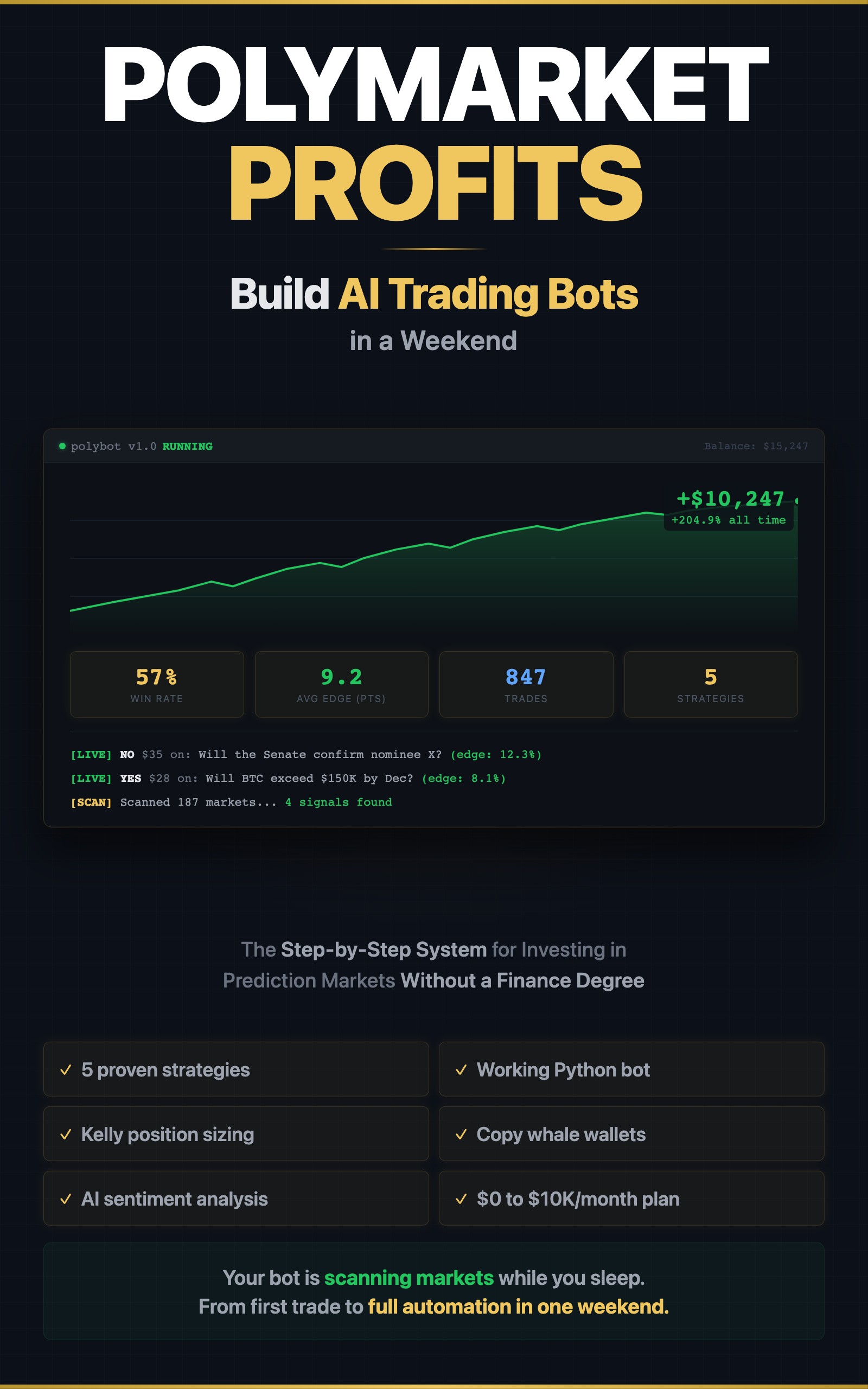
We opened all 28 first-page Kindle results for "polymarket" and "prediction market trading" and compared them on what they build, price and reader ratings. Disclosure: John Cook, who wrote this guide, also wrote our top pick. As an Amazon Associate we earn from qualifying purchases. Of the best Polymarket books, Polymarket Profits is the pick for a Python bot, whale vetting and Kelly sizing in one book. If you don't code, start with Kalshi & Polymarket Trading with AI.
Key Takeaways
- Amazon shows 71 Kindle results for "polymarket", and most books have no visible rating. 16 of the 28 books we opened show no stars at all. Read the description and the page count, not the stars.
- Only 1 of the 25 books by other authors promises a bot that trades for you. That is Polyquant, published 17 days before we checked. The other three are by the author of this guide.
- Copy trading is a clear promise in 3 descriptions out of 28. 35 Polymarket Strategies grades it as one of its 35 strategies. The other two are our pick and its sequel, by the author of this guide.
- The loss numbers on the shelf run from 70% to 87.3%. Three books quote that share of wallets or traders losing money. Our pick cites backtests with win rates of 55-65%, "not the mythical 85%."
- Kindle prices run from $0.99 to $12.99. 21 of the 28 are free on Kindle Unlimited. Our pick is $12.99 or free on Kindle Unlimited.
Free: The book's companion repo: the paper-trading bot, the whale and arbitrage scripts, the Kelly calculator and the blank sheets, ready to run with no key and no account. Get the companion repo on GitHub.
What a Polymarket Book Actually Is (and What It Is Not)
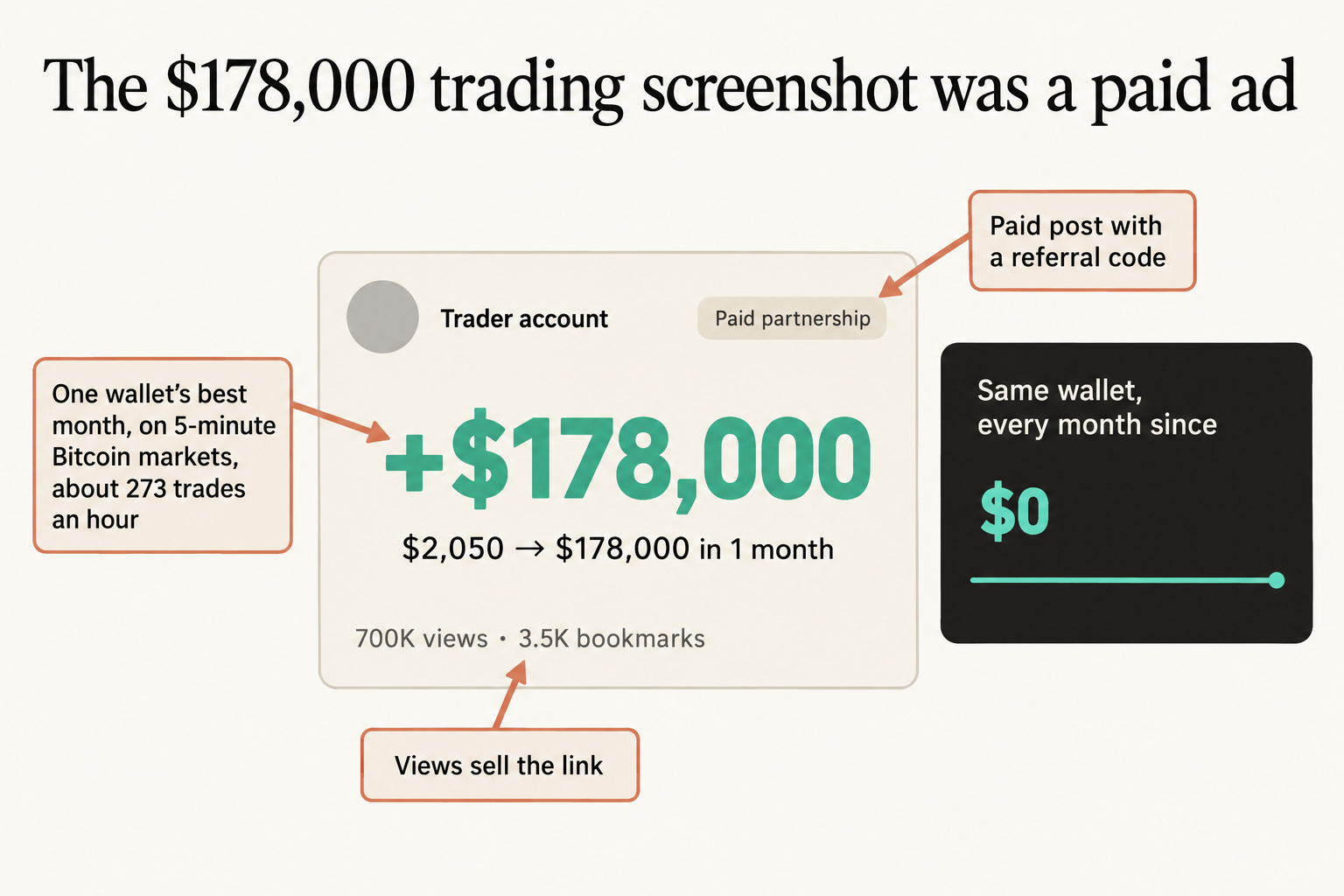
A Polymarket book should leave you with a way to decide which prices are wrong and how much to put on each one. A share pays $1.00 or nothing, so its price is the crowd's probability, and a book earns its price when it teaches you to estimate a better number, size the trade and check the result. The viral $178,000 screenshot below showed a result and none of the process behind it.
Four kinds of book share these search results. Bot books in Python hand you code to run against Polymarket's public data. Strategy books give you rules for finding mispriced markets, often with Kelly sizing. Beginner guides walk you through a wallet, a deposit and a first trade, some in under 30 pages. And story books collect real traders and wallets. Any of them can be the right buy, depending on whether you want to run code or trade by hand.
A book is also not the only way in. Polymarket's own docs and free data endpoints are public, and plenty of free posts explain what a prediction market is. A book earns its price by taking you further, to a tested strategy, a size for each trade and a record you can check.
How We Ranked These Books
We opened 28 Amazon product pages live on the same day: all 16 first-page results for "polymarket" (71 results) and the 12 other first-page results for "prediction market trading" (717 results). Each book is scored only on what a buyer can see before paying, the same way for every book, including ours.
- Jobs covered. How many of 7 jobs the description promises: Python code or a repo, a bot that trades or paper-trades, edge or expected-value math, position sizing, copy trading, Kalshi or cross-platform arbitrage, and the tax and legal risks. These are the jobs our #1 pick's author thinks matter, which is why it scores highest. A clear promise counts 1 and a hint counts half.
- Reader proof. Star rating and number of ratings on Amazon, shown as is.
- Price. Kindle price, print price, and whether it is free on Kindle Unlimited.
- Honest numbers. Whether the description backs its claims with loss data or a realistic win rate, or leans on promises of "consistent profits."
- Length. Print length as listed, since the shelf runs from 18 pages to 444.
Two other books by the author of this guide score 4.5 by the same method, Polymarket Profits 2 and Use Claude to Build an AI Trading Bot. We left them out of the ranking and list them in the notes under the comparison table. We rank jobs covered above ratings, and break ties on the number of ratings. If you weigh reviews first, the books with 7 or more ratings are Polyalpha (4.8 on 10), Kalshi & Polymarket Trading with AI (4.8 on 7) and The No-BS Guide to Prediction Market Arbitrage (4.6 on 10).
The Best Polymarket Books in 2027
Eight books made the list. Quick picks: for a Python bot with copy trading and Kelly, Polymarket Profits; for evidence on each strategy, 35 Polymarket Strategies; for no-code with taxes covered, Kalshi & Polymarket Trading with AI; for arbitrage without code, The No-BS Guide to Prediction Market Arbitrage; for a 24/7 bot, Polyquant; for real trader stories, The Polymarket Files; for a short read on edge and Kelly, The Prediction Market Playbook; for a beginner covering both platforms, Kalshi & Polymarket: The Complete Beginner's Trading Playbook. The other 20 books we opened are in the notes under the comparison table.
1. Polymarket Profits, best for a Python bot, whale vetting and Kelly sizing in one book
At a glance: 6.5 of 7 jobs covered · $12.99 or free on Kindle Unlimited · 206 pages · free companion repo · no ratings shown · See it on Amazon
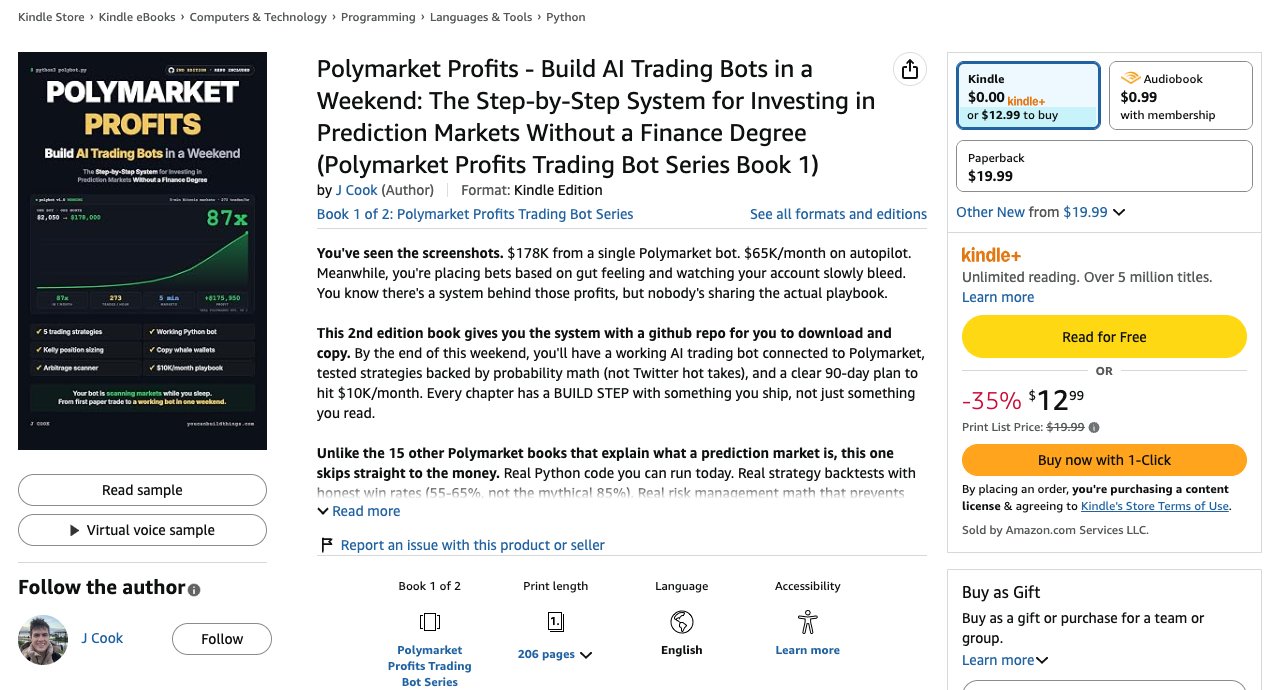
This is the book I wrote, so weigh this entry with that in mind. The 2nd edition promises "a working AI trading bot connected to Polymarket, tested strategies backed by probability math (not Twitter hot takes), and a clear 90-day plan to hit $10K/month." The bot reads live Polymarket prices, measures edge after the taker fee and paper-trades every decision into a CSV log, with no key and no account.
It covers six of our seven jobs outright: Python code ("a github repo for you to download and copy"), the bot, the probability math, "The Kelly formula for position sizing so you never blow up your bankroll," copy trading ("Copy whale wallets making $65K/month with automated tracking systems") and "The real risks: regulation, rug pulls, taxes, and platform failures nobody else covers." The description never names Kalshi or arbitrage, and the cover art lists an arbitrage scanner, so that job gets half a point. Without it the book scores 6 and still ranks first.
Its description cites "Real strategy backtests with honest win rates (55-65%, not the mythical 85%)." It costs $12.99 or is free on Kindle Unlimited, with a $19.99 paperback, and shows no star rating yet.
Best suited for: a trader who can run a Python script and wants a bot, a way to vet wallets before copying them, and a size for every trade. If you never open a terminal, start with entry 3 or 4.
2. 35 Polymarket Strategies, Graded by Evidence, best for checking which strategies hold up
At a glance: 5 of 7 jobs · $12.99 or free on Kindle Unlimited · 444 pages · open-source companion package · no ratings shown · See it on Amazon
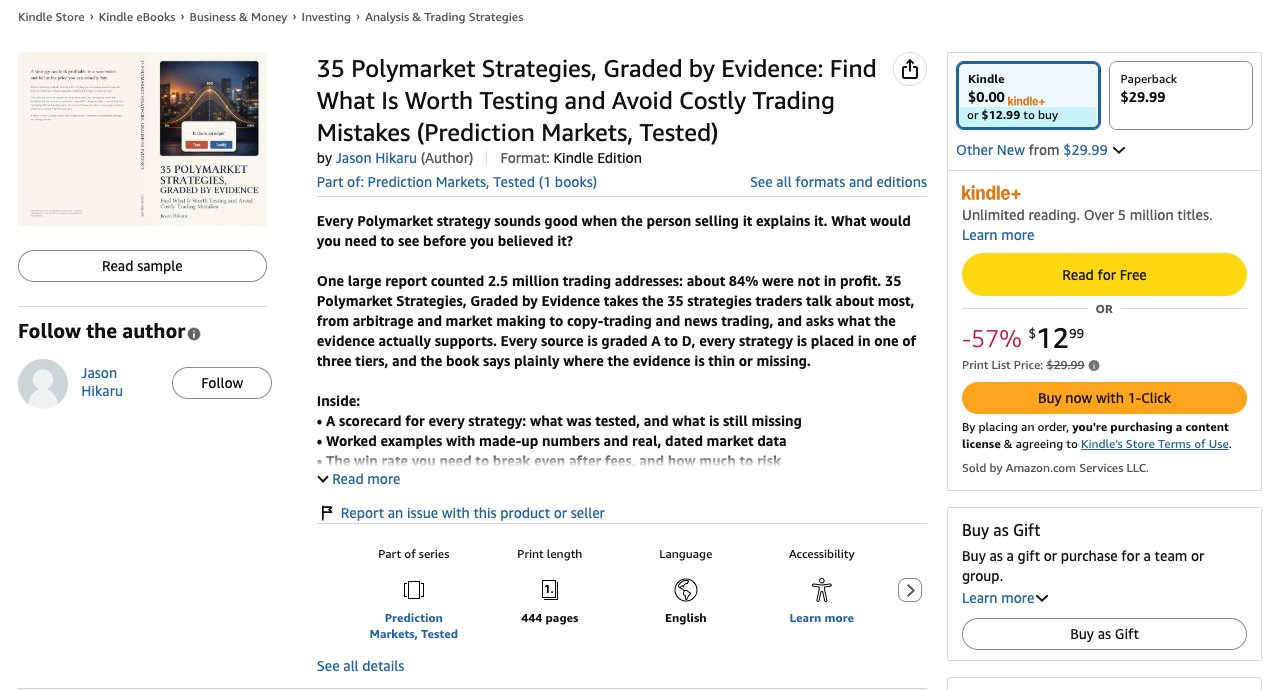
Jason Hikaru takes "the 35 strategies traders talk about most, from arbitrage and market making to copy-trading and news trading," and grades each on the evidence behind it. It opens with a hard number: "One large report counted 2.5 million trading addresses: about 84% were not in profit."
It scores 5 of our 7 jobs. It promises "A free, open-source companion package with a tool for each strategy," "The win rate you need to break even after fees, and how much to risk," and copy trading as one of the graded strategies. Its testing is "A paper-trading protocol, a ninety-day test plan and a safety checklist," a protocol for you to run, not a bot of its own.
Its verdict: "Only three strategies pass the book's evidence bar, and in the author's reading, bots dominate all three. The other 32 are plausible but unproven." At 444 pages it is the longest book on our list, published 14 days before we checked, with no ratings yet.
Best suited for: a trader who wants to know which strategies have evidence behind them before testing any of them. It pairs well with a book that builds the bot those three strategies need.
3. Kalshi & Polymarket Trading with AI, best for a no-code start with taxes covered
At a glance: 4.5 of 7 jobs · 4.8 stars, 7 ratings · $8.99 or free on Kindle Unlimited · 166 pages · See it on Amazon
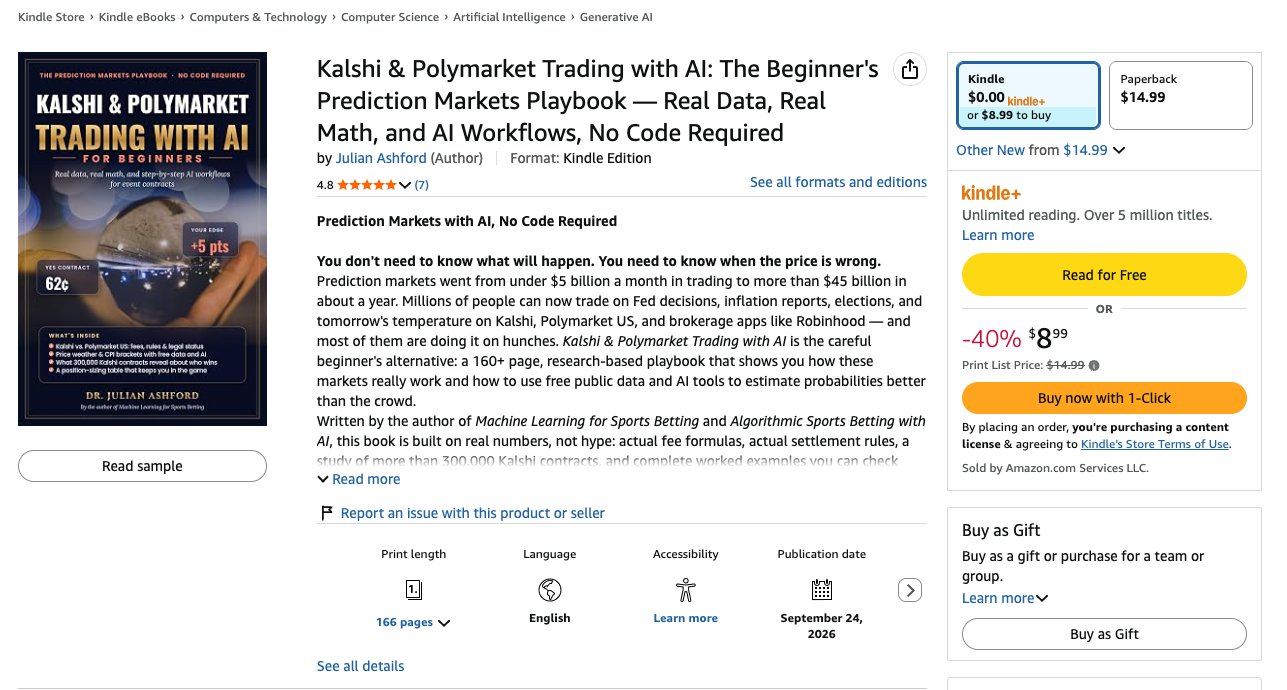
Julian Ashford's subtitle says it plainly: "Real Data, Real Math, and AI Workflows, No Code Required." In place of code you get "23 copy-paste AI prompts" and "One complete week of research and trades, every number shown — including a loss."
It scores 4.5 of our 7 jobs, and its forecasting promises are specific: "how to calculate your break-even before every trade," "Forecasting skills that work: base rates, decomposition, updating, and Brier scores," and "Kelly-based position sizing with a simple lookup table and exposure limits." It covers trading "on Kalshi, Polymarket US, and brokerage apps like Robinhood," and it is one of five books on the shelf with a clear promise on "Taxes, account security, scams, and the warning signs of problem trading."
It backs its warnings with data, "cheap "lottery ticket" contracts have lost over 60% on average," and says outright "This is not a promise of profit." At $8.99 or free on Kindle Unlimited with 4.8 stars on 7 ratings, it has one of the best rating records on our list.
Best suited for: a US trader who wants AI prompts in place of code and the tax and safety basics in the same book. No bot and no copy trading.
4. The No-BS Guide to Prediction Market Arbitrage, best for cross-platform arbitrage without code
At a glance: 4 of 7 jobs · 4.6 stars, 10 ratings · $7.99 or free on Kindle Unlimited · 267 pages · See it on Amazon
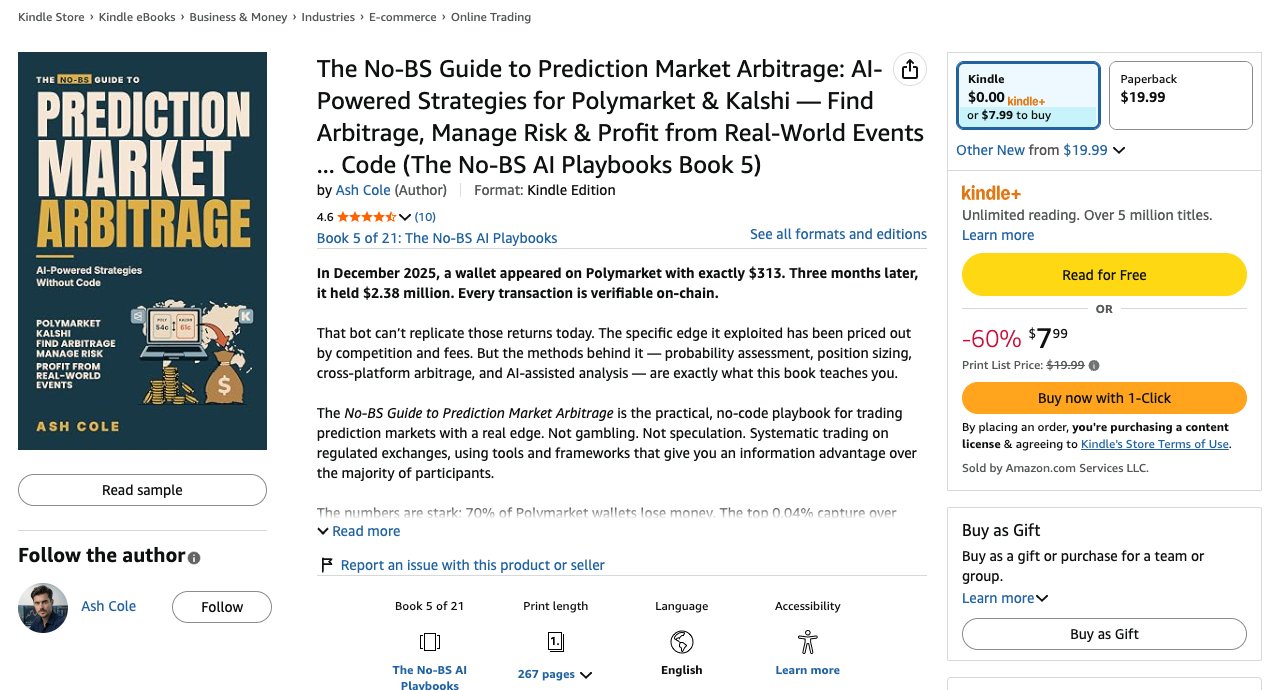
Ash Cole's book was the #1 result for "polymarket" in Amazon's default order on the day we checked. It calls itself "the practical, no-code playbook for trading prediction markets with a real edge," and its main lesson is "Cross-platform arbitrage between Polymarket and Kalshi — step-by-step, with fee calculations and real examples."
It scores 4 of our 7 jobs. Sizing is spelled out: "The Kelly Criterion for position sizing — full mathematical walkthrough with quarter-Kelly defaults for capital preservation," plus "5% position caps, 15% daily loss limits, and the 20–25% drawdown kill switch." Execution runs through third-party tools ("ArbBets, PredictEngine, and the complete scanner-to-execution workflow"), which earns half a point for a bot. It covers CFTC regulation but not taxes.
It opens on a $313 to $2.38 million wallet story and then admits "That bot can't replicate those returns today," and it quotes "70% of Polymarket wallets lose money." It has the most ratings of our eight, 4.6 stars on 10, at $7.99 or free on Kindle Unlimited.
Best suited for: a trader with accounts on both platforms who wants arbitrage and sizing rules without writing code.
5. Polyquant, best for a Python bot that runs on a server 24/7
At a glance: 4 of 7 jobs · $12.99 or free on Kindle Unlimited · 175 pages · downloadable codebase · no ratings shown · See it on Amazon
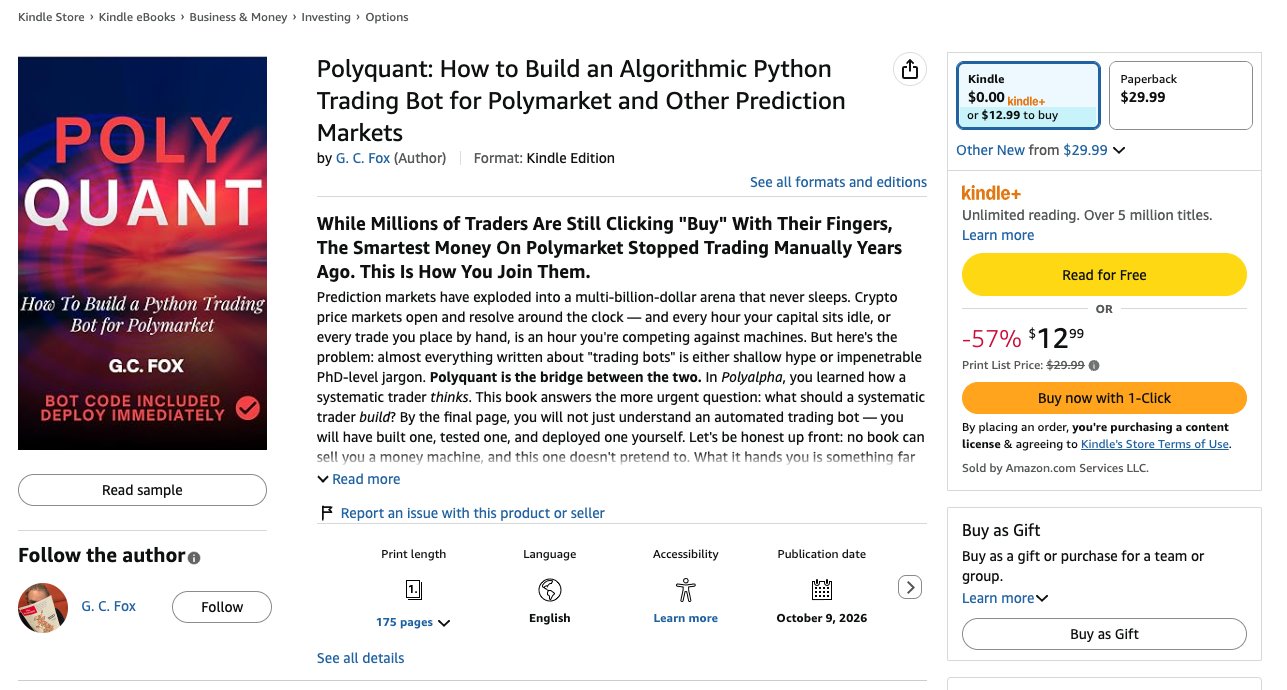
G. C. Fox, the author of Polyalpha, wrote this one as its code companion: "a fully functional Python trading bot for Polymarket, with every line of code explained, every architectural decision justified, and a free, downloadable production codebase." It is the only book by another author on the shelf that promises a bot that trades.
It scores 4 of our 7 jobs. You "Construct a complete "Last-Minute Sniper" bot, step by step," organize it into "the professional five-department architecture ... Intelligence, Strategy, Risk, Execution, and Audit," and finish by "launching your bot onto an always-on cloud server that trades for you 24/7." Sizing is "the 2% position-sizing rule, and automatic circuit breakers." Backtesting gets half a point for edge math, and cross-platform arbitrage appears as an advanced topic.
It is honest about the limits: "no book can sell you a money machine, and this one doesn't pretend to." It was published 17 days before we checked and shows no ratings yet.
Best suited for: a Python developer who wants one strategy running on a cloud server around the clock. No copy trading and no tax coverage.
6. The Polymarket Files, best for real trader stories with the numbers
At a glance: 3.5 of 7 jobs · 5.0 stars, 1 rating · $4.99 or free on Kindle Unlimited · 242 pages · See it on Amazon
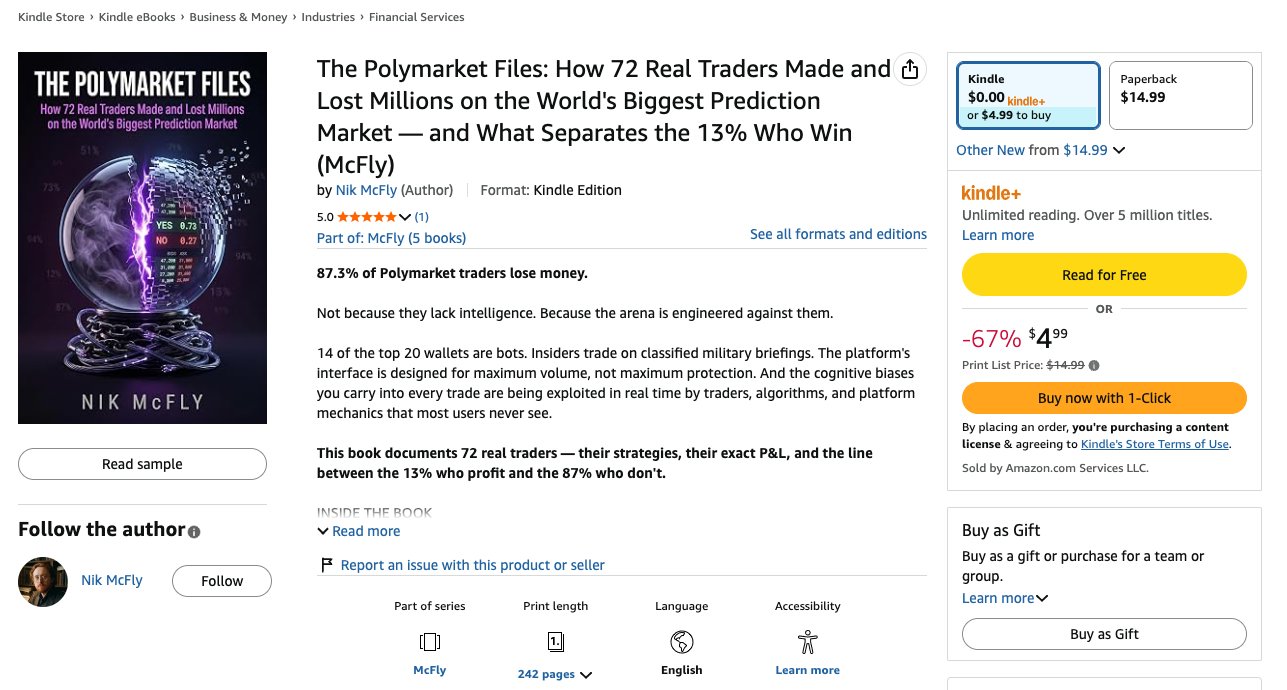
Nik McFly built this book from "72 named trader cases with documented P&L," and the hook is the gap between winning bets and making money: "A trader who won 79.6% of the time and still lost $42,000." It leads with "87.3% of Polymarket traders lose money" and "14 of the top 20 wallets are bots."
It scores 3.5 of our 7 jobs. It promises "The Kelly Criterion adapted for prediction markets" and "The contrarian playbook backed by data from 112,000 wallets," a "Platform comparison (Polymarket vs. Kalshi)," and the risk side in full: "Resolution risk defense. Tax guidance," plus "$143 million in insider trading profits documented by Columbia Business School." The trader cases get half a point toward copy trading, since they show what the winners did without a tool to follow them.
At $4.99 or free on Kindle Unlimited it is the cheapest of our eight over 200 pages, and it shows one 5-star rating.
Best suited for: a reader who learns from real cases and wants the loss data before risking money. No code and no bot.
7. The Prediction Market Playbook, best for a short read on edge, Kelly and arbitrage
At a glance: 3 of 7 jobs · 5.0 stars, 5 ratings · $6.49 or free on Kindle Unlimited · 60 pages · See it on Amazon
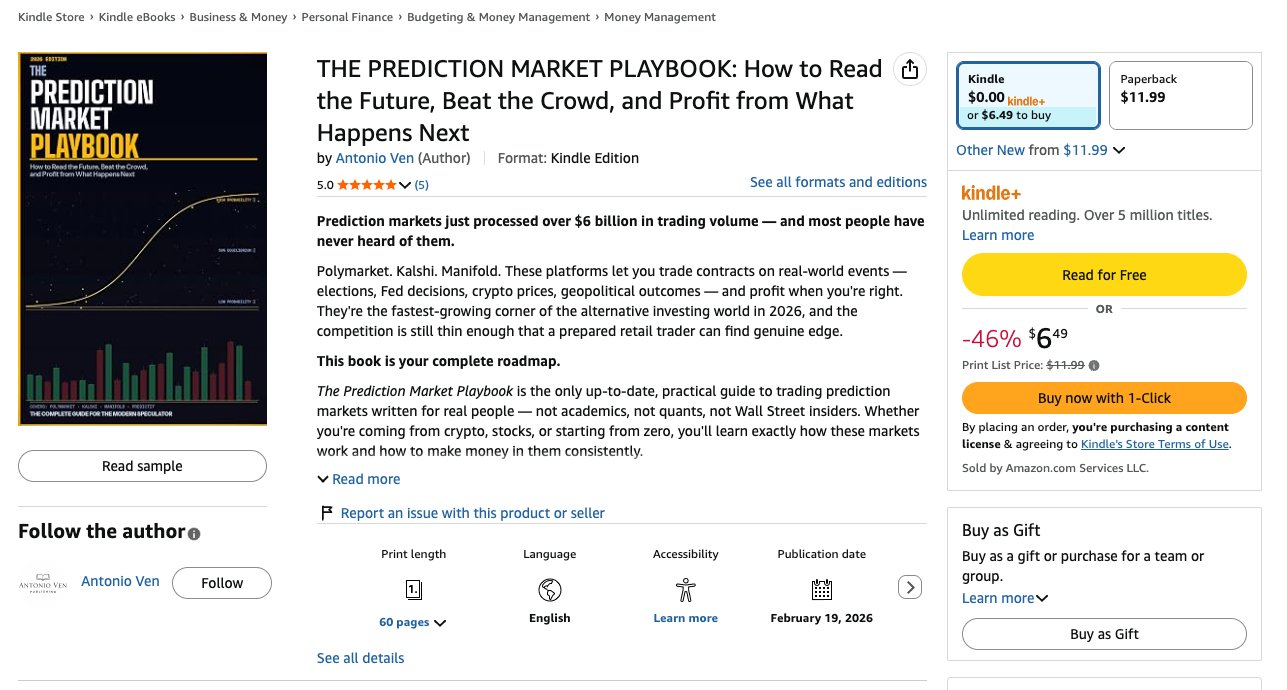
Antonio Ven has four books on this shelf, and this is the short one with the best rating record: 5.0 stars on 5 ratings. Its subtitle, "How to Read the Future, Beat the Crowd, and Profit from What Happens Next," sets up 60 pages of method.
It scores 3 of our 7 jobs, all of them clear. It teaches "How to read contract prices, calculate expected value, and identify mispriced markets," then "The Kelly Criterion, position sizing, and bankroll management explained in plain English," then "Advanced tactics including cross-platform arbitrage, correlated market hedging, and market making."
It makes no win-rate claims either way. At 60 pages it is the shortest of our eight, it ranks #148 in Derivatives on Amazon, and at $6.49 or free on Kindle Unlimited it reads in an evening.
Best suited for: a trader who wants expected value, Kelly sizing and arbitrage explained quickly, by hand, before committing to anything longer. No code, no bot, no tax coverage.
8. Kalshi & Polymarket: The Complete Beginner's Trading Playbook, best for a beginner covering both platforms
At a glance: 3 of 7 jobs · 5.0 stars, 4 ratings · $7.49 or free on Kindle Unlimited · 134 pages · See it on Amazon
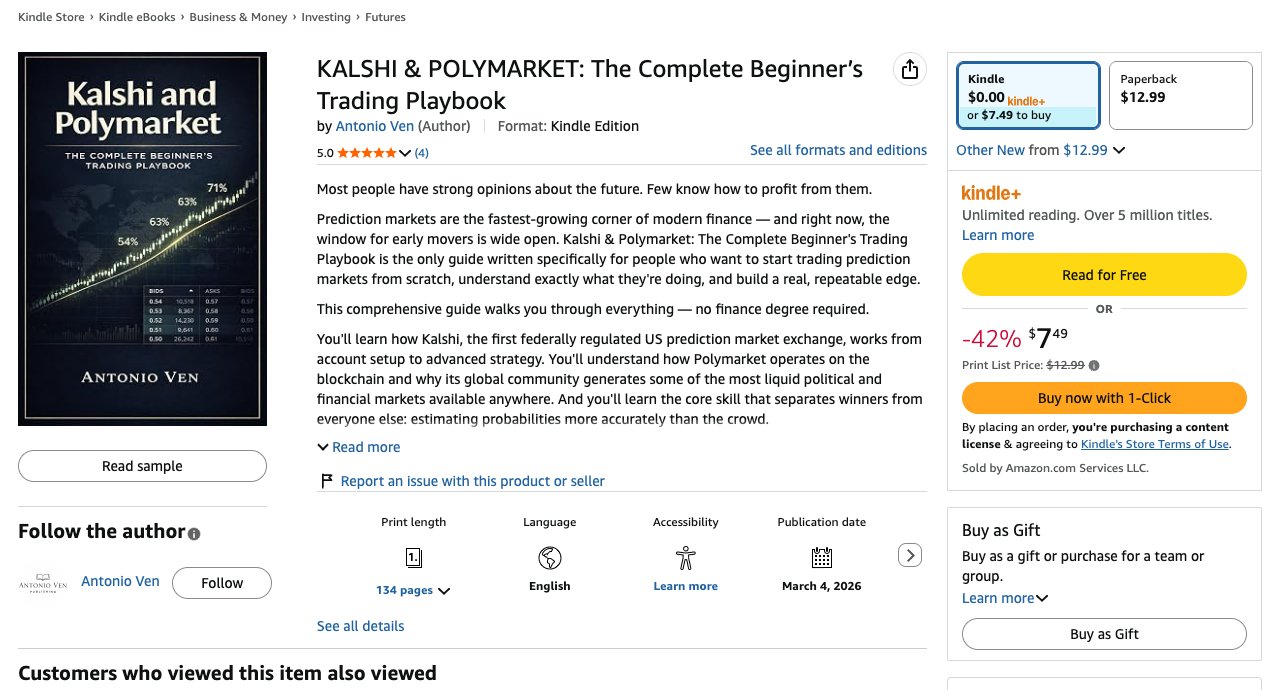
Antonio Ven's beginner playbook covers both big platforms, including "Kalshi, the first federally regulated US prediction market exchange," and walks through "estimating probabilities more accurately than the crowd."
It scores 3 of our 7 jobs. The edge math and the sizing are clear promises: "position sizing, the Kelly Criterion, and growing your bankroll with discipline," plus "The exact risk management framework." It adds "Six advanced trading strategies including the favorite-longshot bias, fading news overreaction, and incremental position building." Kalshi coverage and regulation get half a point each, since the description sets up both platforms without arbitrage or tax detail.
It holds 5.0 stars on 4 ratings at $7.49 or free on Kindle Unlimited. It ties with seven other books on 3 jobs, and its 4 ratings are the most in that group after entry 7.
Best suited for: a new trader who wants one book to get set up on Kalshi and Polymarket and learn sizing before the first real trade. No code and no bot.
Side-by-Side Comparison
The ranking criteria, one row per book, as shown on each product page. Jobs covered counts the 7 jobs named in the methodology, read from the description.
| Book | Best for | Kindle price | Kindle Unlimited | Pages | Rating (count) | Jobs covered (of 7) |
|---|---|---|---|---|---|---|
| Polymarket Profits | Python bot, whale vetting, Kelly | $12.99 | Yes | 206 | None shown | 6.5 |
| 35 Polymarket Strategies, Graded by Evidence | Evidence per strategy | $12.99 | Yes | 444 | None shown | 5 |
| Kalshi & Polymarket Trading with AI | No code, taxes covered | $8.99 | Yes | 166 | 4.8 (7) | 4.5 |
| The No-BS Guide to Prediction Market Arbitrage | Arbitrage without code | $7.99 | Yes | 267 | 4.6 (10) | 4 |
| Polyquant | 24/7 Python bot | $12.99 | Yes | 175 | None shown | 4 |
| The Polymarket Files | Real trader cases | $4.99 | Yes | 242 | 5.0 (1) | 3.5 |
| The Prediction Market Playbook | Short read, edge and Kelly | $6.49 | Yes | 60 | 5.0 (5) | 3 |
| Kalshi & Polymarket: The Complete Beginner's Trading Playbook | Beginner, both platforms | $7.49 | Yes | 134 | 5.0 (4) | 3 |
Prices, ratings and page counts as shown on the day we checked. Also opened, not listed (fewer than 3 jobs, or tied on 3 with fewer ratings): Polyalpha ($12.99, 4.8 on 10, 184 pages; quant strategies and Kelly, no code), The Dummy-Proof Guide to Polymarket ($3.99 or Kindle Unlimited, 239 pages; 3 jobs, no rating shown), Trading The News ($4.99 or Kindle Unlimited, 326 pages; 3 jobs), Trade the Game ($2.99 or Kindle Unlimited, 273 pages; sports, 3 jobs), Prediction Markets Made Simple ($0.99 or Kindle Unlimited, 58 pages, 4.0 on 1; 3 jobs), Prediction Markets for Traders ($0.99 or Kindle Unlimited, 45 pages, 5.0 on 1; 3 jobs), Trading Tomorrow ($4.99, 176 pages; 3 jobs), Prediction Markets: Trading Probability on Polymarket ($7.00, 4.5 on 2), Kelly Criterion: The Math Behind Smart Bets ($0.99 or Kindle Unlimited, 49 pages), The Polymarket Edge ($9.99 or Kindle Unlimited, 4.6 on 3), Polymarket: The Complete User Manual ($0.99, 25 pages), AI + Prediction Markets: The New Edge ($0.99, 50 pages), Crypto Prediction Markets ($0.99, 45 pages), Polymarket for Beginners ($2.99, 18 pages), Polymarket Made Simple ($2.99, 31 pages), Trading Prediction Markets ($9.99, 167 pages), Prediction Markets: How to Profit from Political Betting ($2.99, 5.0 on 1) and Trading Prophecies ($0.99 deal). Two more are by the author of this guide and are left out of the ranking: Polymarket Profits 2 ($12.99, 306 pages; seven bots including arbitrage, resolution scanning and copy trading) and Use Claude to Build an AI Trading Bot ($12.99 or Kindle Unlimited, 2.8 on 4; stocks with a prediction-market section).
Which Polymarket Book Fits Your Use Case
The right book depends on whether you run code and how you want to find your trades, more than on how much you already know.
| If you | Pick | Why |
|---|---|---|
| Want a Python bot reading live prices this weekend, plus whale vetting and Kelly | Polymarket Profits | Paper-trading bot, wallet record check, Kelly sheet, free repo |
| Want to know which strategies have evidence first | 35 Polymarket Strategies | 35 strategies graded, a tool for each, 444 pages |
| Don't code and trade from the US | Kalshi & Polymarket Trading with AI | 23 AI prompts, break-even math, taxes, 4.8 on 7 |
| Hold accounts on both platforms and want arbitrage | The No-BS Guide to Prediction Market Arbitrage | Fee math, quarter-Kelly, no-code tools, 4.6 on 10 |
| Want one bot on a cloud server around the clock | Polyquant | Downloadable codebase, five-department design |
| Learn best from real traders' wins and losses | The Polymarket Files | 72 trader cases with P&L, tax guidance, $4.99 |
| Want the math in one evening | The Prediction Market Playbook | Expected value, Kelly and arbitrage in 60 pages |
| Are brand new and want both platforms set up | Kalshi & Polymarket Beginner's Playbook | Setup, Kelly, six strategies, 5.0 on 4 |
What Results Look Like With the Book's Tests
The #1 pick shows no star rating on Amazon yet, so here is what its code printed when we ran it while researching this guide. These runs read Polymarket's and Kalshi's live public data with no key, so your numbers will differ as the markets move.
- 14 paper trades from 31 live markets. The bot's single scan read 31 Yes/No markets, logged 14 paper trades at edges of 13.5% to 43.5% after the fee, and logged 0 on a second run because it remembers what it traded. Its estimate is still a coin flip, so most of those 14 are the first lesson in why the estimate matters.
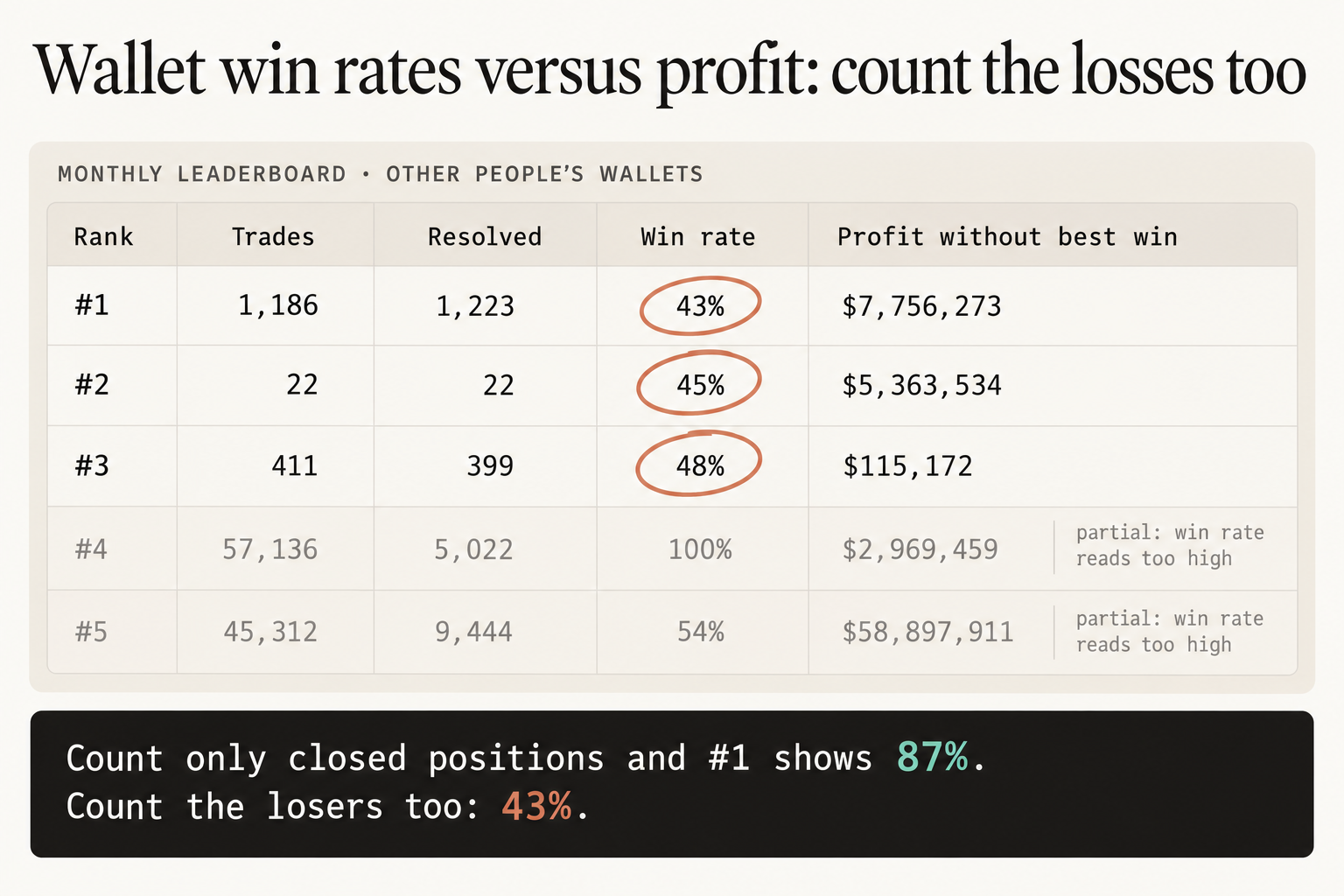
- 87.7% becomes 42.2%. The whale script read the top monthly wallet at 87.7% winners on its 633 closed positions and 42.2% once its 684 resolved positions that were never cashed out, where the losing bets sit, were counted, still up $8,231,518 without its best win.
- 4.6 cents a pair, and 0 live candidates. The arbitrage script reproduced the book's made-up pair at $0.046 after both fees, then scanned 34 Polymarket and 72 Kalshi markets and found no matched pairs that day.
The full runs are in our guides to building a Polymarket trading bot, finding the Polymarket whales worth copying, Polymarket and Kalshi arbitrage and finding mispriced markets.
Get Polymarket Profits
You've seen the screenshots, and the wallets behind them are public. This book gives you a Python bot that reads live Polymarket prices and logs every trade it would make, with no key and no account. It gives you the script that pulls any whale's full record, losers included, before you copy a dollar. It gives you the Kelly sheet that sizes every trade and three paths from a paper bot to monthly income. The free companion repo has every script, so the bot runs tonight. Get Polymarket Profits on Amazon.
Frequently Asked Questions
What is the best book on Polymarket?+
For a working Python bot plus the math and copy trading behind it, Polymarket Profits, which promises 6.5 of the 7 jobs we scored. For the evidence behind each strategy, 35 Polymarket Strategies, Graded by Evidence. For a no-code start with taxes covered, Kalshi & Polymarket Trading with AI, at 4.8 stars on 7 ratings.
What is the best Polymarket book if I don't code?+
Kalshi & Polymarket Trading with AI says "No Code Required" and gives you 23 copy-paste AI prompts, break-even math and Kelly sizing. The No-BS Guide to Prediction Market Arbitrage calls itself a "no-code playbook" for cross-platform arbitrage and has the most ratings of the eight, 4.6 on 10.
Which Polymarket books include Python code?+
Two books by other authors promise code you can download. Polyquant builds a Python bot with a downloadable codebase, and 35 Polymarket Strategies ships an open-source companion package. Our top pick comes with a free GitHub repo of the paper-trading bot, the whale and arbitrage scripts and the Kelly calculator.
How much do Polymarket books cost?+
On the day we checked, Kindle prices ran from $0.99 to $12.99 across the 28 books we opened. 21 of the 28 were free on Kindle Unlimited, including our top pick.
What win rate should a Polymarket book promise?+
Be careful with high ones. The books that cite loss data put losing accounts at 70% to 87%, and a study of 1.72 million Polymarket accounts found accuracy is driven by a small minority of informed traders, around 3% of accounts. Our top pick cites backtests at 55-65%, not the mythical 85%.
How do I copy trade whales on Polymarket?+
Pull the wallet's full record from Polymarket's free Data API, count every resolved bet including the losers, and check its profit without its single best win. In our run, the top monthly wallet read 87.7% winners on closed positions and 42.2% with its losers counted, and was still up millions.
Can I build a Polymarket trading bot without an account?+
Yes, for paper trading. Polymarket's market data is public, so a bot can read live prices and log paper trades with no key, no wallet and no account, from any country. Placing real orders needs a funded account and the official SDK.